

 GMA Brandtalk
 Tracking
 Archives


Watchdog finds P1-T 'red flags' under House-approved 2027 budget; Senate to check
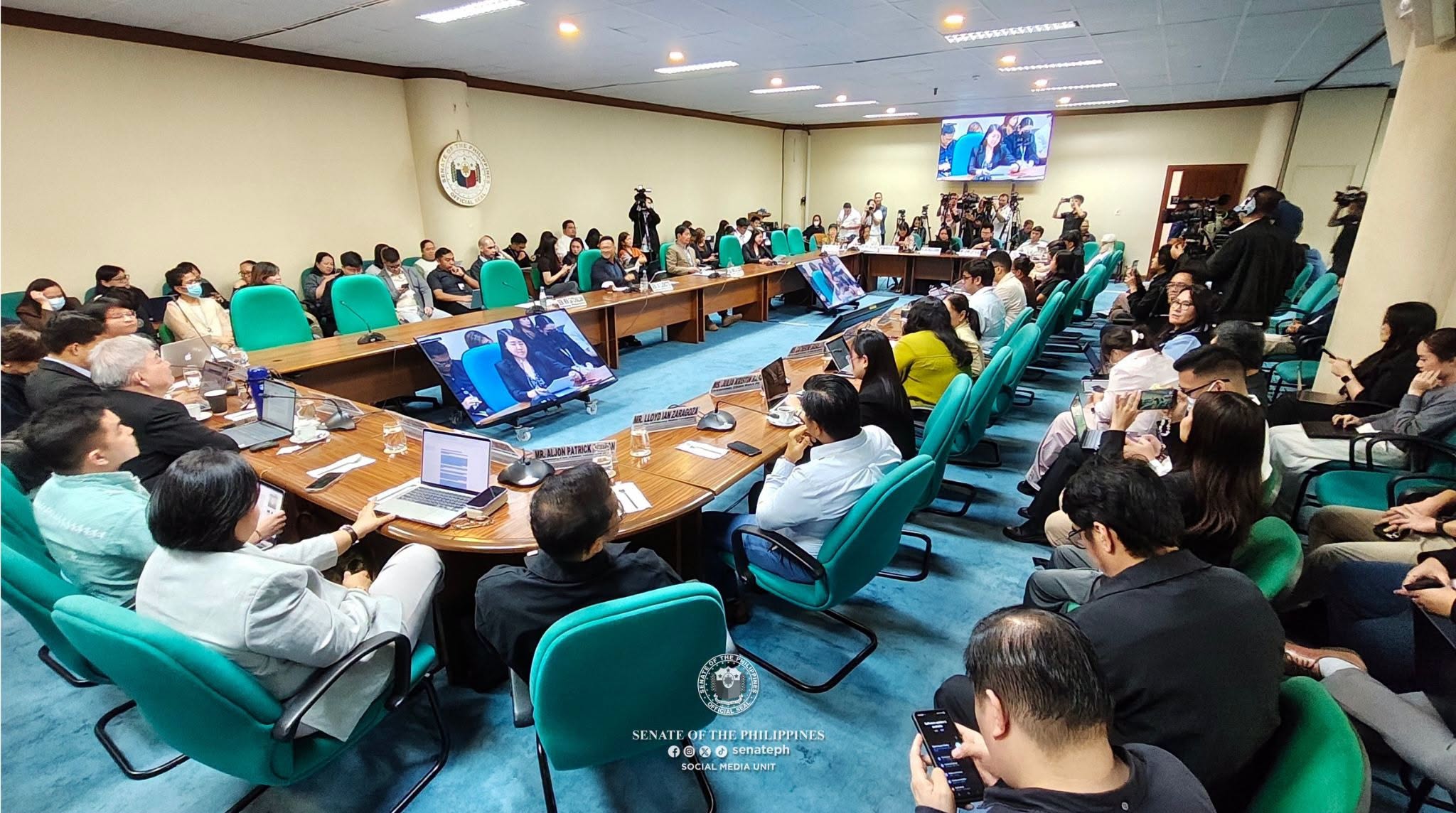
The People's Budget Coalition (PBC) has cautioned against over a trillion worth of “red flags” under the proposed P7.2 trillion national budget for fiscal year 2027, a claim the Senate committed to look into.
During the Senate Finance panel’s consultation on Monday with civil society organizations to discuss the proposed 2027 budget, PBC co-convenor AJ Montesa flagged various types of “pork” or discretionary funds in the House of Representatives’ version of the 2027 budget.
“Lampas P1 trilyong red flags ang nakita namin sa 2027 budget—P210 billion sa soft pork sa anyo ng patronage-driven ayuda, P695 billion sa hard pork, which is politicized infrastructure, and P112 billion po sa shadow pork o ‘yung unprogrammed appropriations,” Montesa said.
(We identified over P1 trillion worth of ‘red flags’ under the 2027 budget—P210 billion of which was ‘soft pork’ in the form of patronage-driven financial assistance; P695 billion in ‘hard pork,’ which consists of politicized infrastructure projects; and P112 billion in ‘shadow pork,’ or unprogrammed appropriations.)
“In our assessment, altogether, this produces a budget that serves politicians before it serves the people,” he added.
Senate President Sherwin Gatchalian, in response, explained that Congress could make adjustments in the proposed budget with a valid basis. Regardless, he said the Senate would assess if such amendments made by the House were necessary.
“Pinag-aralan rin namin ‘yung kanilang pag-aaral at tumutugma naman doon sa mga nakikita namin,” Gatchalian said Tuesday, referring to the findings of the PBC.
(We examined the PBC’s analysis, and it aligns with our own findings.)
“So ngayon ang process namin, I'm collaborating with the chairman of the Finance Committee, si Senator JV, dito sa mga changes, amendments, insertions na ginawa ng House. Pag-aaralan naming mabuti kung ‘yun ay valid at may pangangailangan ba,” he added.
(Currently, I am working with Senator JV, the chairman of the Finance Committee, to review the changes, amendments, and insertions made by the House. We will carefully assess whether these are valid and truly necessary.)
The Senate President also said that he is coordinating with the Department of Public Works and Highways (DPWH) to ensure that such amendments were supported by feasibility studies, work programs, and other necessary technical assessments.
The PBC noted that under the 2027 National Expenditure Program, P72 billion was allocated for “ayuda” programs like Assistance to Individuals in Crisis Situations (AICS), Medical Assistance for Indigent and Financially Incapacitated Patients (MAIFIP), Tulong Panghanapbuhay sa Ating Disadvantaged/Displaced Workers (TUPAD), Presidential Assistance for Farmers and Fisherfolk Program, and Tulong Dunong Program.
However, the House reportedly increased the amount to nearly double, or P137 billion, under its version of the General Appropriations Bill (GAB).
“Year after year, the House tends to bloat these programs that give preferential treatment to beneficiaries through letters that legislators hold lodged in the budgets of DSWD, DOH, and DOLE, which implicitly carve out these funds for the individual legislators,” Montesa said.
Meanwhile, public finance specialist Zy-Za Nadine Suzara said that based on PBC’s analysis, P499 billion was certified by the Treasury as available for unprogrammed appropriations in 2024 to 2025 alone.
Of this amount, she said P493 billion was released to various government agencies.
“Forty percent or P195 billion of the P493 billion was released to DPWH. P107 billion of that went to flood control,” Suzara said.
“Furthermore, P29 billion was released to DSWD for AICS, [at] P10 billion was released to DOH for MAIFIP,” she added.
PBC co-convenor Kenneth Abante also flagged P190 billion in alleged House insertions, involving nearly 7,000 infrastructure projects “without publicly available attachments.”
Abante said the bulk of these projects, or almost 6,200 projects, worth P172 billion, was “inserted” into the budget of the DPWH.
In the Department of Health (DOH), he said more than 180 new health facilities were supposedly inserted worth over P2 billion.
The House also allegedly inserted more than 350 farm-to-market roads worth P6 billion under the Department of Agriculture (DA) budget.
Abante said over 200 new irrigation projects worth over P7 billion were also inserted into the National Irrigation Administration.
“Hindi po namin sinasabing katiwalian ang lahat ng ito. Kailangan po natin ng mga imprastraktura ito, pero sana maayos,” he emphasized.
(We are not saying that all of these constitute corruption. We do need these infrastructure projects, but they should be done properly.)
“At ang panawagan po namin, kung walang published na dokumento, tanggalin ng Senado, i-veto ng Pangulo. Sa budget na pinaghirapang buwis ng taumbayan, bawal magka-typo,” he added.
(And our call is this: if there is no published document, the Senate should remove it, and the President should veto it. When it comes to a budget funded by the hard-earned taxes of the people, there is no room for typos.)
Districts with biggest increases
Specifically, Abante noted that Ilocos Norte 1st district, represented by presidential son Rep. Sandro Marcos, topped the PBC’s list of district engineering offices with the most increases in the House GAB, amounting to P4.37 billion.
Other district offices with the biggest increases include:
- Misamis Occidental 2nd district: P1.8 billion
- Davao de Oro 2nd district: P1.7 billion
- Isabela 4th district: P1.7 billion
- South Cotabato 2nd district: P1.6 billion
- Bohol 1st district: P1.5 billion
- Nueva Ecija 1st district: P1.3 billion
- Batangas 2nd district: P1.3 billion
- Zambales 2nd district: P1.2 billion
Abante thus called on concerned citizens to continue demanding accountability to prevent the “cancer of corruption” from spreading.
“We need to reimagine our people power in the budget. To prevent the cancer of corruption from spreading, we need to strengthen our nation’s immune system. That means all of us—media, civil society, academe, and oversight agencies—have the data to demand accountability from the people who decide on our taxpayer money,” he said.
GMA News Online reached out to the House of Representatives for comment and will publish it once available.
House leaders earlier defended the amendments made by the chamber to the proposed 2027 national budget, saying these were purportedly based on agency proposals and had been made on valid grounds.
House appropriations panel senior vice chairperson Albert Garcia of Bataan and Deputy Speaker Ronnie Puno of Antipolo made the statements amid criticisms from civil society organizations and opposition lawmakers over projects allegedly bearing questionable documentation and incorrect coordinates. —AOL, GMA News

