

 GMA Brandtalk
 Tracking
 Archives

ADVERTISEMENT
Filtered By: Topstories
News
Three-year college courses will save students money, reduce schools' revenues
(Updated 9:09 p.m.) Three years for a college degree. That aim of the Commission on Higher Education (CHED) will warm any budget-conscious parent's heart, and console students who must now spend extra years in lower levels under the Department of Education's Kindergarten to Grade 12 (K-12) program. CHED is reviewing the general education curriculum (GEC) of baccalaureate programs with a view to makiing tertiary education, or college, a year shorter, CHED officials told GMA News Online on Friday.
A shorter bachelor’s program would “very likely affect most courses,” a trade-off for the newly instituted K-12 program, CHED executive director Julito Vitriolo said in a text message.
The reform could involve most of the GEC subjects and even vocational-technical subjects in Grades 11 and 12 of the senior high school curriculum now being formulated by the DepEd, said Vitriolo.
Dr. Sinforoso Birung, CHED Programs and Standards director, told GMA News Online in a phone interview the changes in GEC are a “work in progress” that could take at least one year or possibly two years to complete.
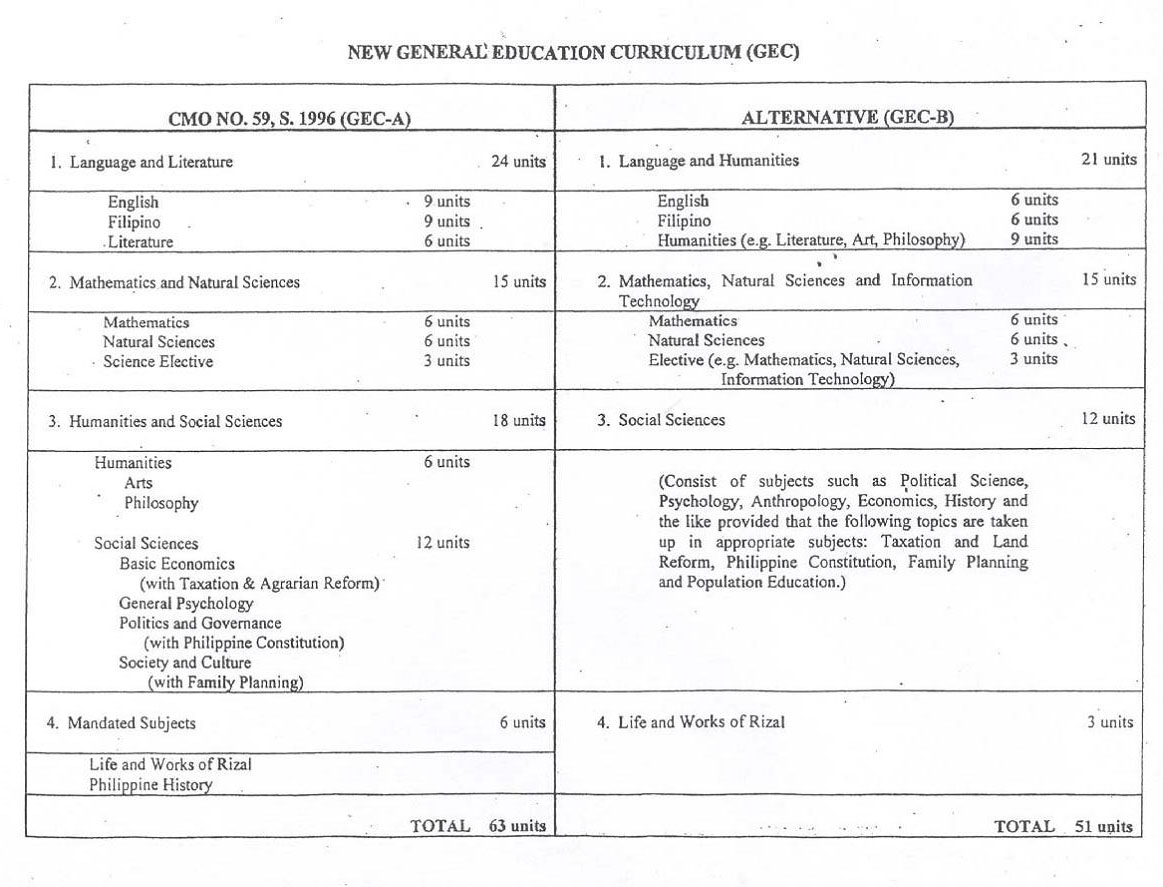
The current General Education Curriculum (GEC) required by the Commission on Higher Education (CHED).
Most bachelor programs in the country are four-year courses, and some are five-year programs, mostly in the health and engineering disciplines and business specializations. Public hearings
The CHED Technical Panel on the GEC is studying the options available, according to the CHED director.
After the three-stage internal review by CHED, the draft Policies, Standards, and Guidelines (PSG) will be scrutinized in public hearings.
Inputs from the consultations will be considered before the CHED approves and issues the PSG.
DepEd Secretary Armin Luistro has said the shortened period of college education would mean cost savings for parents, but also less revenue for colleges and universities.
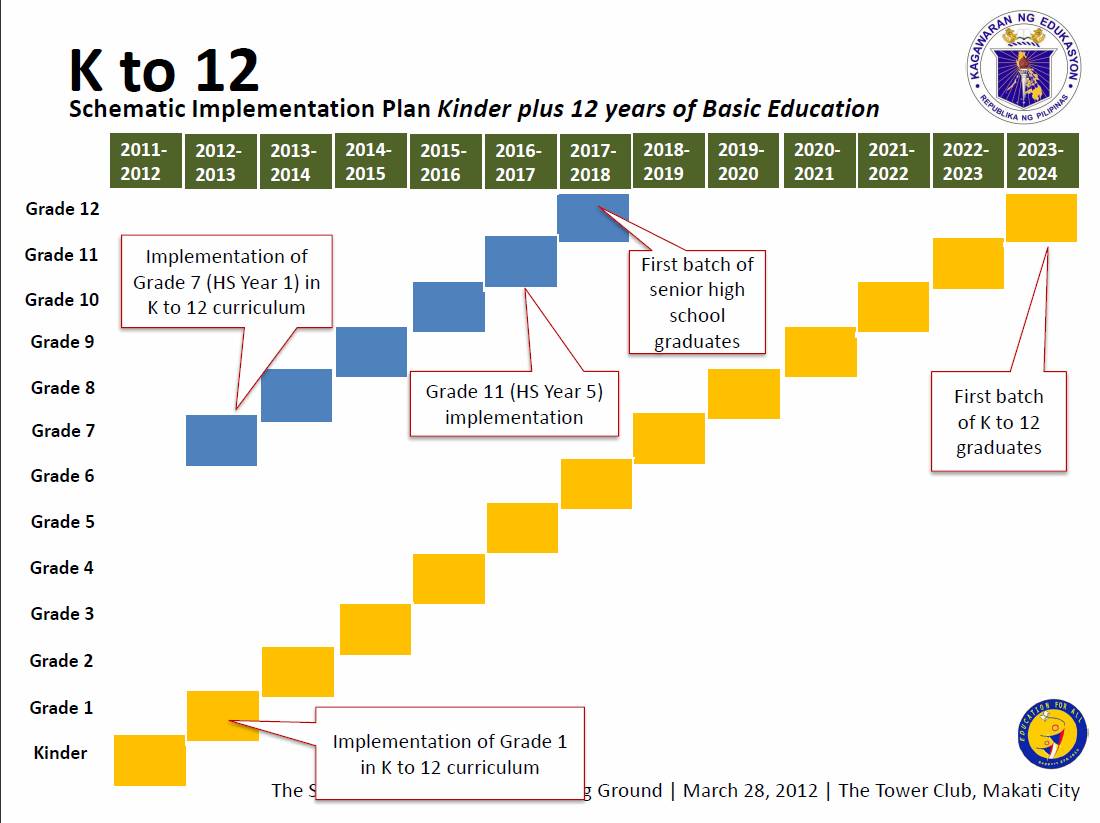
The first batch of senior high school graduates in 2018 while the first graduates of the full K-12 program march in 2024, according to DepEd Secretary Armin Luistro.
According to the DepEd chief, HEIs will see their enrolment figures drop during the transition, but there are several response options available, including:
- Offer senior high school
- Retool and retrain teachers
- Conduct adult education courses.
The department is working closely with the commission and the Technical Education and Skills Development Authority (TESDA) on the impact of K-12 on the education continuum, Luistro assured.
Some universities already asked if they could offer senior high school—Grades 11 and 12—prompting the DepEd, CHED, and TESDA to start working on the implementation details. Two high school graduations
President Benigno Aquino III will no longer be President when the first batch of the K-12 program—senior high school—graduates in 2018.
By the summer of 2016, the Class of 2012 which finished elementary school this March will just be preparing to enter the fifth year of the six years of high school under the K-12 curriculum.
The K-12 Grade 11 is equivalent to the fifth year of high school when the Aquino administration succeeds in getting Congress to amend the Education Act of 1982, so that the two years of senior high school—Grades 11 and 12—will be established in the public school system.
However, in the summer of 2015, when the Grade 6 graduates of today will have finished Grade 10 or the last year of junior high school, Aquino will still be President.
In the K-12 program, high school students will graduate twice, Luistro noted. The first graduation is at the end of junior high school and the second time at the end of senior high school or Grade 12.
Luistro said the first batch of students to complete the full K-12 program will graduate in school year 2023-2024. “Educational reform takes at least a generation,” he added. —VS/HS, GMA News

