

 GMA Brandtalk
 Tracking
 Archives

ADVERTISEMENT
Filtered By: Topstories
News
Justices speak out on cyberbullying as SC oral arguments on cybercrime law begin
Danny Pata
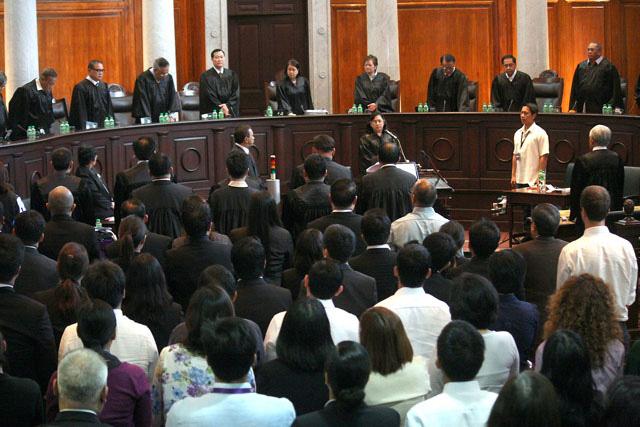
(Updated 10:16 p.m.) Amid protests outside the Supreme Court, Chief Justice Maria Lourdes Sereno presided over the first oral arguments on the controversial Cybercrime Law Tuesday, with petitioners insisting the law violated the constitutional rights of the public by creating a "chilling effect" on free speech. But at least two justices, including Sereno, expressed concern about the cyberbullying that is occurring on the Internet.
The argument was opened by petitioner Sen. Teofisto "TG" Guingona III, who described the law as a "Cyberdracula... with fangs that instill fear in the hearts of people."
As of posting time, University of the Philippines law professor Harry Roque Jr. was presenting arguments against the section on electronic libel and cybersex.
In his presentation, Roque criticized the law for its "overbreadth" and for being "overbroad."
Roque cited social networking sites Twitter and Facebook, saying "the statute does not tell you who is responsible if you click on the like button." He also said the law's use of the word "lascivious" was vague. Chris Lao "Does the State not have a right to regulate the invasion of lives of these people so that [the government] cannot be faulted?" Sereno asked. Blogs
To demonstrate how statements in social media could become defamatory, Associate Justice Marvic Leonen -- the newest addition to the high court and formerly an avid user of social media -- cited the case of then-University of the Philippines law student Chris Lao, who was bullied online after a TV report showed him losing his cool after driving his car into a flooded street in Quezon City in 2011.
Leonen, a former UP Law dean who publicly expressed sympathy for Lao at the time, said: "Because of what happened to him in cyberspace, he was transformed."
In interpellating Roque, Sereno stressed Leonen's stand against cyberbullying.
"By taking such a stance [against cyberbullying], Justice Leonen demonstrated that those who are free in expressing their thoughts can also be the most capable of inflicting harm," Sereno said.
The Chief Justice also expressed her concern about cases of victims of cyberbullying who took their own life because of the experience.
"I'm concerned about those who commit suicide, those who cannot wait for the deleting of posts against them," Sereno said.
In the case of blogs, Roque said the Cybercrime Prevention Act does not specify "if the blog owner is liable for libel if the comment posted on the blog is liable."
Roque expressed fears that the law could "lead to the chilling of rights." He said there is a possibility that even Internet service providers (ISPs) could be held liable as the law also punishes those that "cause" the publication of libelous statements online.
Associate Justice Roberto Abad, however, said that ISPs do not necessarily have to be made liable, citing a comparison to prove his point.
"For instance, we can post a bulletin board for people to post things. But if someone posts something libelous, does that make the Supreme Court liable?" Abad said.  'Balancing of rights'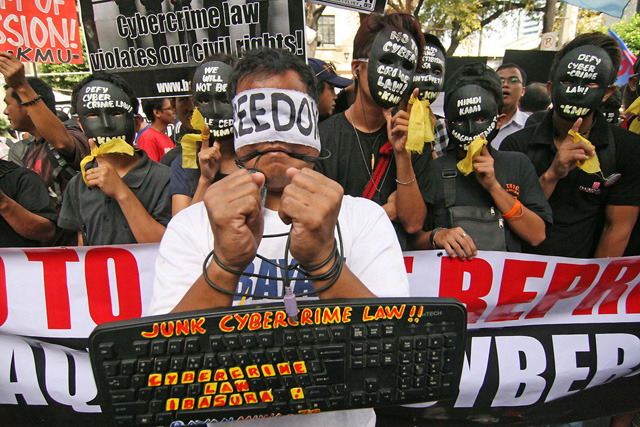
Senator Teofisto Guingona III confers with other anti-cybercrime law petitioners before the start of the oral arguments at the Supreme Court on Tuesday. Guingona described the cybercrime law as a 'cyberdracula' with fangs that instill fear in people's hearts. Danny Pata
In response, Roque emphasized the need to have a "very delicate balancing of rights," emphasizing the importance of the freedom of expression.
Asked by Leonen what alternative protection can be given to victims of online libel in case Section 4(C)(4) is struck down as illegal, Roque said balance can be achieved in preventing electronic libel by imposing civil damages instead of incarceration.
In the middle of interpellation, Justices Abad and Leonen separately emphasized that their line of questioning during interpellation does not reflect how they would vote on the case.
"We try to keep an open mind until the case is submitted for resolution," Abad stressed. "Our opinions will not be affected by our interpellation," Leonen said.
Various groups opposing the Cybercrime Prevention Act of 2012 on Tuesday gathered in front of the Supreme Court to renew calls for the junking of the law, as the high court held an en banc session for the start of the oral arguments on the controversial measure. Danny Pata
Rep. Neri Colmenares, in arguing against Section 6 and 7 of the Cybercrime Law, said the statute is "badly crafted [and that] Congress must craft another law."
Section 6 punishes crime by one degree higher than those crimes covered by the Revised Penal Code; while Section 7 provides that a prosecution under the law shall be without prejudice to any liability under the RPC.
In interpellating Colmenares, Carpio pointed out that there was nothing in the law that requires a computer to be online before a cybercrime is committed. He pointed out that everything that comes out in the media right now is aided by a computer, be it connected to a network or not.
"[Would this mean] all crimes now will practically be cyber libel and no ordinary libel," Carpio asked.
Lawyer Rodel Cruz argued against Section 19 of the law, which empowers the Department of Justice to block computer data found to be in violation of the law.
Justice Teresita Leonardo De Castro, an appointee of former President Gloria Macapagal-Arroyo, repeatedly raised her reservations about the law, which was signed by President Benigno Aquino III September last year.
"Sec 19 [take down clause] isn't specific enough as to how government intends to find prima facie evidence. This is something we need to find out," De Castro said.
UP Law professor Jose Jesus Disini Jr. meanwhile tackled Section 12, which empowers law enforcement authorities to collect traffic data in real time with specified communications transmitted through a computer system.
De Castro expressed fears that through the law, government might not only gather traffic data but also other kinds of data. She also suggested to the lawyers to "examine closely" the definition of terms used in the law to determine if they are really "overbroad."
The last lawyer to argue against the law was lawyer Julius Matibag, who tackled Section 5(1) and (b) of the law, which punishes an Internet user for aiding or abetting a cybercrime offense. Like Roque, he feared the law would create a "chilling effect" on netizens.
While oral arguments were ongoing, various groups gathered some 200 meters away from the Supreme Court fto protest against the controversial law. Earlier in the day, police tightened security around the premises of the high court a few hours before the scheduled oral arguments on the cybercrime law.
Radio dzBB's Carlo Mateo reported that the Manila Police District kept watch over protesters who held a vigil Monday night near the court premises.
The report also said police observed maximum tolerance in dealing with the protesters. The protest had been peaceful as of Tuesday morning, the report said. Download the entire four-hour plus proceedings at the cybercrime act oral arguments page at http://sc.judiciary.gov.ph/features/oral_arguments/cybercrime/index.php — KG/RSJ/HS, GMA News

