

 GMA Brandtalk
 Tracking
 Archives

ADVERTISEMENT
Filtered By: Topstories
News
Special Advertising Feature: New San Jose Builders’ victory in the north
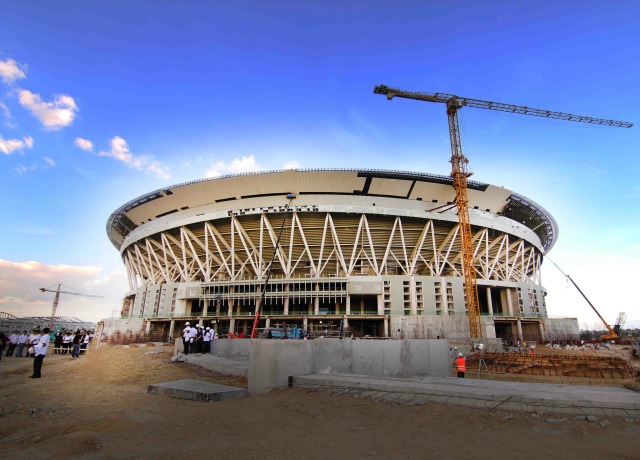
Along the North Luzon Expressway, 24 kilometers north of Metro Manila, the most arresting sight motorists would see is the imposing facade of the Philippine Arena, the world's largest indoor arena and the jewel in the real estate crown that is the Ciudad de Victoria ("City of Victory"), a 70-hectare mixed-use tourism enterprise city encompassing the towns of Bocaue and Santa Maria in Bulacan. Owned by the Iglesia ni Cristo, Ciudad de Victoria was officially inaugurated by President Benigno Aquino III and the INC's Executive Minister Eduardo Manalo on July 21, 2014 and was the site of the INC's 100th anniversary celebrations a week later on July 27.
Before its spectacular public debut, however, Ciudad de Victoria was the potential millstone around the neck of New San Jose Builders, Inc. (NSJBI), a real estate development company headed by chairman Jose L. Acuzar and co-chairman Dr Isagani Germar. Faced with considerable financial risk, NSJBI decided to place its bets on Ciudad de Victoria becoming the vanguard of economic development north of Manila, becoming a residential, business, educational, sports, and cultural complex rivaling similar planned communities in the south. With the arrival of the INC, that venture has become less of a risk and more of a certainty.
For the Iglesia ni Cristo, Ciudad de Victoria was a long-sought dream fulfilled.
For New San Jose Builders, it was an enormous gamble that paid off.
The rise of a new city
While the past several years have seen a boom in property development in provinces south of Metro Manila, NSJBI decided to strike out in a different direction and immediately started acquiring properties north of the metropolis.
It was a challenging, risky endeavor initially met with skepticism. "Developers [were] concentrating in the south [of Manila] because it's easier to consolidate properties there," says Isagani Germar. "But we stood by the potential we saw in the north. It took us a long time to consolidate land in Bulacan; it was a very tedious job, but looking back, it had definitely been worth it."
Soon enough they were able to accumulate enough land to form a sizeable—and potentially massively profitable—chunk of real estate. The land value, already high, rose even higher when an agreement was reached between NSJBI and the Manila North Tollways Corporation that, subject to certain conditions, the company's development would be granted its own entryway into the North Luzon Expressway—a privilege not generally extended to private property developers.
The land secured, questions were now raised on what could be built on it. "We originally planned it to be something like a 'Pyroville', because Bocaue is known for its pyrotechnics," says Germar. The planning went as far as designating a secure perimeter for fireworks exhibitions. But the dreaming didn't stop there: "We even came up with an amusement park." The idea, though, had always been to use the land for something grand enough that, whatever it is, would attract significant economic interest to the north of the capital.
Then one day, the Iglesia ni Cristo came calling. And the rest, as they say, is history.
Economic hub for the north
The main advantage of Ciudad de Victoria for NSJBI is the fact that it's the major real estate development project in the northern outskirts of the capital. The operative idea behind the city is that, as a new economic center, it would serve to help decongest already-overpopulated Metro Manila. Germar points out that when development is distributed throughout provinces adjacent to the metropolis, informal settlers would no longer need to seek their fortunes in the big city where opportunities are slim and poverty is a virtual guarantee. "Normally, when real estate companies start a development, you can already expect the congestion that comes with it," he says. "But with the development of Ciudad de Victoria, we're glad that instead of creating more congestion, we're decongesting Metro Manila."
Ciudad de Victoria is also poised to become a major tourism hub. With the city's first phase of development complete—the construction and opening of the Philippine Arena and the Philippine Sports Stadium and the Sports Center—plans are underway to start the second phase of development, which include the construction of the Eraño G. Manalo Medical Center, the Bulacan campus of New Era University, and other business establishments as well as hotel and residential areas.
Historic megastructures
The Philippine Arena is the world's largest indoor arena, with a maximum seating capacity of 55,000 people, nearly twice that of its nearest rival, South Korea's Gwangmyeong Velodrome. Designed by the Australian architectural firm Populus, NSJBI spearheaded the construction and served as the project manager for the entire development. NSJBI laid out the foundations, with its affiliates completing the other structural details.
The design of the arena is an unusual yet sophisticated one, hearkening back to the ancient Greek amphitheaters and their semi-circular seating. "The arena is unique because it has a different configuration. Unlike other arenas where the stage is located at the center, the Philippine Arena has its stage on one side while the audience arcs around it," Germar remarks. "Even with its size, it doesn't have a single column in the middle. Instead, a sturdy perimeter serves as its support."
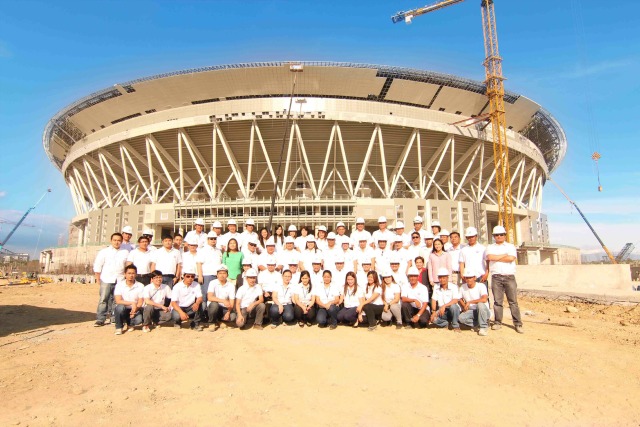
NSJBI relished the challenge presented by the design. "With such a structure, normally it would take 5 years to have it completed […] We had completed it in 3 years' time."
The particular goal for the Philippine Arena, with its record-breaking capacity, is for it to grow in international esteem to rival other well-known stadia such as the Staples Center in Los Angeles or Madison Square Garden in New York City. The inauguration of the arena was a milestone for NSJBI. "It was," Germar says, "an unforgettable moment indeed."
Achieving victory in other ways
Ciudad de Victoria is not the only high-end, high-profile project on NSJBI's books, nor is NSJBI driven solely by the business of moneymaking. As a Filipino-owned company, NSJBI has made its goal to promote Filipino talent and culture and elevate them to world-class excellence. The company has added to its considerable portfolio the Las Casas Filipinas de Acuzar, a 400-hectare historical resort park in Bagac, Bataan. Las Casas has become a popular tourist destination for its faithful recreation of Spanish-Filipino culture with its cultural shows and is famous for its Spanish heritage houses, transported from different parts of the country and painstakingly rebuilt and repurposed into hotels and casitas for visitors to stay in. Las Casas is also set to host a big event in 2015.
NSJBI also continues its excellent work in its residential properties, established with the simple goal of fulfilling every Filipino's desire to acquire a home they can call their own. Amongst its developments are: Victoria Towers at the crossroads of Panay Avenue and Timog Avenue, Victoria Stations 1 and 2 linked to the MRT Kamuning Station, and Victoria de Tomas Morato in Quezon City; Victoria de Manila 1 and 2 at the heart of Taft Avenue in Manila; Victoria de Makati near Ayala Avenue in Makati, Fort Victoria in Bonifacio Global City in Taguig, and Isabelle de Valenzuela along MacArthur Highway.
New San Jose Builders, Inc.: victorious in its ambitions, victorious in its goals.

