

 GMA Brandtalk
 Tracking
 Archives

Philippines joins world in condemning North Korea rocket launch
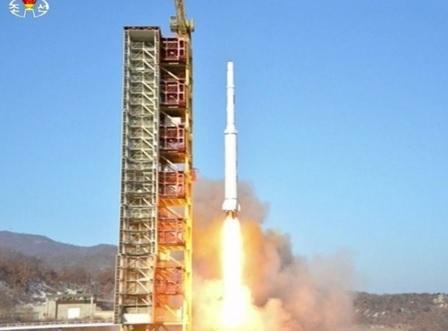
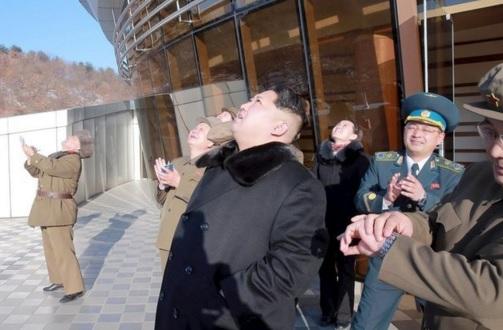
The Philippines on Sunday joined the international community in condemning North Korea for launching a long-range rocket into space in defiance of United Nations sanctions and just weeks after conducting a nuclear bomb test.
"The Philippines condemns the DPRK’s launch of a long range rocket in violation of UNSC (Security Council) resolutions and international calls for DPRK to end its testing," a statement released by the Department of National Defense quoting its spokesman Peter Paul Galvez read.
DPRK which stands for Democratic People's Republic of Korea is North Korea's official name.
"The Philippines strongly urges it to abandon its nuclear and ballistic missile technology programs in a complete, verifiable, irreversible manner. The Philippines reiterates its readiness to work with international partners to ensure peace and stability in the region and the rest of the world," the statement added.
Galvez said the defense department and the military have been monitoring the reported launch "with the help of our concerned neighbors".
"We have no info yet where it landed. Initial info is that it went somewhere in the Pacific Ocean. No info yet as to where exactly," Galvez said in a text message to reporters Sunday.
The US Strategic Command said it had detected a missile entering space and South Korea's military said the rocket had put an object into orbit, quashing earlier media reports indicating the rocket might have failed in flight.
The rocket was launched at around 9:30 am Korea time (8.30 am in the Philippines) in a southward trajectory. Japan's public broadcaster showed a streak of light heading into the sky, taken from a camera at China's border with North Korea.
But US authorities who tracked the rocket's trajectory said there was no sign it had posed a direct menace to the United States or its friends in the region.
North Korea, which last month exploded a nuclear device, had notified UN agencies that it planned to launch a rocket carrying an Earth observation satellite, triggering opposition from governments that see it as a long-range missile test.
The UN Security Council was likely to hold an emergency meeting on Sunday to discuss the launch, at the request of the United States, Japan and South Korea, diplomats said.
Isolated North Korea had initially given a February 8 to 25 time frame for the launch but on Saturday changed that to February 7 to 14, apparently taking advantage of clear weather on Sunday.
Some of North Korea's neighbors as well as major powers like Washington and Moscow denounced the launch as a missile test.
The United States vowed to take all necessary actions to defend itself and its allies following the rocket launch, and said it would seek "significant measures" in the UN Security Council to hold North Korea to account.
The long-range rocket launch, carried out in defiance of international warnings, drew threats by US lawmakers of new sanctions, calls for expanded missile defense and criticism from Republican presidential candidates that President Barack Obama had failed to deter Pyongyang.
North Korea said the rocket carried a satellite, but its efforts have raised strong suspicion in Washington that Pyongyang is seeking to eventually develop ballistic missiles capable of reaching the United States.
US President Barack Obama's senior aides responded quickly with harsh condemnation of the reclusive government, appealing for a unified international front and reaffirming of Washington's commitment to the defense of allies Japan and South Korea.
"We call upon the international community to stand together and demonstrate to North Korea that its reckless actions must have serious consequences," said Susan Rice, Obama's national security adviser.
Senior US officials said North Korea's "provocations" threatened Washington's interests and its allies' security.
The United States and China, North Korea's main ally and neighbor, have appeared divided over how to respond to the North Korean nuclear explosion, with Washington urging tougher sanctions and Beijing stressing the need for dialogue.
"North Korea's launch using ballistic missile technology, following so closely after its January 6 nuclear test, represents yet another destabilizing and provocative action and is a flagrant violation of multiple United Nations Security Council resolutions," US National Security Adviser Susan Rice said.
Secretary of State John Kerry said the United States would "continue to work with our partners and members of the UN Security Council on significant measures to hold the DPRK to account."
Russia's Foreign Ministry said the rocket launch could not but provoke a "decisive protest", adding Pyongyang had once again demonstrated a disregard for norms of international law.
The ministry said in a statement on its website that such actions dealt a serious blow to the security of governments in the region, and first of all to North Korea itself.
"We strongly recommend the leadership of the Democratic People's Republic of Korea think about whether a policy of opposing the entire international community meets the interests of the country," the statement read.
China meanwhile called on Pyongyang to exercise restraint.
"China thinks that North Korea fundamentally should have the right to peaceful use of the skies. But currently North Korea's right has been restricted by United Nations security council. Under the current circumstances China hopes North Korea can maintain restraint and proceed cautiously on the satellite launch issue, and not make any moves that might make further increase the levels of tensions on the peninsular," said newsreader Yan Yuxin.
A commentary by China's state-run Xinhua news agency on Sunday called for calm. Beijing is Pyongyang's main ally, although it disapproves of its nuclear weapons program.
France also condemned North Korea's launch of a long-range rocket as "senseless provocation" and called for a "rapid and tough" response from the UN Security Council.
"France condemns with the utmost firmness the new flagrant violation by North Korea of the resolutions of the Security Council," the presidential Elysee Palace said in a statement.
"The launch... is a senseless provocation," it added, saying "France calls for a rapid and tough response from the international community at the Security Council" meeting in New York later Sunday.
ADVANCED MISSILE-DEFENSE SYSTEM
South Korea said on Sunday it and the United States would begin discussion on deploying an advanced missile-defense system to South Korea to counter the growing threat of North Korea's weapons capabilities.
US military officials have said the sophisticated system called Terminal High Altitude Area Defence (THAAD) was needed in South Korea, which faces the threat of an increasingly advanced North Korean missile program.
"To respond to the increasing threats from North Korea, South Korea and the United States have decided to start a formal discussion on the possibility of THAAD (Terminal High Altitude Area Defense) deployment by the US Armed Forces in South Korea to improve the missile defense capabilities of the South Korea and US alliance," said Yoo Jeh-seung, a senior official at the South Korean defense ministry said in a joint news conference with Thomas S. Vandal, commander of the Eighth US Army based in South Korea.
"If THAAD is deployed to the Korean peninsula, it will be only operated against North Korea," Yoo added.
Eighth US army commander Vandal said the decision was made upon the commander of US forces in Korea Curtis Scaparrotti's recommendation, adding that "it is time to move forward on the issue."
"It is time to move forward on this issue. We look forward to close consultation and coordination on that as well as dealing with the threat to peace and stability posed by DPRK," said Vandal at the joint news conference. — APG, GMA News with Agence France-Presse and Reuters

