

 GMA Brandtalk
 Tracking
 Archives

War vs. drugs: 6 years of PNoy’s admin, 2 weeks after Duterte’s oath-taking
Even before he was formally sworn in as the country’s 16th President, Rodrigo Duterte had already declared that his administration would launch a “bloody” fight against illegal drugs, even vowing to kill 100,000 criminals including drug dealers and dump their bodies in the Manila Bay to “fatten the fish."
But how massive really is the task of eradicating illegal drugs? How is the Duterte administration faring so far in its fight against this decades-old problem?
More than 8,000 barangays affected
Based on the 2014 data released last year by the Philippine Drug Enforcement Agency, 20.51 percent or 8, 629 out of 42,065 villages nationwide are affected by illegal drugs.
Based on the same data, 92 percent of Metro Manila have drug-related cases with seven cities namely, Cloocan, Taguig, Muntinlupa, Las Piñas, Makati, Pasay, and Parañaque recording 100 percent drug-affectation rate.
Second with the highest drug-affectation rate is Region 4-A or Southern Tagalog with 33.78 percent.
The data showed that methamphetamine hydrochloride or shabu remained the most abused drug substance with 88.78 confiscation rate by law enforcement agencies, followed by marijuana with 8.86 confiscation rate.
Other dangerous substances such cocaine, ecstasy, ephedrine, 'fly-high' and constitute the 2.36 percent confiscation rate.
Meanwhile, in a 2012 United Nations (UN) World Drug Report, the Philippines was cited as the country in South East Asia with the highest use of shabu.
‘Narco generals’ named
With barely a week after he assumed presidency, Duterte shocked the nation by publicly naming five former and active police generals allegedly involved in illegal drugs.
In his speech at the 69th anniversary of the Philippine Air Force (PAF) on July 5, Duterte identified former Philippine National Police (PNP) deputy director general Marcelo Garbo, Jr. as “protector of drug syndicates” while Vicente Loot, Bernardo Diaz, Edgardo Tinio, and Joel Pagdilao were identified as involved in the illegal drugs trade.
Garbo and Loot have already retired from the PNP.
Loot is the newly elected mayor of Daanbantayan town in Cebu.
Diaz was director of the Police Regional Office 6, Tinio was director of the Quezon City Police District Office and Pagdilao was director of the National Capital Region Police Office.
In the same speech, Duterte said he had already ordered Diaz, Tinio and Pagdilao relieved from their posts.
The five police generals have since then vehemently denied the allegation, claiming that they are victims of “black propaganda”.
While many lauded the President’s bold move, critics said what Duterte did was tantamount to subjecting the five former and active police generals to trial by publicity.
Chief presidential legal counsel Salvador Panelo, however, said that what Duterte did was legal. He added that Duterte wanted to give the five generals a chance to air their side.
Panel added that the President had “valid basis” for making the announcement.
Top alleged drug lords identified
Following Duterte’s shocking pronouncements about the five former and incumbent police generals, Malacañang then went on naming the three alleged top drug lords in the country.
In a briefing, Solicitor General Jose Calida identified the top three drug dealers as Wu Tuan, alias Peter Co; Herbert Colangco, alias Ampang; and Peter Lim, alias Jaguar.
Calida said Duterte had reliable information about the illegal drugs activities of the three.
Co and Colangco are high profile inmates at the New Bilibid Prison while Lim is out of the country.
Calida said the President also received information that Garbo was the “protector” of the three alleged drug lords.
In a taped briefing, Duterte said he also had intelligence information on the supposed involvement of several mayors in the illegal drugs trade.
In a press conference, PNP chief Director General Ronald “Bato” Dela Rosa said there are about 23 mayors on Duterte’s list and the president may name them soon.
Anti-drugs campaign in two weeks
Even prior to June 30, when Duterte took his oath as president, the PNP had already started its intensified campaign against illegal drugs.
According to a PNP report, at least 18,000 drug suspects were arrested and 68 drugs suspects were killed from January 1 to June 15.
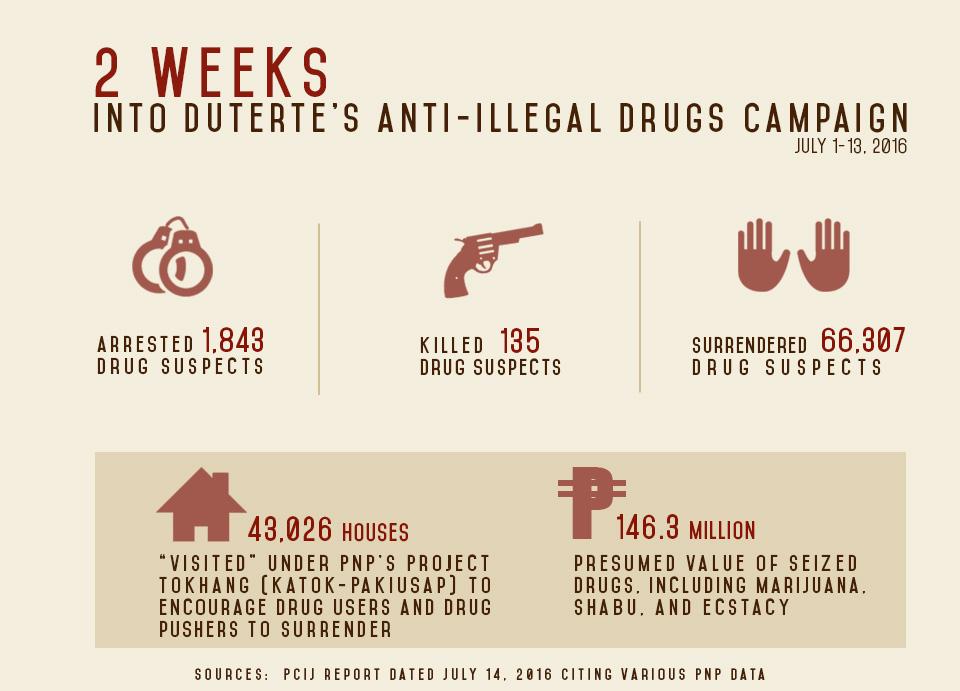
Meanwhile, based on the report of the Philippine Center for Investigative Journalism (PCIJ), at least 1,843 drug suspects were already arrested by the PNP from July 1 to 13 or two weeks since Duterte assumed presidency.
Two weeks of the Duterte presidency also saw more than 66,000 individuals surrendering to authorities. This included 60,393 alleged drug users and 5,914 alleged drug pushers.
The PCIJ report said the PNP, within two weeks, has also “visited” 43,026 houses under its Project Tokhang (Katok-Pakiusap) to encourage people engaged in illegal drug use or drug trade to surrender.
Lack of rehabilitation centers
But while the public has already seen in the past weeks the massive surrender of individuals, most of them admitted that they were into illegal drug use, the government is now confronted with the problem of rehabilitating them.
In Quezon City for example, more than 300 suspected drug users and pushers who surrendered to authorities early this month, were just sent back home due to lack of facilities in the city’s existing rehabilitation centers.
"On the part of the national and local government, we must invest in more rehab centers... It's quite a big investment hindi lang yung facilities kung hindi pati yung psychiatrists mo, yung peer facilitators mo. Mayroon pang after care yan na kailangan i-monitor mo siya for six months kung magba-backslide [sila] o hindi," Quezon City mayor Herbert Bautista said in an earlier interview with GMA News.
Record from the Dangerous Drugs Board (DDB) shows that as of December 2015, the country only has 15 government-owned and 27 non-government owned treatment and rehabilitation centers nationwide accredited by the Department of Health.
In a press briefing, presidential spokesperson Ernesto Abella said the Duterte administration is planning to put up regional rehabilitation centers across the country.
In a press statement, Interior and Local Government Secretary Ismael Sueno said Duterte had already instructed the Department of Budget and Management (DBM) to “look for money” for the establishment of four 500-person capacity drug rehabilitation and treatment centers to be set up each in Northern Luzon, Southern Luzon, Visayas and Mindanao.
Sueno said each of these 500-person capacity center is estimated to cost P674 million.
Killings of drug suspects on the rise
But while the PNP boasts of its intensified anti-illegal drugs campaign, human rights advocates as well as several lawmakers have already expressed alarm over the rising number of summary executions in relation to illegal drugs.
Based on the report of PCIJ citing various data from the PNP, a total of 135 “hostile” drugs suspects were killed from July 1 to 13 (two weeks under the Duterte presidency) while in the supposed act of resisting arrest during police operations.
The PCIJ said the figure was equivalent to about ten persons a day getting killed in connection with police anti-illegal drugs operations.
The figure is apart from the daily reports of bodies dumped in the inner streets of Metro Manila, believed to be victims of summary executions.
The PNP has earlier denied involvement in the vigilante-style operations against illegal drugs, maintaining that all police operations were legitimate and in accordance with the rule of law.
Meanwhile, Liberal Party stalwarts Sen. Leila De Lima and Ifugao Rep. Teddy Baguilat earlier this month filed resolutions seeking inquiries on the rising number of drugs suspects getting killed.
Duterte, during his inaugural address, said Congress and the Commission on Human Rights (CHR) should not to get in the way of his administration’s fight against criminality and illegal drugs.
He said he was aware of the importance of adhering to the rule of law while performing his duties.
"As a lawyer and a former prosecutor, I know the limits of the power and authority of the President. I know what is legal and what is not," Duterte said.
"My adherence to the due process and the rule of law is uncompromising. You mind your work and I will mind mine," he added addressing the Congress and CHR.
Duterte also vowed that his administration’s fight against criminality and illegal drugs “will be relentless and will be sustained".
“I know that there are those who do not approve of my methods of fighting criminality, the sale and use of illegal drugs and corruption. They say that my methods are unorthodox and verge on the illegal,” Duterte said
“In this fight, I ask Congress and the Commission on Human Rights and all others who are similarly situated to allow us a level of governance that is consistent to our mandate. The fight will be relentless and it will be sustained,” Duterte added. —Jessica Bartolome/ALG/NB, GMA News

