

 GMA Brandtalk
 Tracking
 Archives

DDB OKs up to P2-M reward for law enforcers’ drug ops
The Dangerous Drugs Board (DDB) has approved a regulation of a monetary reward program for law enforcers and anti-illegal drug units amounting from P1,000 to a maximum of P2 million.
At a press briefing on Wednesday, DDB chairman Sec. Felipe Rojas said "Operation Lawmen" seeks to encourage law enforcers to intensify their anti-illegal drug operations.
"The DDB approved the resolution giving rewards not only to informants, civilian informants, but to law enforcers as well. This would encourage law enforcement agencies to really intensify the operations against illegal drugs," Rojas said.
Rojas added this will be the first time the government will reward law enforcers for their successful operations which used to only reward the informants.
“Ang dating policy kasi, the reward is given to informants, not the law enforcement agency. But this time, to encourage more accomplishments, we encourage, we give rewards to the law enforcement agencies,” he said.
The board regulation states that the confiscation or recovery of shabu, cocaine, heroin and ketamine will have a minimum reward of P1,000 for less than 200 grams and more than P1.4 million for drugs 200 kilograms or more.
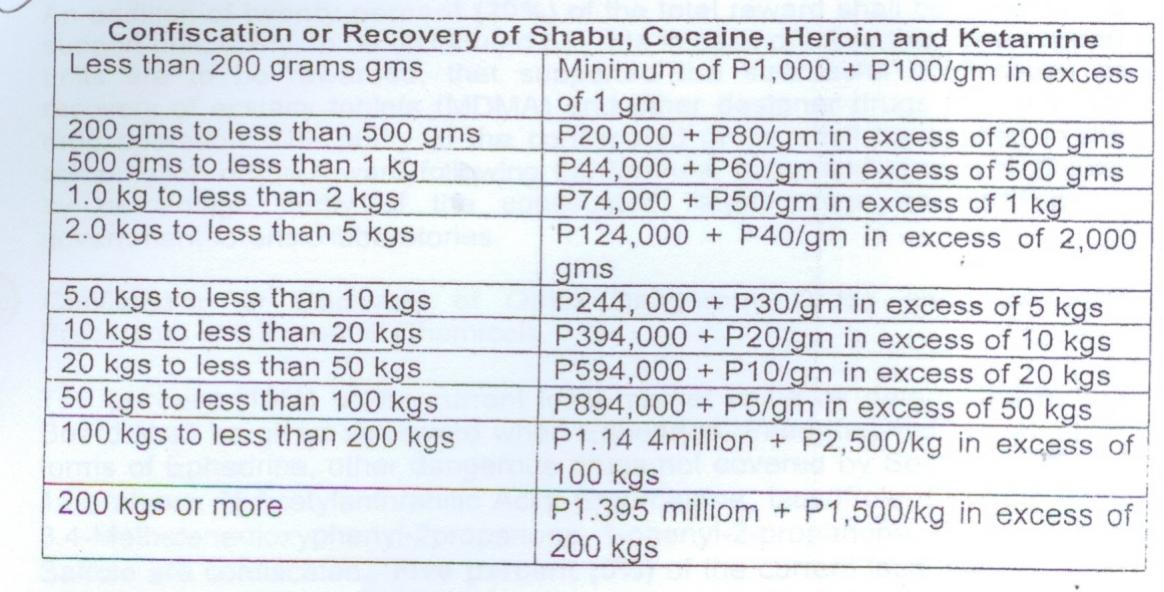
Meanwhile, the reward for ecstasy and other designer drugs will be based on the number of tablets from P100 per tablet to a maximum amount of P1.395 million plus P1,500 for anything in excess of more than 260,000 tablets.
Designer drugs are tablets with a substance capable of mimicking the actual effect of an illegal drug and without the detection in drug tests.
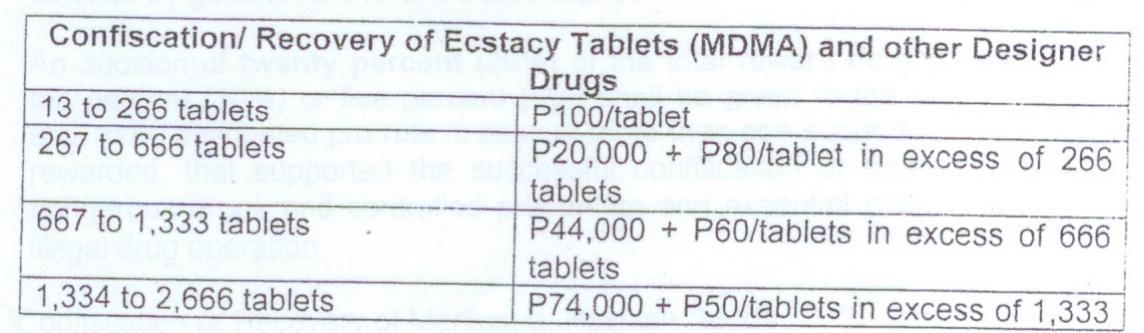
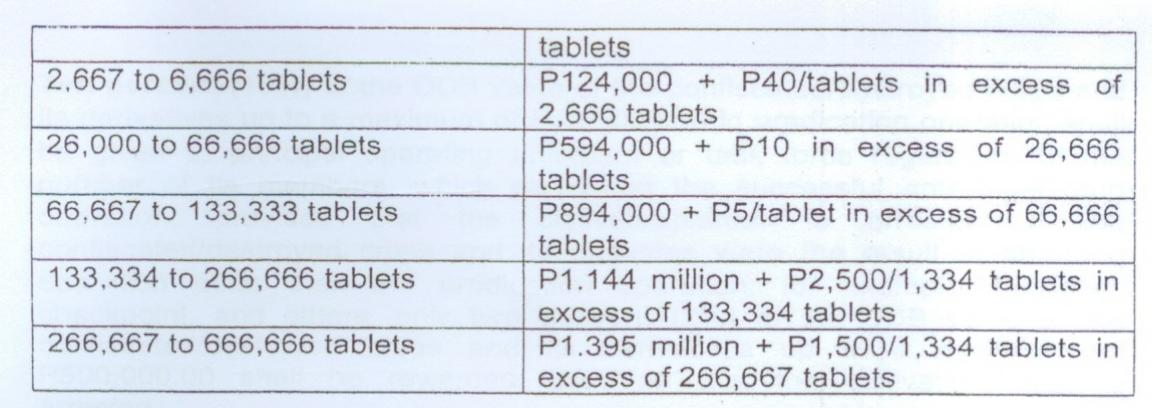
An additional 20 percent of the total reward will be distributed to the support unit, if any, that led to the successful drug operation.
On the other hand, an equivalent of 10 percent of the current market value will be given as reward to other dangerous drugs and a 5 percent reward for essential chemicals.
Ten percent of the DDB value of the confiscated or destroyed marijuana or hashish crops and its derivatives up to a maximum of P700,000 will be rewarded to the principal operating team.
The reward for the dismantling of clandestine laboratories will be classified on whether the laboratory is small scale (at least P500,000), medium scale (at least P1,000,000), and large scale (at least P1.5 million).
“Granting of monetary rewards will boost their morale as law enforcement operatives particularly those pursuing high value targets and high impact operations. Thus, this will enhance the operational effectiveness and efficiency of the country’s drug law enforcers,” the DDB said.
Rojas said the funds for the reward money will be taken from the operation and intelligence funds of the implementing agencies-- the National Bureau of Investigation, the Philippine National Police, and the Philippine Drug Enforcement Agency.
Not prone to abuse
Rojas said the DDB will draft the guidelines for “Operation Lawmen” to prevent law enforcers from becoming mercenaries.
Rojas added the temptation to abuse the regulation will always be present but said he is confident that law enforcers will look the other way.
“We have to institute guidelines on how the system would not be abused. We don’t want our law enforcers and other agencies to be mercenaries for money. Kung hindi, just an assistance to them to counter the temptation of being bribed or recycling illegal drugs,” Rojas said.
“There is always the temptation but we trust our law enforcement agency, our law enforces – the NBI, PNP, PDEA – to really stick to the guidelines of handling illegal drugs,” Rojas said.
The regulation states that law enforcers can only receive the reward when “criminal charges or information have been filed and raffled in court and a specific docket number has been obtained.”
Rojas said the law enforcers can still receive the reward money even if the case is dismissed but will be subject to investigation.
“Ang condition ‘filed the case’ ibig sabihin pag nareceive ng korte yun, there is probable cause for trial itong kaso. Now later on kung madismiss o ano man, another investigation,” he said. — RSJ, GMA News

