

 GMA Brandtalk
 Tracking
 Archives

Sandiganbayan justice eyeing SC seat says anti-terror shouldn’t be nullified
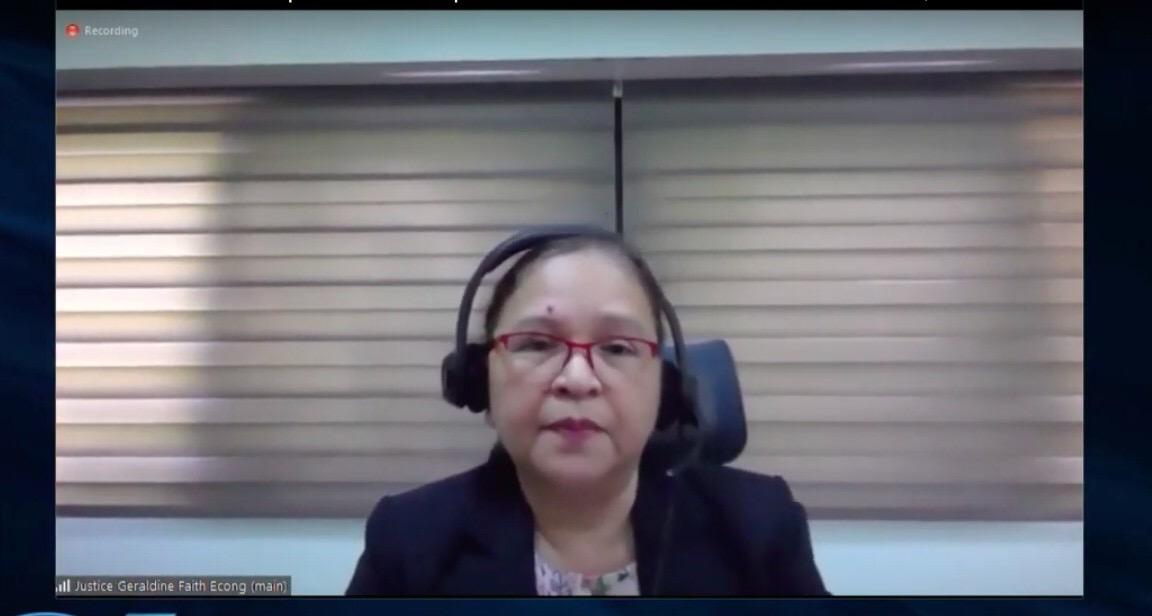
A Sandiganbayan magistrate eyeing to become a member of the Supreme Court (SC) said Wednesday the controversial anti-terror law should not be invalidated despite allegations the measure will open the door to human rights violations.
During the public interview organized by the Judicial and Bar Council (JBC), Sandiganbayan Associate Justice Geraldine Econg acknowledged allegations that the law is vague and has overly broad definition of terrorism.
Still, Econg believes that “we should not scrap the anti-terror law altogether.” She was not able to expound her answer as JBC member and retired SC Justice Noel Tijam asked another question.
It was Tijam who raised the issue of the anti-terror law.
Econg also said the SC cannot issue special rules to allay the fears of opponents of the law because that would be tantamount to judicial legislation.
She added the SC does not have the power “to determine how Congress should make the law and on what the contents of the law should be.”
Petitions challenging the constitutionality of the anti-terror law are pending before the high court.
For his part, Sandiganbayan Associate Justice Rafael Lagos said the power of judicial review allows the SC to look into the issues against the law.
“Justices have their own way of thinking. If they find something unconstitutional, let’s say a provision in the anti-terror law, they might strike it down; not the entire law but a particular provision which would violate a constitutional right,” said Lagos, also an applicant for the SC post.
Lagos also said it is the duty of the authorities to arrest terrorists, regardless of the location such as churches, and use necessary force.
“We have to weigh the balance between the terrorists running around an urban city and destroying something which is part of our heritage,” he said.
“If these are known terrorists and they really endanger the security of the nation or the government, then the government has the right to employ reasonable force. Not only reasonable but very, very effective and destructive force against the terrorists.”
Retired SC justices Antonio Carpio and Conchita Carpio Morales are among the law’s critics, as well as lawmakers, activists, teachers, students, artists, and journalists, who argued that it could violate basic rights and legitimize supposed state attacks against government critics.
However, Solicitor General Jose Calida said there were safeguards in the law to prevent abuse such as a prohibition against torture or coercion during interrogation and upholding the constitutional rights of persons under custodial investigation.
Econg also discussed her positions on same-sex marriage, powers of the Ombudsman, disposition of cases, and the remedy of quo warranto.—AOL, GMA News

