

 GMA Brandtalk
 Tracking
 Archives

Guevarra: Removing impeachable officials via quo warranto aboveboard
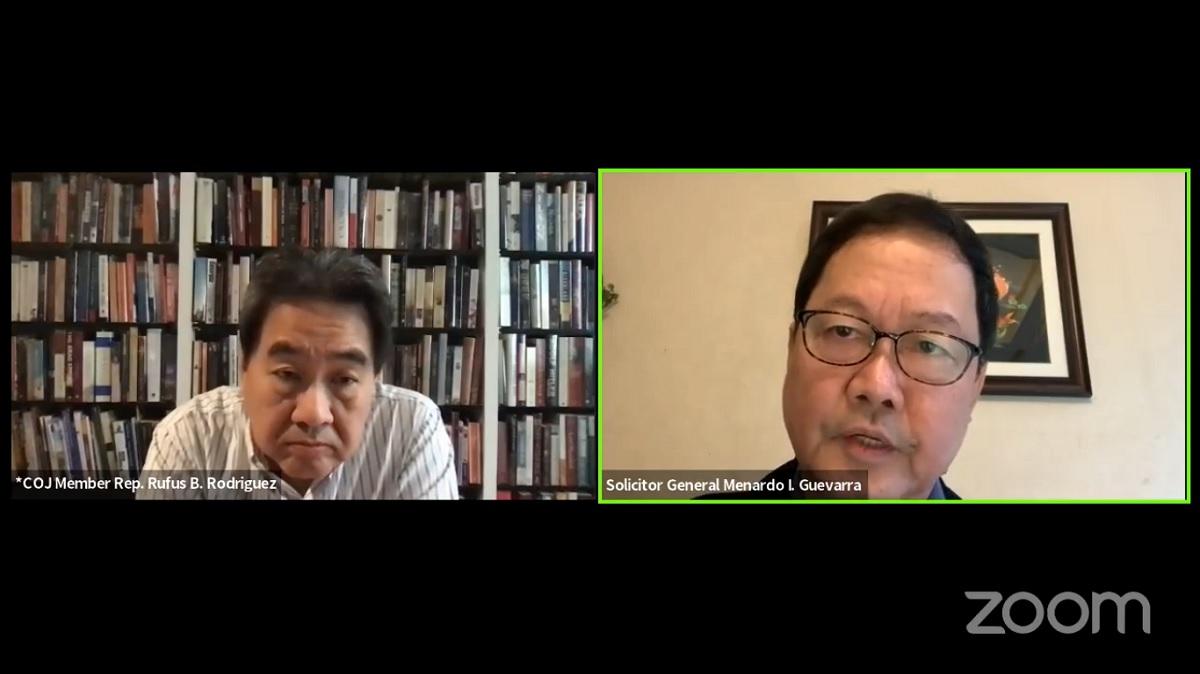
Solicitor General Menardo Guevarra on Wednesday said that filing a quo warranto petition to oust an impeachable officer before the Supreme Court is a legal remedy of last resort.
Guevarra made the position after Cagayan de Oro Representative Rufus Rodriguez asked his stance on the removal of former chief justice Maria Lourdes Sereno from her post via quo warranto petition, initiated by Guevarra's predecessor Jose Calida.
Rodriguez argued that post-appointment by the President, the Constitution provides that an impeachable officer should only be removed via impeachment, which process starts in the House of Representatives.
"It is a tough question. My distinction between the two remedies on the matter is when the remedy is available. If it is dealing with the qualifications, eligibility of the person to a certain position, then the possibility of filing a quo warranto petition will be the proper remedy," Guevarra, the Justice chief during the Duterte administration, told the House Justice Committee.
"When the person assumed the position...assumed the impeachable position and it involved acts such as gross violation of the Constitution, disloyalty to the Republic, et cetera, and that happened after the person assumed the position, then the proper remedy is impeachment," Guevarra added.
Rodriguez, however, countered that the qualification of an impeachable officer is already determined ahead of the Presidential appointment by the Judicial and Bar Council (JBC) which is mandated to evaluate nominees and submit the short list of nominees to the President where the Chief Executive will choose his or her appointee.
"The qualification [of a nominee] is taken in the JBC. If you pass the JBC [evaluation], you earn the recommendation of JBC which submits the short list to the President. JBC has already scrutinized and studied all the possible qualifications [of a nominee at that point]," Rodriguez pointed out.
"JBC is the constitutional body tasked to determine if you are qualified or not and gives the list to the President. While the Executive Branch has the discretion on appointments, the JBC already determines who's qualified. It is not within the jurisdiction of the Supreme Court or the OSG once there is already an appointment," Rodriguez added.
Guevarra, however, said that quo warranto provides remedy when there is human error in JBC deliberations.
"Under the Rules of Court, the quo warranto is of last resort because despite the screening process, there may be some possible lapses that have been committed, qualification issues that have been overlooked," Guevarra said.
"That is why we still have that remedy in the Rules of Court. Human error can come in any scenario," Guevarra added.
Sereno was ousted as Chief Justice post in May 2018 after the High Court granted Calida's petition via an 8-6 vote. It marked the first time that the Supreme Court justices ousted one of their own.
Calida's quo warranto petition accused Sereno of non-compliance with the requirement of the JBC, the body that screens and submits a shortlist of applicants to judiciary posts for the president's perusal, on the submission of Statements of Assets, Liabilities and Net Worth (SALN). — BM, GMA News

