

 GMA Brandtalk
 Tracking
 Archives

OCTA: NCR COVID-19 positivity rate up to 11.1%
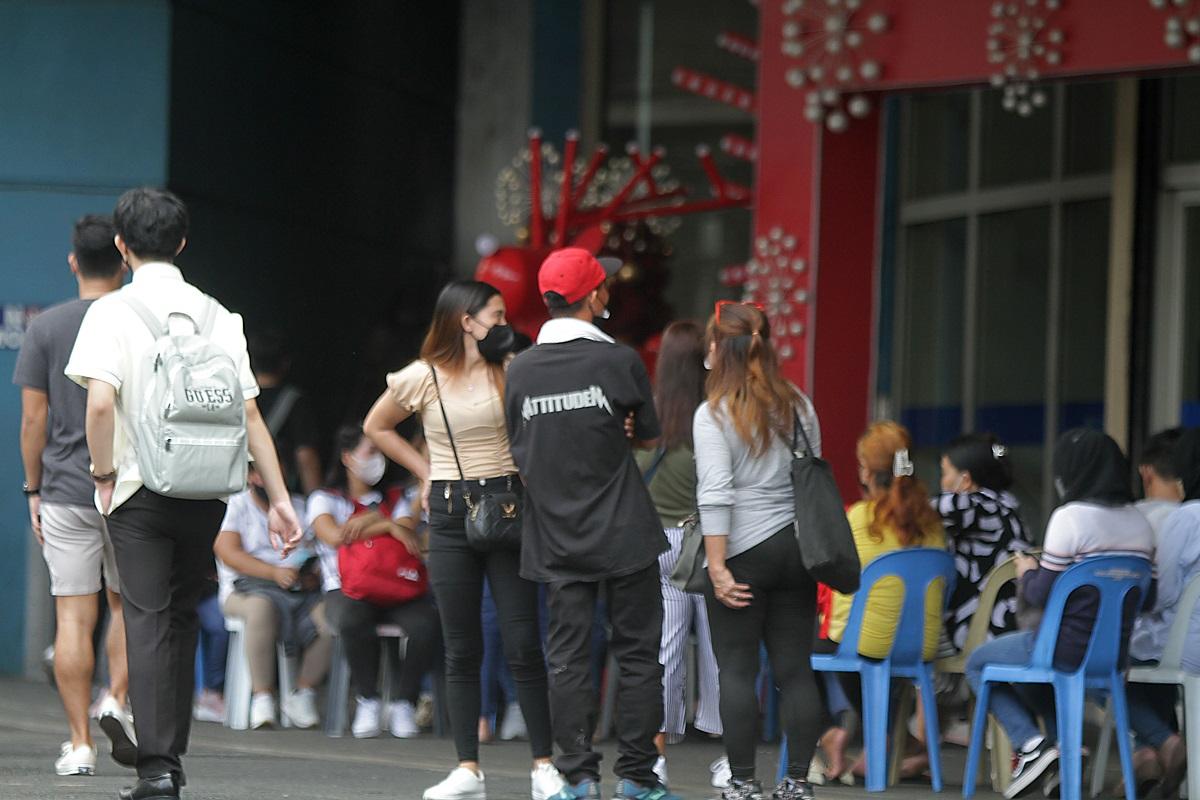
The seven-day COVID-19 positivity rate in the National Capital Region (NCR) further rose to 11.1%, while other areas in Luzon also showed increases, according to the data shared by independent monitoring group OCTA Research on Sunday.
OCTA fellow Dr. Guido David reported that NCR’s positivity rate — or the percentage of people who were found positive for COVID-19 among the total number of individuals tested — jumped from 7.5% on November 19, to 11.1% on November 26.
Likewise, positivity rates in other Luzon provinces like Batangas, Benguet, Bulacan, Cagayan, Ilocos Norte, Ilocos Sur, Kalinga, La Union, and Pangasinan also went up.
Isabela recorded the recent highest positivity rate in Luzon with 44.4%, down from 49.4% on November 19.
Twelve areas in Luzon showed a decline in positivity rates over the same period. These were Albay, Bataan, Camarines Sur, Cavite, Isabela, Laguna, Nueva Ecija, Pampanga, Quezon, Rizal, Tarlac, and Zambales.
The Philippines on Sunday recorded 1,326 new COVID-19 cases—the fifth straight day that more than 1,000 new cases were logged.
The Department of Health (DOH) said that NCR recorded the most cases in the last two weeks with 3,874. It was followed by Calabarzon with 1,961, and Western Visayas with 1,293.
Omicron BQ.1
The country has recently detected the Omicron BQ.1, a sublineage of the highly transmissible BA.5 subvariant. Currently, 14 cases of BQ.1 have been found here based on the latest genome sequencing.
OCTA Research on Saturday said that Omicron BQ.1 may cause a spike in COVID-19 cases and positivity rate.
COVID-19 vaccinations should be intensified after the BQ.1 sub-variant was detected in the country, Dr. Rontege Solante, an infectious disease expert, said Saturday.
Solante also answered in the affirmative when asked in a TV interview on Monday if the increase in NCR's COVID-19 positivity rate to 11.1% would be a cause of concern come the holiday season.
“Yes, I would say that as long as we have this BQ.1 and a lot has not received their needed booster doses, then that is expected that infection will rise, there will be an uptick of cases. It will be a concern, especially for the vulnerable population,” he said in a CNN Philippines interview.
Pending the country’s procurement of the bivalent COVID-19 vaccines that may be more effective against the Omicron variant, Solante encouraged unvaccinated senior citizens and those with comorbidities to no longer wait for their arrival and get the available primary vaccine series and boosters now.
“Waiting should not be an option because anytime you get the infection, especially ‘yung mga vulnerable population natin…because we’re still getting these people admitted in the hospital because of complications of COVID. I think for them, it should not be an option. They should be getting their needed booster doses for them to be protected against severe infections,” he said.
“For those, who want to wait for the bivalent, they can have that option but as long as they would still be complying with the health protocols strictly in terms of wearing the face mask, not much with the parties and get together during Christmas,” he added.
The DOH earlier announced that these second-generation COVID-19 vaccines would be available in the country by the end of December. —KG, GMA Integrated News

