

 GMA Brandtalk
 Tracking
 Archives

NEA partners with DepEd to energize remote schools
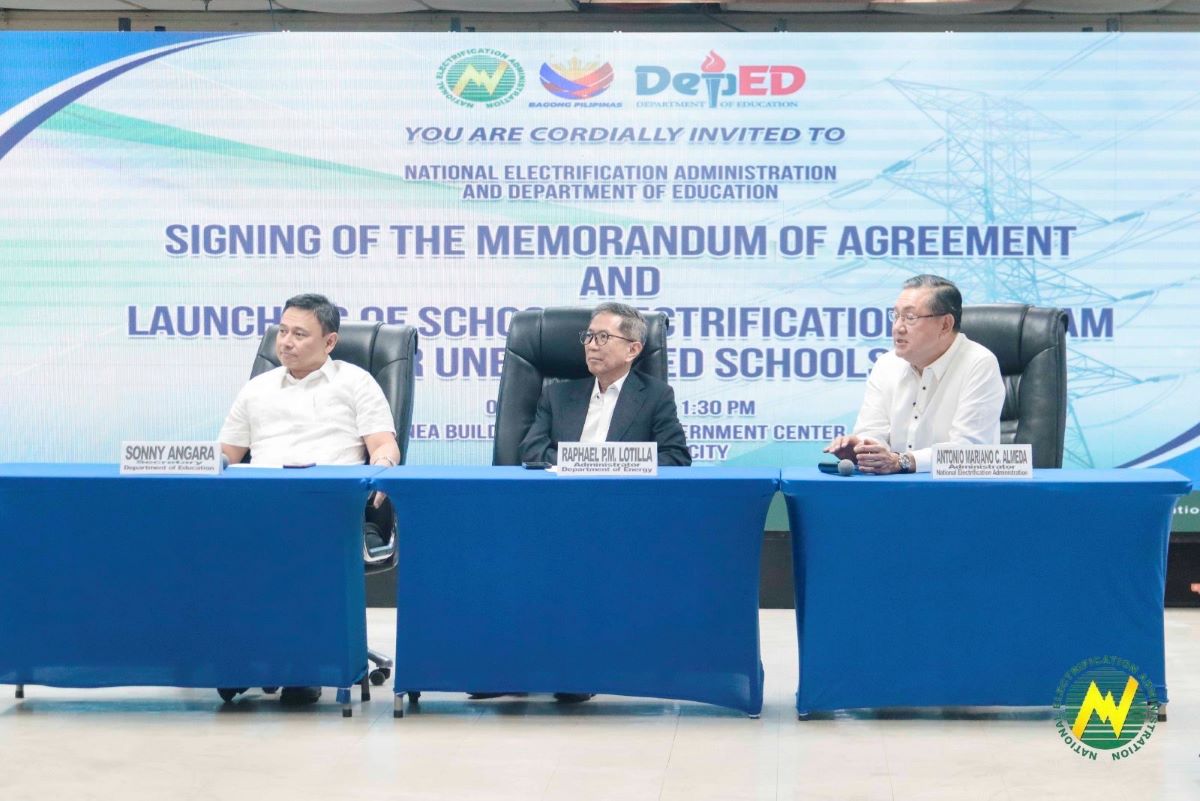
The National Electrification Administration (NEA) on Wednesday entered into a partnership with the Department of Education (DepEd) for the installation of solar photovoltaic (PV) systems in far-off schools without reliable access to electricity.
The project was sealed through a memorandum of agreement (MOA) inked by NEA Administrator Antonio Mariano Almeda and Education Secretary Juan Edgardo “Sonny” Angara.
Energy Secretary Raphael Lotilla and University of the Philippines (UP) president Angelo Jimenez witnessed the signing.
Under the MOA, the DepEd is tasked with identifying and prioritizing schools needing electrification, facilitating the necessary permits from concerned local government units, and providing counterpart logistical and financial support to execute the project.
The NEA, through its partner electric cooperatives (ECs), will provide technical assistance in setting up the solar PV panels, monitoring its system, and conducting further evaluations to ensure the project's completion.
The UP College of Engineering will be commissioned to develop the prototype for the planned solar PV systems in remote schools.
“We are forging a partnership that holds the promise of brighter futures and opportunities for students in underserved communities,” Almeda said in his remarks.
“This initiative paves the way for a transformative shift in rural education, enabling the integration of modern teaching methods, expanding access to online resources, and equipping students with the skills needed to thrive in today’s digital world,” the NEA chief said.
Lotilla said 1.6 million students are seen to benefit from this initiative.
The Energy chief said that approximately 1,500 public schools in the country still do not have electricity, citing a report from the Second Congressional Commission on Education.
Lotilla added that one-third of approximately 1,500 public schools without access to electricity are situated in the Bangsamoro Autonomous Region in Muslim Mindanao and provinces such as North Cotabato, Palawan, Sulu, Zamboanga del Sur, and Negros Oriental.
Funding for the initiative will be drawn from various sources, including but not limited to national or local government allocations, private institution grants and partnerships, or other approved financial mechanisms.
The NEA will also mandate electric cooperatives (ECs) to refrain from imposing any charges, fees, or costs in relation to the maintenance and sustainability of this project.
Almeda said that this would be “a form of corporate social responsibility” on the part of the NEA and ECs.
“Hopefully this year, we will finish it (the energization project). But of course, sometimes the terrain is very challenging,” Angara said. —VBL, GMA Integrated News

