

 GMA Brandtalk
 Tracking
 Archives

Lawmakers urge making spreading fake news by groups a crime
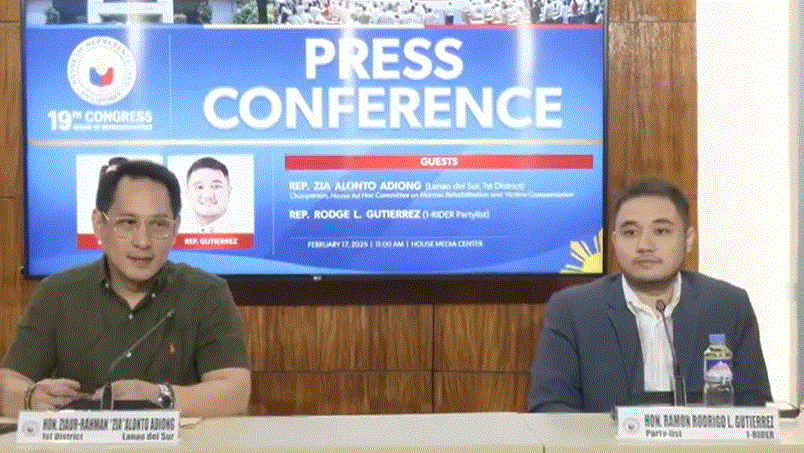
Two administration lawmakers said they favor passing a bill penalizing organizations peddling false information online.
1 Rider party-list lawmaker Rodge Gutierrez and Lanao del Sur Rep. Zia Adiong made the call ahead of the House probe on the proliferation of disinformation online on Tuesday February 18.
“We're in the early stages of our committee hearings and legislation on preventing disinformation online could very well be civil or criminal or both. I do believe nothing precludes a criminal punishment for the things that we seek to avoid here. We already have slander and libel laws, and these are criminal in nature and are constitutional,” Gutierrez, a lawyer, said.
“There are individual acts that might be deemed punishable, and you could liken that to libel, slander. But you also have to consider the organizational nature of disinformation, the machinery that deploys disinformation. How much more if the machinery is being funded by a foreign entity? Personally, I’d say that should be criminal,” he added.
Gutierrez cited that the findings of PressOnePH during their last hearing were examples of an organizational-level disinformation effort that can already be considered a criminal enterprise.
The purported false information online was linked to Chinese-owned and pro-China social media accounts which aimed to discredit the Philippines’ legal claims in the West Philippine Sea,
“If you are selling your opinion to the highest bidder, and if that highest bidder is a foreign entity, kapag binebenta mo yung opinion dun sa foreign adversary that would have an interest of putting our society in disarray, I think there should be some limitations, we should be open to [regarding the offense as] criminal in nature. But definitely, at the bare minimum, we are also considering making it a civil case,” Gutierrez said.
“We just have to be very careful with the tests that were already laid out by jurisprudence such as clear and present danger. We have to consider the chilling effect that it might have upon journalists and on freedom of expression. But with that said, I believe there is a way that we can really balance,” Gutierrez said.
Adiong, for his part, said that disinformation that puts national security at risk should be regarded as a criminal case.
“There's already a way on how we can file complaints or libel cases against those who are spreading false information against a certain individual or organization. But the point that we need to really strengthen here, based on what we have gathered during the last hearing, is that the disinformation operations online are already falling under the national security issue. Adiong, the House Assistant Majority Leader, said.
“If it's individual cases, there’s already cyberlibel, libel laws. But on the more collective ...those who employ amplifiers, we should have a law for this,” Adiong added.

