

 GMA Brandtalk
 Tracking
 Archives

Marcos to meet Trump in Washington, Rubio says

President Ferdinand Marcos Jr. and US President Donald Trump will have their first bilateral meeting in Washington, US Secretary of State Marco Rubio said as the two treaty allies strengthen their defense and military ties to deter China's aggression in the South China Sea.
The Philippines will also deploy a trade delegation to the US next week to continue negotiations after the Trump administration increased its tariff to the Philippines to 20% unless a deal is reached.
"(We) look forward to hosting the President of the Philippines in Washington in a few days," Rubio told reporters Thursday following his meeting with Philippine and Japanese counterparts at the sidelines of ASEAN ministerial meetings in Kuala Lumpur, Malaysia.
The Department of Foreign Affairs in Manila confirmed Rubio's statement and said Marcos will be in the US from July 20 to 22.
"We are working with the US State Department to finalize the details of the visit," the DFA said in a statement.
It will be an official working visit for Marcos, the first head of state from the Association of South East Asian Nations to be invited by Trump to the White House, Philippine Ambassador to Washington Jose Manuel Romualdez told GMA News Online.
Two Philippine government officials, who spoke to GMA News Online but asked not to be named as they are not authorized to speak on the matter, said Manila and Washington are eyeing the talks between Trump and Marcos to take place either on July 21 or July 22.
Palace Press Officer Undersecretary Claire Castro confirmed the visit but she refused to provide details and deferred to the Department of Foreign Affairs.
Rubio, Philippine Foreign Secretary Theresa Lazaro, and Japanese Foreign Minister Takeshi Iwaya held their first trilateral meeting Thursday, reaffirming their commitment to enhancing their economic and security ties as they face an increasingly assertive China, which has expanded its military presence in the disputed South China Sea - a key trading route.
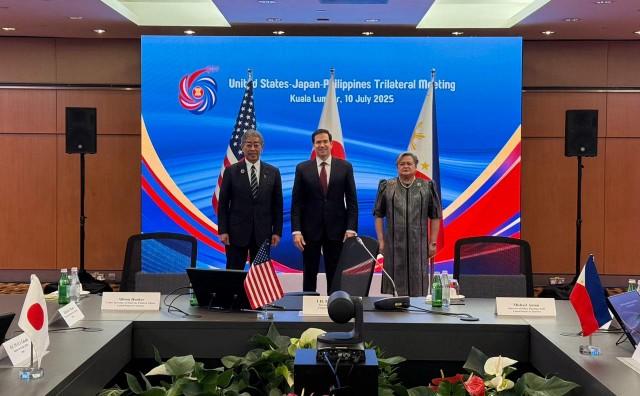
Rubio described the meeting as "excellent" when asked about the outcome of the meeting, signaling Washington's commitment to the trilateral arrangement initiated by Trump's political rival and predecessor, Joe Biden.
"We have a great relationship with Japan and the Philippines, and work very closely with them on the economic corridor on maritime security, and territorial integrity to build upon that partnership," Rubio said.
Lazaro, in a statement from Kuala Lumpur where she attended the ASEAN ministerial talks, which included an expanded security dialogue that included the US and Japan, among others, said the trilateral meeting maintained their commitment to bolstering their security cooperation.
They also vowed to continue "safeguarding regional peace, stability and freedom of navigation in the South China Sea."
Defense Secretary Pete Hegseth undertook his first symbolic visit in March with the Philippines and Japan as his chosen destinations. Hegseth said in Manila that the US will ramp up deterrence with its allies against Chinese aggression in the region.
Chinese Coast Guard, Navy, and suspected maritime militia ships have used high-pressure water cannons and dangerous maritime maneuvers to Philippine ships or vessels China has accused of entering its territorial waters illegally.
Japan, on the other hand, has a separate territorial dispute with China over a set of islands in the East China Sea.
In his Manila visit, Hegseth reaffirmed the Trump administration's "iron-clad" commitment to its obligations under the 1951 Mutual Defense Treaty, which obliges the US and the Philippines to help defend one another in case of an external attack.
"The Philippines continues to regard the United States and Japan as indispensable partners in enhancing the Philippines’ defense and security capabilities," Lazaro said.
Manila's new top diplomat said she thanked Rubio and Iwaya for their countries' "enduring support for the Philippines’ position in the South China Sea and the United States’ steadfast commitment to the Mutual Defense Treaty."
Manila renamed the stretch of waters in the South China Sea closer to the Philippines’ western coast as West Philippine Sea.
Lazaro also discussed advancing the US-envisioned growth region in Asia, called the Luzon corridor, for major infrastructure and other key economic projects with support from Japan and other like-minded states during the talks.
"In order for us to be politically strong, we have to be economically strong,” she said, noting Washington's $3.8-million funding for the pre-feasibility study of a freight railway connecting Subic, Clark, Manila, and Batangas.
The Luzon economic corridor will enable emergence of new growth hubs in Central and Southern Luzon.
Apart from collaboration on trade, defense, and maritime security, the three Foreign Ministers vowed "deeper cooperation" on cybersecurity capacity building and workforce development "to build safer, more secure, and more resilient cyberinfrastructure and systems." —with a report from Anna Felicia Bajo/VAL/AOL, GMA Integrated News

