

 GMA Brandtalk
 Tracking
 Archives

AFP prepares in case China retaliates after Bajo de Masinloc incident
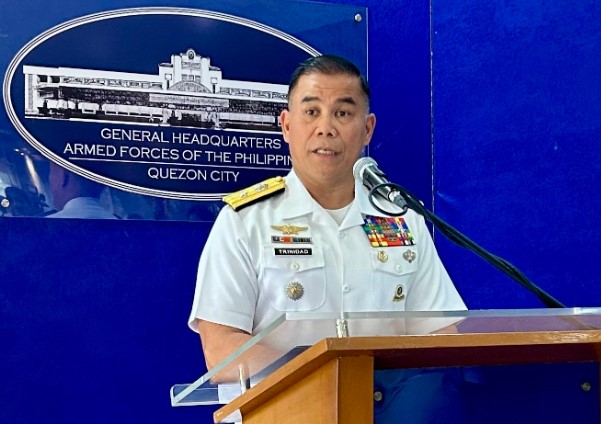
The Armed Forces of the Philippines (AFP) on Tuesday said it is making preparations for possible retaliation by China after its two vessels collided while chasing a Philippine ship in Bajo de Masinloc on Monday.
In a press briefing, Philippine Navy spokesperson for West Philippine Sea (WPS) Rear Admiral Roy Vincent Trinidad was asked about China’s possible retaliation and change of tactics after the incident.
“The AFP thrives on plans. We plan, we prepare, we don't anticipate. Whatever situation arises, your AFP could respond appropriately,” Trinidad said.
On Monday, the Philippine Coast Guard (PCG) as well as the Bureau of Fisheries and Aquatic Resources (BFAR) headed to Bajo de Masinloc to distribute aid to local fishermen as part of the Kadiwa program.
Several Chinese vessels harassed Philippine vessels by using water cannon, performing dangerous maneuvers, and shadowing.
According to the PCG, People's Liberation Army Navy (PLAN) 164 and China Coast Guard (CCG) vessel 3104 collided while they were chasing PCG's BRP Suluan.
The CCG vessel sustained substantial damage, rendering it unseaworthy, while the flagpole of the PCG vessel was also damaged, the PCG said.
Trinidad noted that the Philippine military’s use of force is not authorized except for self-defense.
“The rules of engagement are given by higher headquarters to govern whether force is allowed for mission accomplishment or not,” Trinidad said.
“The guidance has been very clear in conducting our aerial missions, in conducting our patrols, maritime patrols, air surveillance flights, the use of force is not authorized except for self-defense situations,” he added.
According to Trinidad, there was a spike in the number of Chinese vessels not only in Bajo de Masinloc but also in the northern islands.
“There was a noted spike in the number of research vessels and CCG ships in the northern islands, Batanes, Babuyan Group of Islands, and Bajo de Masinloc,” Trinidad said.
AFP spokesperson Colonel Francel Margereth Padilla said the alliances with like-minded nations are working to boost cooperation for a free Indo-Pacific.
“Itong alliances natin with like-minded nations and well-meaning nations are really working towards enhancing yung cooperation natin with other countries,” Padilla said.
(Our alliances with like-minded nations and well-meaning nations are really working towards enhancing our cooperation with other countries.)
“So lumalawig itong gustong sumali sa ating pinaglalaban dito for a free and open Indo-Pacific. We are here with one common goal with other allied nations,” she added.
(So more countries are joining our fight here for a free and open Indo-Pacific. We are here with one common goal with other allied nations.)
Chinese Foreign Ministry spokesperson Lin Jian on Monday maintained China's claim to the WPS, saying that it had to do what is “necessary to safeguard our territorial sovereignty and maritime rights and interests in accordance with the law.”
“The Philippines’ moves seriously infringed upon China’s sovereignty and rights and interests, and seriously harmed peace and stability at sea. These moves are of a malign nature,” the Chinese Foreign Ministry said.
“China urges the Philippines to stop the infringement and provocative activities at once and refrain from challenging China’s firm resolve to safeguard our lawful rights and interests,” he added.
Scarborough Shoal is located 124 nautical miles off Masinloc, Zambales, and is considered within the Philippines’ 200-nautical-mile exclusive economic zone (EEZ).
Tensions continue as Beijing claims almost all of South China Sea, a conduit for more than $3 trillion of annual shipborne commerce, including parts claimed by the Philippines, Vietnam, Indonesia, Malaysia, and Brunei.
Parts of the South China Sea that fall within Philippine territory have been renamed by the government as West Philippine Sea to reinforce the country’s claim.
The West Philippine Sea refers to the maritime areas on the western side of the Philippine archipelago including Luzon Sea and the waters around, within and adjacent to the Kalayaan Island Group and Bajo de Masinloc.
In 2016, the Permanent Court of Arbitration in the Hague ruled in favor of the Philippines over China's claims in the South China Sea, saying that it had "no legal basis."
China has refused to recognize the decision. — BAP, GMA Integrated News

