

 GMA Brandtalk
 Tracking
 Archives

PH in talks with US on Trump’s 100% semiconductor tariff – envoy
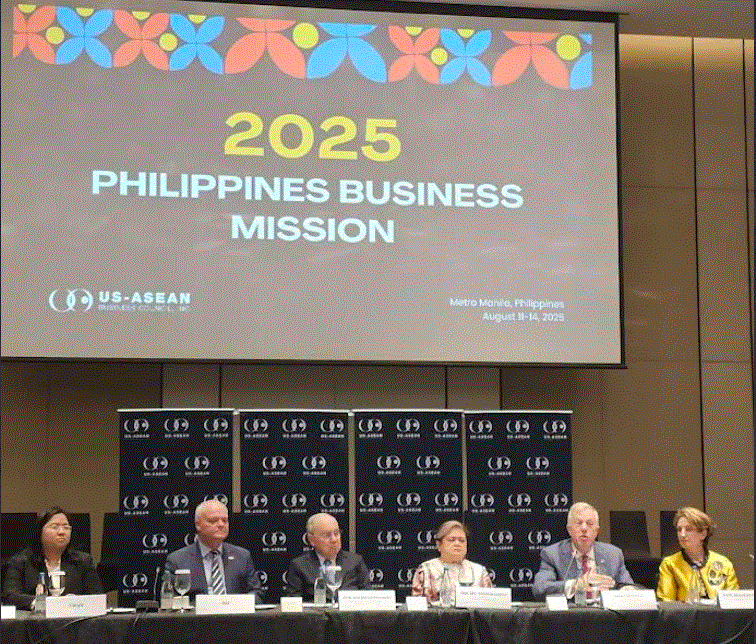
The Philippines is in talks with the United States on the Trump administration’s plan to impose a 100% tariff on semiconductors and computer chips, Manila's top diplomat to Washington said Thursday, warning that the new US tax policy would hurt two of Manila’s largest export industries.
Ambassador Jose Manuel Romualdez expressed concern that the imposition of fresh steep tariffs, which he described as “very disturbing” would affect the global semiconductor supply chain, impacting “a lot of companies, not only here in the Philippines, but all over the Asia-Pacific region.”
“We are asking our friends also from other organizations that have been helping us…to be able to exempt this particular industry, especially those that have been established here in the Philippines for so many decades now,” Romualdez said at a moderated discussion with the media during the US-ASEAN Business Council meeting in Manila.
Romualdez said the impact on the Philippines’ semiconductor manufacturing industry would be “substantial” if the new round of tariffs were to push through.
The Philippines is the world's ninth-largest chip exporter and the semiconductor sector is the country's largest export industry.
“It's a very substantial amount. I can just tell you that it's very important for us to make sure that this industry is maintained here,” he told reporters in a separate interview.
The envoy said American semiconductor manufacturer Texas Instruments, which has maintained decades-long presence in the Philippines, for example, recently made huge investments in the country, but remains “in limbo” until details on the new chip tariff are finalized.
Romualdez said consultations are ongoing with US trade officials, the US-ASEAN Business Council, US Chamber of Commerce and the Semiconductor Association in the United States and Washington D.C.
Trump’s latest announcement on global duties on electronics came more than three months after announcing sweeping reciprocal tariffs ranging from 10% to 100% on its global trading partners, including security allies, such as the Philippines and Japan.
Trump, however, said American companies that will manufacture the crucial chips and semiconductors, which power automobiles, computers, mobile phones, gadgets, appliances and other essential tech equipment, in the US would be exempted from duties.
Manila, on the other hand, is still in the process of finalizing details on the new 19% duties imposed by the Trump administration on Filipino products entering America, Romualdez said, adding that not all US imports are duty-free.
The tariff on the Philippines is considered final, he said, but trade officials from Manila and Washington are “still on the negotiating stage” on the specifics and exemptions contained in the trade deal. US agricultural products are likely not included in the list of duty-free American goods, Romualdez said.
“Of course, we have to consider the agricultural sector, which is very important for us,” he said.
Foreign Secretary Theresa Lazaro said the Association of South East Asian Nations (ASEAN), of which the Philippines is a member along with nine other countries, is expected to ramp up and expand intra-ASEAN trade in response to the US tariffs.
“Discussions are evolving within ASEAN,” said Lazaro, who was also present at the forum with the media.
Romualdez said President Ferdinand Marcos Jr.’s recent state visit to India, which pledged $446 million in investments, is “a clear indication” of how the Philippines is looking for other markets outside of the United States and also in Europe as a result of the US tariffs. —LDF, GMA Integrated News

