

 GMA Brandtalk
 Tracking
 Archives

ATOM back on streets over 40 years after Ninoy Aquino slay
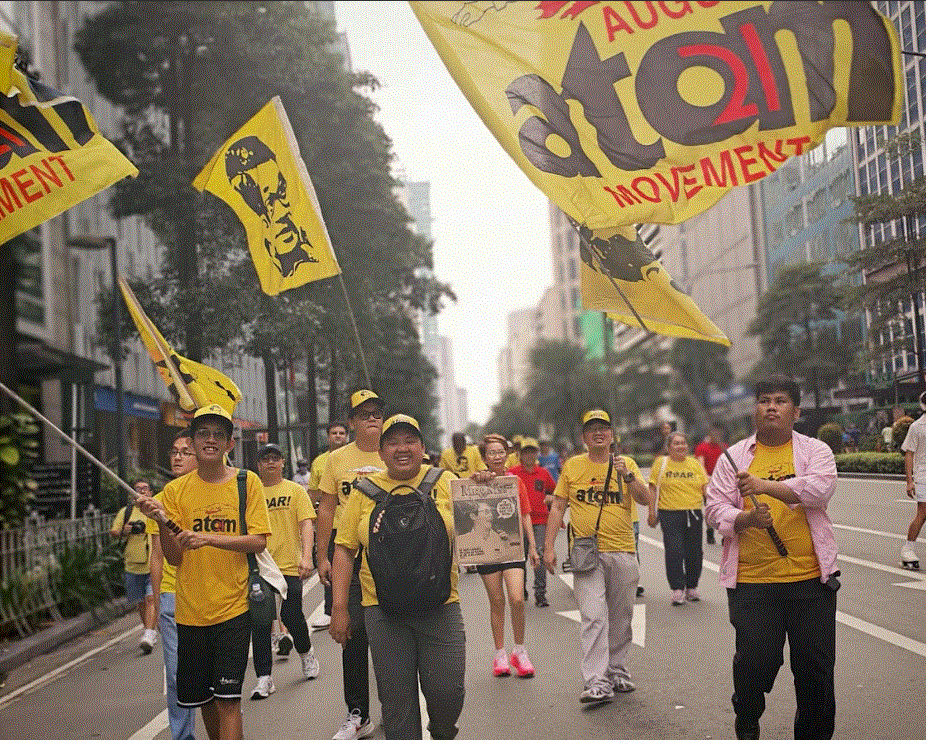
Volt Bohol was in grade school when former Sen. Benigno “Ninoy” Aquino, Jr., was shot dead upon his arrival at the Manila International Airport that for almost 40 years now bears his name.
By Bohol’s admission, he must not have been “at the right age” to look inside the coffin of the fallen opposition leader, whose bloodied body laid in state at the Santo Domingo Church just beside his school.
“I was probably not at the right age to see what Senator Ninoy looked like inside the coffin because it was a violent death. That was something that I will probably never forget,” Bohol said.
Now, 53, Bohol is the president of the organization put up by Ninoy’s brother, Agapito or Butz, to rally mainstream protest against the assassination of the senator, as well as against the country’s ills, which remained decades after the EDSA Revolution in 1986.
“The young ones in 2022, the Pink movement...it exploded in our faces and caught us by surprise. A lot of them came from that movement. Nabitin sila sa nangyari noong 2022 and they wanted to do more,” Bohol said.
“They came across ATOM,” Bohol said. The August Twenty-One Movement.
Motley crew
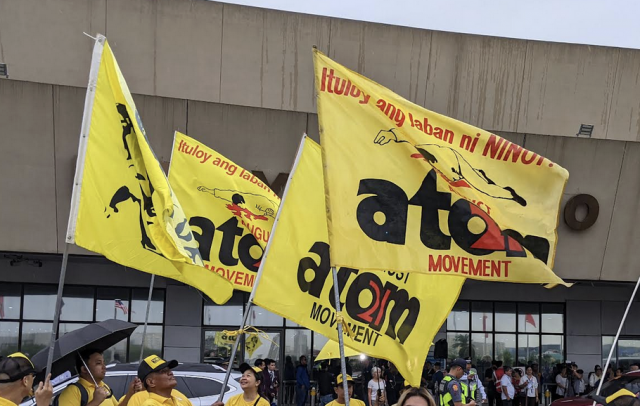
Since last year, a motley crew of professionals, bikers, youth, and volunteers – all from the August Twenty One Movement (ATOM) – have been staging a monthly gathering in Makati City as part of their ROAR or Run/Ride On Against Revision of History campaign.
The activities are nothing grand, unlike ATOM’s mobilizations in the 1980s after the Aquino assassination, such as the “Tarlac to Tarmac” march, the rain of confetti on Ayala Avenue, and the random marches to Mendiola Bridge and elsewhere.
ATOM was founded in September 1983, two months after the August 21 assassination of Ninoy Aquino, exactly 42 years ago today.
According to the Bantayog ng mga Bayani Foundation, Ninoy’s brother, the late Sen. Agapito “Butz” Aquino, and public relations man, Reli German, founded the group. It became the “vehicle to attract the middle class to join the protest movement against the Marcos dictatorship.”
On the day Ninoy was felled by bullets at the tarmac, Butz had been waiting at the airport lounge together with other family members and prominent opposition leaders.
“When the terrible news first came, Butz refused to believe it, only accepting the reality that his brother had been killed when he saw Ninoy’s body at Fort Bonifacio. He mused, “So this is it? What happened to all his plans, his dreams? Were all his preparations, his sacrifice and suffering, all for nothing?” Butz was quoted as saying.
Through ATOM, Butz and German were able to organize supporters and volunteers, even employees, to take part in the rallies.
ATOM also launched the first ROAR, which then meant “Run On for Aquino and Resignation,” where participants, jogging from Roxas Boulevard to Baclaran Church, called for justice and the resignation of Marcos Sr.
Marcos Sr. was eventually ousted in 1986 through EDSA Revolution. Opposition candidate Corazon “Cory” Aquino, Ninoy’s widow, took her oath of office on February 25, 1986 as the country’s new President.
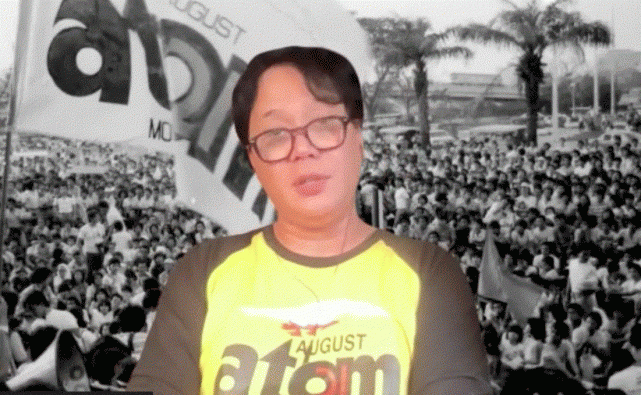
“I joined in 2022 after I heard ATOM is trying to accept new members again, a few months after the 2022 elections. We all know what happened then, and I have a feeling that has a big influence on why the original batch decided that they want new blood, accept new members,” Bohol said.
Bohol referred to what he called historical distortions that ranged subtle, mean, rabid, but ultimately, well-funded.
“I was really triggered because I know that they are actually not just destroying the legacy of Ninoy or Cory,” Bohol said.
Bohol said his sentiments were shared by the youth behind the Pink Movement, the volunteers who supported then Vice President Leni Robredo’s presidential campaign in 2022.
These young ones then expressed a desire to join ATOM after Robredo’s 2022 election defeat.
“Post-EDSA, ATOM was there as a legacy group, ever present in People Power and Ninoy commemorative events. But in 2017, they started denouncing some of the killings that were happening during the Duterte administration,” Bohol said.
“Then, they were very hurt by the results of the 2022 elections. The original batch from ‘83 to ‘86 is still around, the spirit is still strong, but they are not as young; they cannot do much physical activity just like before,” he added.
“They realized they can't do this [by themselves] for the long haul. We need young blood,” Bohol said.
‘Ano ang saysay?’
Archie Ventosa, one of the original members of ATOM, said the group’s relevance in 2025 was clear, given that the young people want to resist the same alleged corruption and abuse of power that they resisted in the 80s.
“Ano ba ang saysay ng ATOM ngayon kumpara sa dati? Before, we were fighting against the dictatorship of Marcos Sr. and his wife Imelda, their conjugal dictatorship and human rights abuses,” Ventosa said.
“First and foremost, it was not a fight between the Aquinos and the Marcoses, or a fight between their supporters. It was a fight of the Filipino people who, for more than 20 years, were under a Marcos conjugal dictatorship and excessive abuses,” he added.
“Now, we have Marcos, Jr., who is apparently mellow, maybe too mellow na hindi natin alam kung may ginagawa ba talaga siya,” Ventosa said.
(We don’t know for sure if Marcos, Jr. is taking any decisive action.)
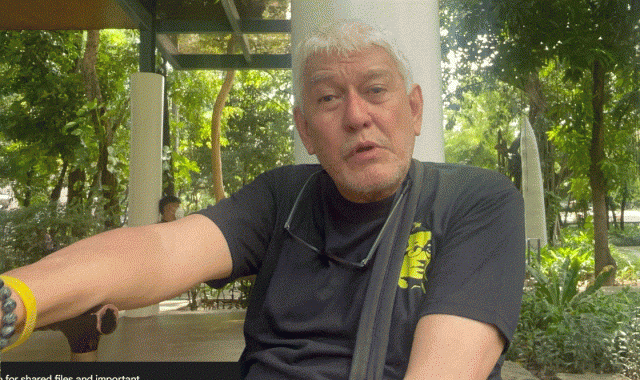
“But the same issues linger: Corruption, human rights abuses are still there, including during the time of the Duterte administration,” Ventosa said.
“There are budget insertions, there are a lot of flood control projects, but who benefited from those? Why does flooding remain unsolved? Corruption is a cancer that kills our nation,” he added.
Referring to its stand on the impeachment of Vice President Sara Duterte and the Senate vote to archive the complaints, Ventosa said, ”ATOM will always be the konsensya ng bayan. Ipagpapatuloy namin ang pagiging konsensya ng bayan, boses ng bayan, tenga ng bayan.
“When we see something that is not good for our country, we will voice it out,” Ventosa added.
Justifying his vote to archive the complaint, Senate President Francis Escudero said, “We chose the Constitution, we chose the rule of law by defending the integrity of the Supreme Court and maintaining the system of checks and balances under our republican system of government."
Preserving legacy
Bohol said ATOM needed to persevere because the alleged attempts to erase the legacy of Ninoy and the People Power Revolution can be just as harmful.
Bohol cited the Marcos administration’s decision not to declare February 25, the last day of the People Power Revolution in 1986, as a non-working holiday for two straight years now. The date was instead declared a special working day.
He also lamented the replacement of the images of Ninoy and the late President Corazon "Cory" Aquino on the P500 bill with local wildlife, the monkey-eating eagle. The Bangko Sentral ng Pilipinas (BSP) also replaced the other images of Philippine heroes on the bills.
In defense of the redesign, the BSP emphasized the importance of showcasing various aspects of national pride.
“It will co-circulate so our paper banknotes featuring our Philippine heroes will still be there,” said Mary Anne Lim, BSP assistant governor.
Bohol said, “The non-declaration of the People Power was a very subtle move, just like iyong our banknotes wherein all of a sudden, they came up with new paper bills na animals ang nakalagay.”
“Some countries do that, but our country is not lacking in heroes. We are a nation of heroes, and we should never forget that,” Bohol said.
“But what made us hopeful is that when People Power Day was not declared a holiday, a lot of the schools declared it a holiday on their own. That is the spirit of EDSA,” he added.
“So it doesn't matter if the government declares it or not. We, the people, will declare it a holiday for ourselves if need be,” Bohol said. –LDF/NB, GMA Integrated News

