

 GMA Brandtalk
 Tracking
 Archives

DFA: PH doesn't recognize Taiwan as a sovereign state
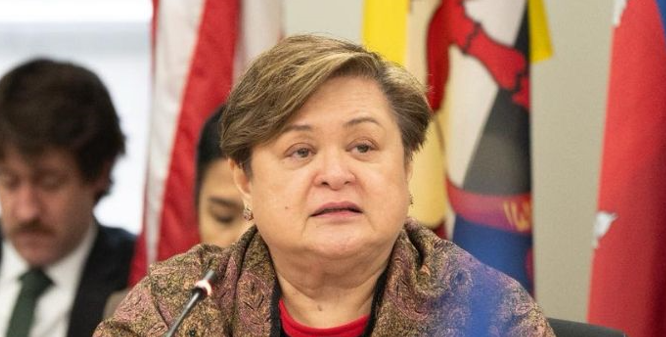
The Department of Foreign Affairs (DFA) on Thursday reaffirmed the Philippines’ adherence to the One-China policy, saying that the country does not recognize Taiwan as a sovereign state.
At the hearing of the Senate Committee on Foreign Relations, Foreign Affairs Secretary Ma. Theresa Lazaro cited the 1975 joint communique of the Philippines and China, which she said “is foundational to the good relations of both countries.”
“The change in recognition of the one sole and legal government of China from the Republic of China to the People's Republic of China is the basis of our One China Policy. The Department of Foreign Affairs, and I'm proud to say that, is the guardian and steward of the One China Policy. And to this very moment, we have been the guardian and steward,” Lazaro said.
“Successive administrations have reinforced the One China Policy through separate but related issuances, and the Filipino people have long-standing relations with the Taiwanese people and we therefore benefit from continued engagement with them. But just to add a little bit more, we do not recognize Taiwan as a sovereign state. We leave it to the Chinese people to resolve cross-straits matters,” she added.
Lazaro issued the statement after President Ferdinand “Bongbong” Marcos Jr. said that the Philippines could be drawn into a conflict between the United States and China over Taiwan.
During his state visit to India earlier this month, Marcos said "there is no way that the Philippines can stay out of it" if an all-out war erupts in the Taiwan Strait due to its geographic location and the presence of around 200,000 Filipino workers on the self-ruling democratic island China claims as part of its territory.
China said it lodged "serious protests" against the Philippines after this statement by Marcos.
President Marcos, in return, admitted that he was a little bit perplexed that his remarks were characterized by the Chinese government as “playing with fire,” but maintained that he was just stating facts.
Lazaro also defended Marcos, saying that he did not deviate from the principle of non-interference, which she said is a principle of the joint communique.
The joint communique, which was signed in June 1975, states that “the two Governments agree to settle all disputes by peaceful means…without resorting to the use or threat of force.”
The DFA chief said that the agency continues to call for restraint and dialogue amid the conflict, expressing concern for around 200,000 overseas Filipinos who may be affected by it.
Lazaro made the remark after Senate committee on foreign relations chairperson Senator Imee Marcos asked the DFA to clarify the Philippines' position on the One China policy, following the statement of her brother, President Marcos.
“Nakakalito at higit sa lahat, nakakatakot. Kaya marami pong natakot. At 'yun nga, nagwala 'yung China at maanghang na sumagot. At ang alam natin, idiniin muli noong dumating dito sa Pilipinas si President Bongbong,” Imee Marcos said.
(It was confusing and above all, scary. A lot of people got afraid. And China also protested against it. But when President Bongbong came back to the Philippines, he maintained his statement.)
Manila does not have official diplomatic ties with Taiwan, a democratic self-ruling island which has been separated from the Chinese mainland since 1949.
The Philippines, however, maintains a de-facto embassy in Taiwan, called the Manila Economic and Cultural Office or MECO. — RSJ, GMA Integrated News

