

 GMA Brandtalk
 Tracking
 Archives

Contingency in place should China 'cross red line,' tow BRP Sierra Madre
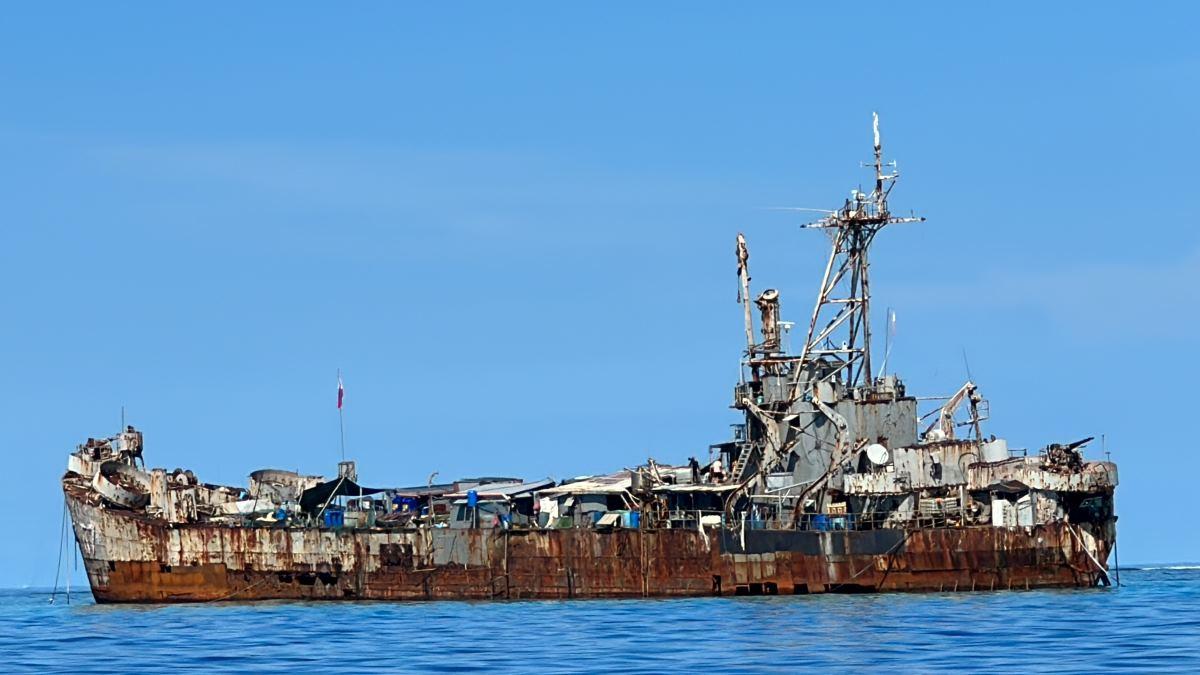
The Philippines has contingency plans in place should China cross the "red line," such as towing the country's permanent outpost, the BRP Sierra Madre, in Ayungin Shoal in the West Philippine Sea (WPS).
"'Yung paglapit lang ng vessel na magto-tow, that is a red line. Hindi natin papayagan 'yan. May red lines ang Philippines government. 'Yung ating contingency plans for that red line ay naka-establish na," Philippine Navy Rear Admiral Roy Vincent Trinidad, Armed Forces of the Philippines spokesperson for WPS, said at a news forum in Quezon City.
(The approach of a towing vessel to the BRP Sierra Madre is a red line. We will not allow that. The Philippine government has red lines. Our contingency plans for that red line have already been established.)
Trinidad, however, declined to divulge details of the Philippines defense forces' contingency measures in response to "red line" situations.
"These are usually operational details that we don't post public. That is part of our approach in the West Philippine Sea… strategic ambiguity. Hindi mo nilalabas lahat ng galaw mo (You do not divulge all you actions)," he said.
Earlier this week, the Philippine Navy bared that the People's Liberation Army Navy (PLAN) of China has deployed a tugboat near BRP Sierra Madre, but said it was not a cause for alarm.
Trinidad had said "it will take more than a tugboat to pull out BRP Sierra Madre."
Tugboat
During the forum, the Navy spokesperson said the PLA Navy tugboat is no longer monitored near the BRP Sierra Madre.
"Ang assessment natin na ang tugboat na 'yun ay para sa kanila (China), kung sakaling may masadsad na barko sila sa Ayungin Shoal," Trinidad said.
(Our assessment is that the tugboat was deployed for China's vessels, in case any of these run aground at Ayungin Shoal.)
Nonetheless, Trinidad said the Philippine military would not allow the BRP Sierra Madre to be towed out of its post.
The World War II-era BRP Sierra Madre has been grounded in Ayungin Shoal since 1999. The ship has become a symbol of Philippine sovereignty in the offshore territory.
Ayungin Shoal is a submerged reef in the Spratly Islands. The shoal is located 105 nautical miles west of Palawan and is within the Philippines 200-mile exclusive economic zone (EEZ).
'Stronger than before'
Trinidad said the country's defense capabilities to defend its territorial sovereignty is now stronger than before.
"Mas malakas tayo ngayon kaysa kahapon. Pero hindi ibig sabihin na tapos na ang modernization. Nasa Department of [National] Defense ang detalye niyan," he said.
(Our defensive capabilities today are stronger than before. But that doesn't mean that modernization is over. The Department of National Defense has the details about that.)
The Navy spokesperson said vessels are already deployed and patrol plans are already in place.
"Kasama sa regular patrol plans ang mga barko at mga eroplano, surveillance flights, and maritime patrols," Trinidad said.
(Our regular patrol plans includes sea vessels and aircraft, surveillance flights, and maritime patrols.)
"Kung sa tanong mo ay at this time, kaya na ba natin magpalubog ng barko? Napakita na natin 'yan sa mga exercises natin, Balikatan, tayo mismo ang nag-launch ng missiles. From land sa dagat at sa himpapawid. At ang target natin ay barko nga," he added.
(If your question is, at this time, can we sink a ship? We've shown that we can in our military exercises, the Balikatan, when we launched the missiles ourselves. From land to sea to air. And our targets were ships.)
'Consequences'
Meanwhile, China's Ministry of National Defense on Friday warned the Philippines of "consequences" over Manila's alleged hyping up of incidents, provocations, and infringements in Ayungin Shoal in the West Philippine Sea (WPS).
"The Philippines should immediately stop making provocations and infringements and stop hyping up incidents. Otherwise, all consequences arising therefrom should be borne by itself," said Chinese defense spokesperson Senior Colonel Zhang Xiaogang in a press conference in Beijing.
Also on Friday, however, Malacañang said China cannot stop the Philippines from asserting its rights in the West Philippine Sea.
"We cannot stop China from making its own narrative. But they cannot also stop us from fighting for our rights based on laws, UNCLOS, arbitral ruling, and for our being [an] independent country," Palace Press Officer Undersecretary Atty. Claire Castro said with regard to the Chinese Ministry of Defense's statement that the Philippines is a "disruptor and troublemaker" in the region.
Tensions continue as Beijing claims almost all of the South China Sea, a conduit for more than $3 trillion of annual shipborne commerce, including parts claimed by the Philippines, Vietnam, Indonesia, Malaysia, and Brunei.
Parts of the South China Sea that fall within Philippine territory have been renamed by the government as West Philippine Sea to reinforce the country's claim.
The West Philippine Sea refers to the maritime areas on the western side of the Philippine archipelago including Luzon Sea and the waters around, within and adjacent to the Kalayaan Island Group and Bajo de Masinloc.
In 2016, the Permanent Court of Arbitration in the Hague ruled in favor of the Philippines over China's claims in the South China Sea, saying that it had "no legal basis."
China has refused to recognize the decision. — VDV, GMA Integrated News

