

 GMA Brandtalk
 Tracking
 Archives

DepEd eyes direct LGU role, less reliance on DPWH in building classrooms
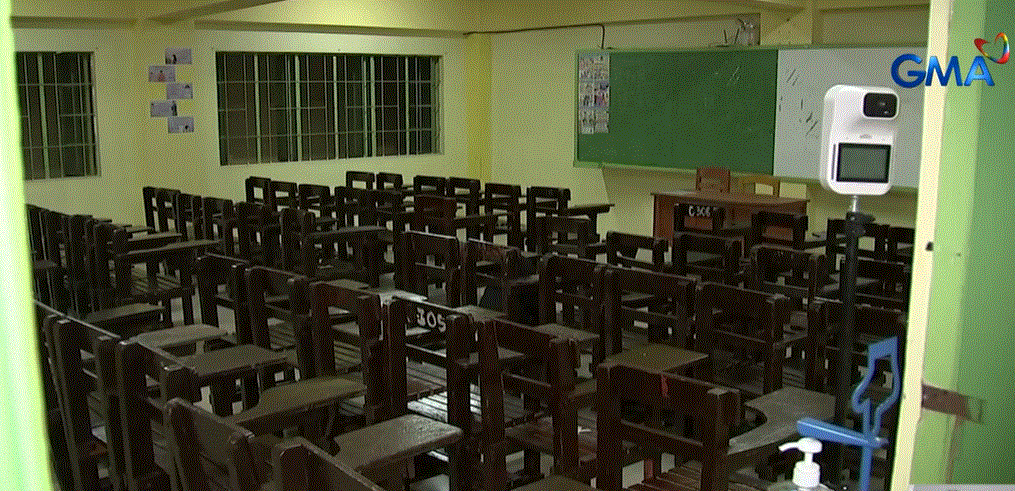
The Department of Education (DepEd) is studying a policy shift that would allow local government units (LGUs) to directly participate in the classroom construction process and effectively veer away from reliance on the Department of Public Works and Highways (DPWH).
In a statement on Wednesday, the DepEd described the building of projects through DPWH as "a process that has faced challenges in speed and efficiency." The policy shift may provide a "potential break" to the current system, the DepEd said, wherein most school building projects are managed by the Public Works Department.
"Every classroom we add brings hope and opportunity to learners. But delays in construction mean children wait longer than they should. That is why we are looking for ways to build faster and smarter, with partners who are closest to the ground," Angara said in a statement.
If successful, Angara hopes the shift would speed up delivery of school infrastructure delivery and help address nationwide shortage of classrooms.
Speaking at Wednesday's hearing of the House of Representatives appropriations committee, Angara said his office is seeking to channel DepEd funds to local government units so that classroom infrastructure requirements would be addressed more effectively.
"Tingin ko, nahihirapan din ang Department of Public Works (I think the Department of Public Works is also facing difficulties), so that's why we are proposing, for the first time... where we allow DepEd budget to be downloaded to cities, to provinces, in addition, without depriving the DPWH, because it is the agency, in terms of capacity, it has the most number of engineers, it has the boots on the ground," Angara told the House panel.
"Pero siguro di niya kaya mag-isa (But perhaps the DPWH cannot do it on its own)," the Education chief said.
'Optional' DPWH involvement
Now, the DepEd is seeking flexibility in the 2026 General Appropriations Act (GAA), subject to congressional approval, to pave the way for LGUs and stakeholders to be "engaged more directly" in school building projects.
The department acknowledged that LGUs vary in readiness, with some having strong technical and financial capacity while others may require additional support.
In view of this, the DepEd is considering an accreditation system, co-financing arrangements, clustering of municipalities, and technical assistance for low-income LGUs.
Even with broader participation, however, the DepEd will continue to provide project guidance through standardized classroom designs, cost ceilings, and technical specifications.
The DepEd sees DPWH involvement "will remain an option where needed," saying this would provide the flexibility of having national oversight combined with local initiative.
Long road ahead
In June, the DepEd reported a backlog of some 165,000 classrooms, which at the current pace of construction could take 55 years to eliminate. Officials have attributed the shortage to rapid population growth, aging infrastructure, frequent natural disasters, and years of underinvestment in facilities.
To expedite the process, the DepEd is also exploring a public-private partnership (PPP) model on a "build now, lease to government" basis—where the private sector constructs classrooms and the government pays in installments over ten years.
Since assuming office in July 2024, Angara has secured more than P458 million in private sector commitments, expected to fund at least 84 new classrooms and several facility upgrades, according to data reported Wednesday by the DepEd.
"Our partners in local governments, civil society organizations, and the private sector have shown they want to be part of the solution. What we hope to do is create the space for their contributions to make a bigger impact," Angara said.
The DepEd emphasized that addressing the classroom gap will require unity across sectors and all levels of government.
"Our goal is simple: every Filipino child deserves a safe and decent classroom. We may not get there overnight, but by working together and exploring new ways forward, we can move closer to that future," Angara said. — VDV, GMA Integrated News

