

 GMA Brandtalk
 Tracking
 Archives

US, Japan, Korea reject ‘unlawful’ maritime claims, dangerous actions in SCS
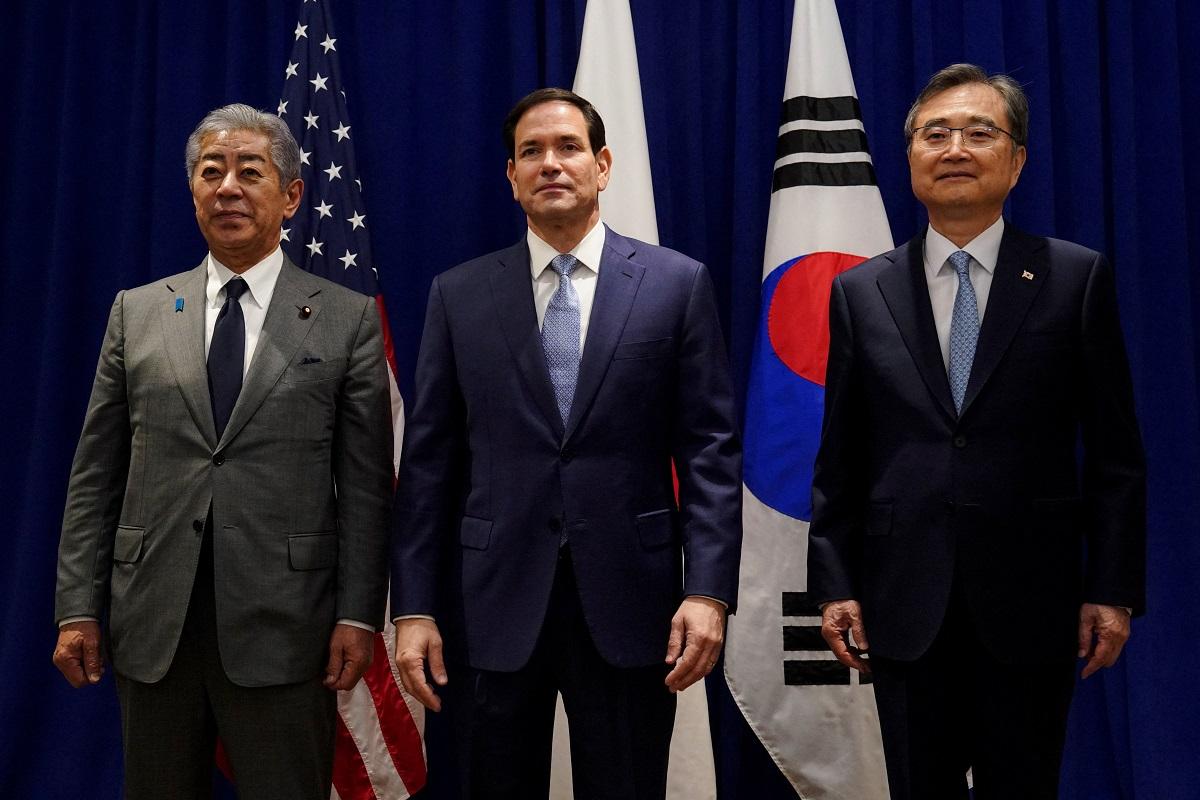
The United States, Japan and South Korea have rejected “unlawful” and “dangerous” actions in the South China Sea amid China’s increasingly aggressive actions against Philippine vessels in the disputed waters.
US Secretary of State Marco Rubio, Foreign Minister of Japan Iwaya Takeshi, and Korean Foreign Minister Cho Hyun met on September 22 on the margins of the United Nations General Assembly in New York City, where they also pledged to assist Southeast Asian partners to enhance maritime response and capacity-building.
“The Secretary and Foreign Ministers strongly opposed unlawful maritime claims in the South China Sea, as well as attempts to enforce such claims,” they said in a joint statement at the end of their trilateral meeting.
They did not name China, but the three top diplomats said “they opposed any attempts to change the status quo, including dangerous and destabilizing actions in the waters of the Indo-Pacific, including the South China Sea.”
China claims the South China Sea virtually in its entirety and has deployed much larger fleets of coast guard, navy and suspected maritime militia ships in the past years to assert that extensive claim against smaller claimant states, which are the Philippines, Vietnam, Malaysia, Taiwan and Brunei.
Confrontations have spiked between Chinese and Philippine coast guard and navy ships in the disputed waters in recent years.
The Philippines challenged the validity of China's sprawling territorial claims in the South China Sea and sought to clarify the territorial entitlements of certain Chinese-occupied features under the United Nations Convention on the Law of the Seas, or UNCLOS. Manila won the case against China, which refused to recognize the ruling.
The US, Japan and Korea said they are committed “to maintaining a free and open Indo-Pacific and upholding international law as reflected in the UN Convention on the Law of the Sea, including freedoms of navigation and overflight and other lawful uses of the sea.”
They also vowed to continue their joint efforts “to advance the safety, security, and prosperity of our three countries and the broader Indo-Pacific region, while upholding shared principles including the rule of law.”
The three ministers said they committed to work under the Trilateral Maritime Security and Law Enforcement Cooperation Framework “to address the multifaceted challenges in the maritime domain and provide joint capacity building assistance to partners in the region.” — BM, GMA Integrated News

