

 GMA Brandtalk
 Tracking
 Archives

DPWH: Only 22 PH classrooms finished so far in 2025
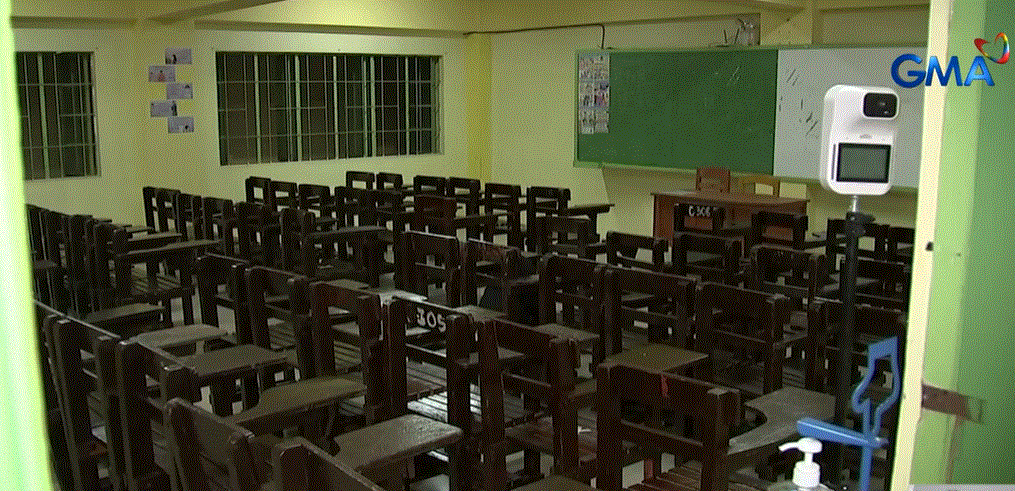
Out of the 1,700 classrooms targeted to be built this year, only 22 classrooms have been finished so far by the Department of Public Works and Highways (DPWH).
DPWH Secretary Vince Dizon disclosed this during the Senate Committee on Finance's deliberations on the agency's proposed P625.78-billion budget for fiscal year 2026 on Monday.
"Totoo ba 'to? Ang baba nito ah. So, for 2025 po, out of 1,700 na dapat gawin, 22 pa lang po ang completed at 822 ang ongoing… at meron pong 882 na not yet even started," Dizon said when asked by Senator Bam Aquino for figures on classroom construction.
(Is this true? This is very low. So, for 2025, out of 1,700 classrooms that needed to be built, only 22 have been completed... and 822 are ongoing. There are also 882 classrooms which construction has not yet started.)
"So, it's a very deplorable rate of only 15.43%," he added.
Aquino, chairperson of the Senate Committee on Basic Education, lamented the low figures, emphasizing that the estimated classroom backlog in the country at the present stands at 146,000.
"When you look at our classrooms, 22 completed for 2025—it's not even, you can't even explain that… Even just saying it, sumasakit po 'yung puso ko na 22 lang ang nagawang classroom (my heart aches that only 22 classrooms were built)," the senator said.
"Ang current classroom backlog ho natin ay 146,000. By 2028, if we continue at this rate, aabot ho tayo ng 200,000," he added.
(Our current classroom backlog is 146,000. By 2028, if we continue at this rate, we will reach 200,000.)
Dizon, in response, said the DPWH would look for a way to fast-track the construction of classrooms, and would coordinate with the Department of Education (DepEd) for such.
"But I think the more important question, Mr. Chairman, is bakit 22 lang ang nagagawa? 'Yan ay kailangan natin malaman at bakit, ano ang cause of delay—pondo ba o proseso ba—kailangan nating malaman 'yan," the DPWH chief said.
(But I think the more important question, Mr. Chairman, is why only 22 classrooms were completed? That is what we need to know and why, what is the cause of delay—was it the funding or the process—we need to know that.)
Aquino suggested that funds for classroom construction be given to local government units (LGUs) so that they can build classrooms in their own areas themselves. He said funds that were stripped off from DPWH supposedly for flood control projects, should be transferred to the proposed Classroom-Building Acceleration Program.
The proposed measure aims to decentralize classroom construction by expanding the mandate beyond DPWH to include LGUs and non-government organizations with a proven track record.
They will be allowed to build classrooms in compliance with the DepEd standards and guidelines within their jurisdiction.
'Slow pace'
Meanwhile, the DepEd expressed concern over the ongoing effort to address classroom shortage.
"The DepEd shares public concern over the slow pace of classroom construction this year," the DepEd said in a statement on Wednesday.
Under current rules, the statement read, all DepEd-funded school building projects are implemented by the DPWH.
The Education department attributed the issue to "DPWH's heavy workload and leadership changes" that have "caused delays," with only 22 classrooms completed so far under the 2025 Basic Education Facilities Fund (BEFF) for new construction.
"Wala pong delayed SARO (Special Allotment Release Order) dito. Bagkus, inabot ng 5 to 6 buwan bago na-transmit ng DPWH ang pag-validate at paglagay ng project amounts," the department clarified.
(There is no delayed SARO here. Rather, it took five to six months before the DPWH transmitted its validation and project costing.)
The DepEd, however, highlighted overall gains to address classroom shortage under the Marcos administration.
From July 2022 to July 2025, the statement read, the DepEd and DPWH completed a total of 22,092 classrooms nationwide, reducing the classroom backlog from around 165,443 to 146,708.
To expedite construction, the DepEd said it is "pushing for flexibility" under the 2026 national budget by allowing classroom projects to be implemented not only by DPWH, but also directly by DepEd, local government units (LGUs), the Armed Forces of the Philippines (AFP) engineering brigades, and through public-private partnerships (PPPs).
As part of efforts to enhance transparency, DepEd also announced two upcoming initiatives:
- launch of an online classroom dashboard for public tracking of classroom needs and construction progress
- a Classroom Summit scheduled for November 20 to strengthen coordination among agencies and partners
— with a report from Sherylin Untalan/ VDV, GMA Integrated News

