

 GMA Brandtalk
 Tracking
 Archives

DepEd urges school trimesters, says 53 school days disrupted in SY 2023-2024
Lawmakers on Tuesday questioned whether the Department of Education’s (DepEd) proposal to shift to a three-term school calendar would meaningfully address learning loss, recurring class suspensions, and teacher workload pressures, as officials disclosed that up to 53 school days were disrupted in a recent academic year.
The discussion took place during a joint hearing of the Senate Committee on Basic Education and the Committee on Finance, which tackled both the proposed shift from a quarterly to a three-term structure and the broader state of literacy in the country.
53 disrupted days, compressed learning
DepEd officials told senators that 53 school days were disrupted in School Year 2023–2024. Of these, 32 were due to climate-related events such as typhoons and extreme weather such as extreme heat.
Assistant Secretary Jerome Buenviaje of the Bureau of Curriculum Development and Learning Delivery said that when classes are suspended, curriculum targets remain unchanged, resulting in compressed instruction.
“When days are lost but curriculum targets remain, lessons are compressed,” he said.
“Learners have less time for mastery and fewer structured opportunities for remediation.”
In some regions, he added, up to 38 of 98 school days in a single term were disrupted, equivalent to nearly two months of compressed instructional time.
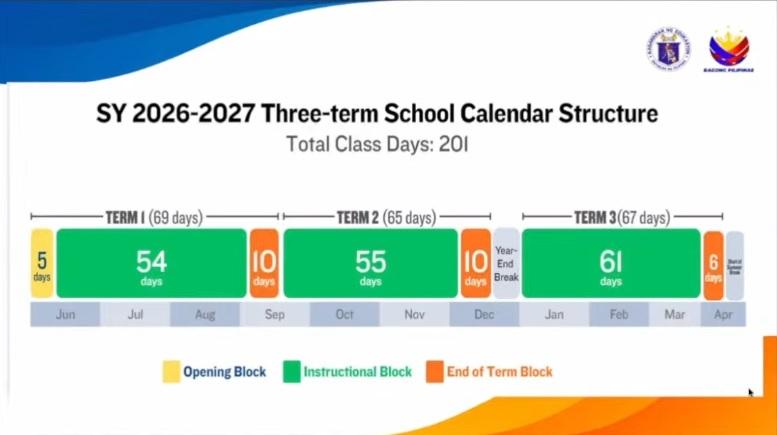
Under Republic Act 11480, schools are required to complete at least 180 class days per school year. The current calendar is set at 201 total class days to account for potential disruptions.
Committee chair Senator Bam Aquino noted that losing around 50 days from a 201-day calendar could leave schools with roughly 150 actual instructional days.
“So 201 days, for example, last school year, there were 201 days but we lost 54 days. So more or less 150 lang yung meron tayo [we only had 150],” Aquino said.
DepEd: Reform is structural, not reduction
DepEd emphasized that the proposed three-term calendar does not reduce total school days or alter curriculum standards.
Under the plan, the 201-day school year would be reorganized into three instructional terms instead of four grading periods. Each term would include:
- An opening block for diagnostic assessments and beginning-of-school-year activities;
- A dedicated instructional block focused solely on teaching and learning;
- An end-of-term block for grade computation, professional development, structured remediation, and designated celebrations.
- The proposal would reduce grading cycles from four to three, which DepEd said could lessen recurring reporting peaks that overlap with instructional weeks and contribute to teacher burnout.
“It’s not just the climate change issue,” Buenviaje told senators, noting that administrative tasks and overlapping grade computation periods also eat into teaching time.
The department said the reform is a structural reorganization intended to protect uninterrupted instructional blocks, not to shorten the school year.
Will it solve learning loss?
Despite the proposed restructuring, senators pressed DepEd on whether the shift would directly improve proficiency outcomes.
Aquino pointed to findings of the Second Congressional Commission on Education (EDCOM II), which showed proficiency declining sharply as students progress through grade levels — from 30.5% in Grade 3 to less than 1% by Grade 12.
“If the curriculum requires 180 days, I want to see 180 days,” Aquino said, suggesting contingency measures may be needed if disruptions continue.
He raised the possibility of extending classes when necessary to ensure students complete the required instructional time.
“Kung kailangan ng 180 na mga bata para matuto, di ba dapat 180 yung makuha nila?” Aquino asked.
(If students need 180 days to learn, shouldn’t they receive 180 days?)
Teachers: 180 days “non-negotiable,” but deeper issues persist
Teachers’ groups agreed that the 180-day benchmark remains essential.
“180 days talaga yung kailangan ng bata in a school year,” said Benjo Basas, chairperson of the Teachers Dignity Coalition.
(Students really need 180 days in a school year.)
However, Basas said calendar restructuring alone would not resolve longstanding structural problems, including low teacher salaries, lack of non-teaching personnel, inadequate facilities, and uneven school distribution.
He also cited instances where local government units declared extended suspensions without coordination with DepEd.
“May isa tayong LGU na nag-declare ng two weeks na suspension ng klase,” he said.
(We had an LGU that declared a two-week class suspension.)
Students cite confusion, consultation gaps
Student leaders likewise raised concerns about consultation.
Matthew Christian Silverio of the Student Council Alliance of the Philippines said senior high school student governments were not directly consulted prior to the proposal’s public announcement.
“The mere fact na nagtanong po sa amin ang [we were asked about it by the] National Federation of Supreme Secondary Learner Government raises a question,” Silverio said.
He also warned that extending classes into hotter months could pose health risks in schools lacking climate-resilient infrastructure.
Several stakeholders, including teachers and student representatives, said they first learned about the proposed shift through media reports, prompting calls for broader consultation before any full rollout.
DepEd to continue consultations
The education department said regional consultations and a national survey are underway, and that the proposed implementation for School Year 2026–2027 remains subject to the outcome of those engagements.
“Kung ano po ang kalalabasan ng konsultasyon, we will have the decision,” he said.
(Whatever the outcome of the consultations, we will make the decision.)
As lawmakers continue to examine both the academic calendar proposal and the country’s literacy crisis, the central question remains whether reorganizing the school year can protect learning time—or whether deeper structural reforms are needed to reverse declining proficiency levels. — BM, GMA Integrated News

