ADVERTISEMENT
LIVE
Filtered By: Topstories
News

LIVE UPDATES: Conflict in the Middle East (April 19, 2026)


+
Add GMA on Google
Make this your preferred source to get more updates from this publisher on Google.
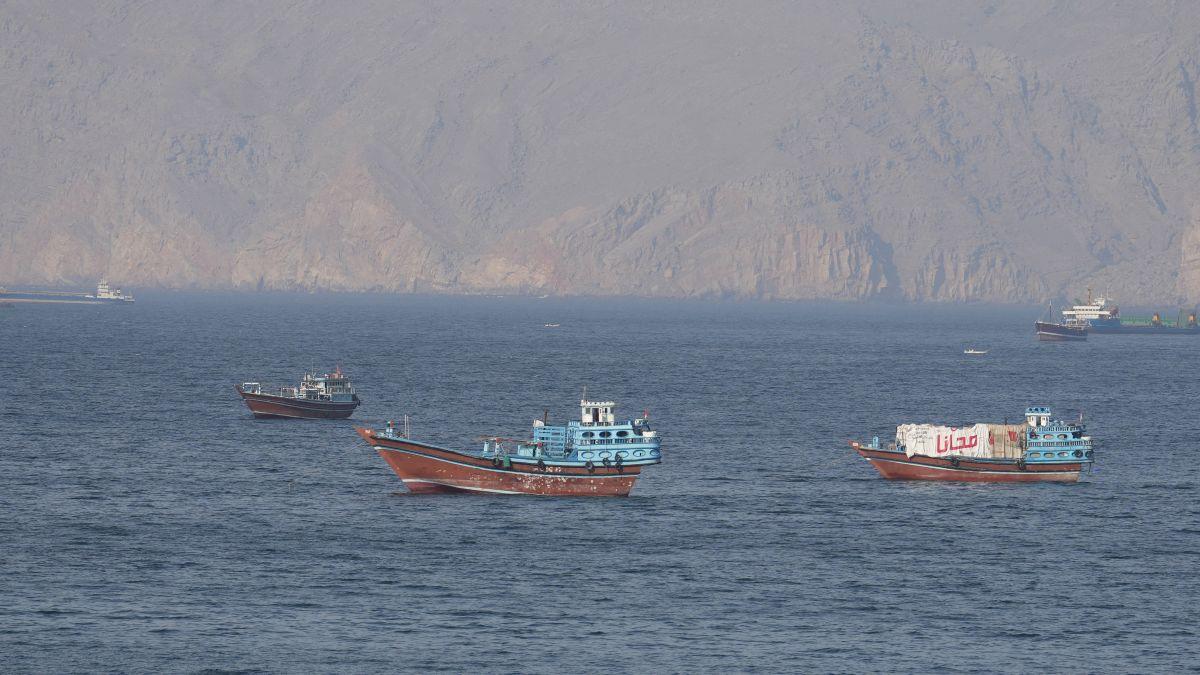
Ships and tankers in the Strait of Hormuz off the coast of Musandam, Oman
Auto-refresh

Iran rebuffs Trump announcement of new peace talks

Iran rejected new peace talks with the United States, its state news agency reported on Sunday, hours after US President Donald Trump said he was sending envoys for talks in Pakistan and would launch new strikes on Iran unless it accepts his terms.

Trump posted on Truth Social that his envoys would arrive in Pakistan on Monday evening for negotiations, a timetable that would leave only a day for talks to make progress before a two-week ceasefire ends.

Iran's official IRNA news agency cited no specific source in its report that Iran had rejected the talks.

Trump accuses Iran of ‘total violation’ of ceasefire, threatens new attacks

US President Donald Trump accused Iran on Sunday of a "total violation" of the two countries' ceasefire for firing on ships near the Strait of Hormuz, and renewed a threat to wipe out Iran's bridges and power plants unless it accepted his terms.

"We’re offering a very fair and reasonable DEAL, and I hope they take it because, if they don’t, the United States is going to knock out every single Power Plant, and every single Bridge, in Iran," he posted on social media. "NO MORE MR. NICE GUY!"

Iran says final deal still far off as Hormuz Strait shuttered

TEHRAN, Iran - The strategic Strait of Hormuz was again closed on Sunday in the stand-off between Iran and the United States, with Iran's powerful parliament speaker signaling a final peace deal remained "far" off despite some movement in negotiations.

As mediation efforts continued following high-level talks in Pakistan that failed to reach a deal, Iran said it will not allow the crucial maritime trade chokepoint to re-open until the United States ends a blockade of Iranian ports.

Mohammad Bagher Ghalibaf, speaker of the Iranian parliament, said in a televised address on Saturday night that there had been "progress" with Washington "but there are many gaps and some fundamental points remain".

"We are still far from the final discussion," said Ghalibaf, one of Tehran's negotiators in the talks aimed at ending the war launched by Israel and the United States against the Islamic republic.

A two-week ceasefire is set to end on Wednesday unless it is renewed.

US President Donald Trump said "very good conversations" were going on with Iran but warned Tehran against trying to "blackmail" the United States.

On Friday, Tehran had declared the Strait of Hormuz, through which a fifth of the world's oil and liquefied natural gas usually transits, open after a temporary ceasefire was agreed to halt Israel's war with Iran's ally Hezbollah in Lebanon.

That prompted elation in global markets and sent oil prices plunging, but Tehran reversed course after Trump insisted the US blockade of Iranian ports would continue until a final deal was struck.

"If America does not lift the blockade, traffic in the Strait of Hormuz will definitely be limited," Ghalibaf said.

Iran's supreme leader Mojtaba Khamenei, who has yet to be seen since taking power after his father was killed in the war's opening strikes, said in a written message that Iran's navy "stands ready" to defeat the United States.

Trump accused Iran of getting "a little cute" with its recent moves and warned Tehran not to try to "blackmail" Washington by flip-flopping on the strait.

"We have very good conversations going on," the president told reporters at the White House, adding that the United States was "taking a tough stand".

'Targeted'

Iran's Revolutionary Guards warned that any attempt to pass through the strait without permission "will be considered cooperation with the enemy, and the offending vessel will be targeted".

A handful of oil and gas tankers crossed the strait early on Saturday during the brief reopening, tracking data showed, but others retreated and hardly any vessels were crossing the waterway by the late afternoon.

A UK maritime security agency said the Revolutionary Guards fired at one tanker, while security intelligence firm Vanguard Tech reported the force had threatened to "destroy" an empty cruise ship that was fleeing the Gulf.

In a third incident, the UK agency said it received a report of a vessel "being hit by an unknown projectile, which caused damage" to shipping containers but no fire.

The Indian foreign ministry said it had summoned the Iranian ambassador to lodge a protest over a "shooting incident" involving two Indian-flagged ships in the strait.

French UN peacekeeper killed

On the diplomatic front, Egypt, which has been involved in mediation efforts with Pakistan, appeared optimistic on Saturday with Foreign Minister Badr Abdelatty saying Cairo and Islamabad hoped to secure a final agreement "in the coming days".

A major sticking point has been Iran's stockpile of near-weapons-grade enriched uranium.

Trump said Friday that Iran had agreed to hand over its roughly 440 kilograms of enriched uranium. "We're going to get it by going in with Iran, with lots of excavators," he said.

Iran's foreign ministry has said the stockpile, thought to be buried deep under rubble from US bombing in last June's 12-day war, was "not going to be transferred anywhere" and surrendering it "to the US has never been raised in negotiations".

The Middle East war began on February 28 with a massive wave of US-Israeli attacks on Iran, despite Washington and Tehran being engaged in negotiations at the time.

The conflict rapidly spread across the region, with Iran targeting neighboring Gulf countries that are home to US military bases, and Iran-backed Hezbollah dragging Lebanon into the war by launching rockets at Israel.

A French soldier was killed and three others wounded in an ambush on Saturday on UN peacekeepers in Lebanon that France's president blamed on Hezbollah, an accusation the group denied.

Israel's military reported that two of its soldiers had also been killed in combat in southern Lebanon since the start of a 10-day truce on Friday between Israel and Lebanon. —Agence France-Presse

Motorcycle taxi and delivery service riders in long lines for ayuda in Caloocan, QC

As early as Sunday morning, long lines of transport network company riders (TNC) hoping to receive cash aid distribution from government payout centers were observed in Quezon City and Caloocan City. 

Motorcycle taxi rider dies while in line for cash aid at Quezon Memorial Circle

A motorcycle taxi rider died while in line to get cash relief assistance at Quezon Memorial Circle on Saturday.

Department of Social Welfare and Development Secretary Rex Gatchalian immediately ordered DSWD personnel to contact the family, DSWD spokesperson Assistant Secretary Irene Dumlao said, according to a report by Sam Nielsen on Super Radyo dzBB on Sunday.

"We’ve heard of the unfortunate at nakakalungkot na (and saddening) incident yesterday and Sec Rex immediately instructed a team to reach out to the family," Dumlao told reporters.

"Nakausap na namin ang anak at tutulungan namin sila magkaroon ng maayos na pagpapalibing sa tatay nila. All other assistance will be extended," she added.

(We were able to talk to the child and we gave assurance that the DSWD would help so they can give their father a decent burial.)

Gatchalian also ordered that the family of the motorcycle taxi rider be fetched from the province and brought to Metro Manila.

He then met the family personally at the hospital on Sunday morning and assured them of the DSWD's help.

The DSWD extended assistance for the hospital expenses, funeral and burial arrangements, transportation for family members, and the continuing education of the rider's daughter.

Motorcycle taxi and delivery riders lined up at Quezon Memorial Circle on Saturday for the special payout of the DSWD of their P5,000 cash relief assistance given by the government amid the rising cost of fuel due to the US-Israel war against Iran.

Contributed video posted by GMA News on Facebook showed numerous riders in line at the perimeter of the QC Circle, some of whom were holding cartons over their heads to block the strong daylight.

The DSWD has encouraged drivers and riders to personally appear to claim their cash assistance, adding that it plans to eventually transition to a digital distribution system. —with reports from Bea Pinlac and Mav Gonzales/KG, GMA News

Fuel hike hits sardines; DTI studies price adjustments

Surging fuel prices are putting pressure on sardine manufacturers, prompting the government to hold ongoing talks with industry players on possible price adjustments.

According to Katrina Son's report on "24 Oras Weekend," the Department of Trade and Industry (DTI) has reportedly been meeting with sardine manufacturers since March to assess the impact of rising oil prices on production costs, amid concerns these could soon affect retail prices of one of the country’s most affordable food staples.

Current suggested retail prices (SRP) of canned sardines range from P15 to P21 per can, depending on the brand, according to the DTI.

For many consumers, sardines remain a daily staple due to their affordability.

“Napupurga na nga kami sa sardinas,” consumer Aida Williams said.

(We’re already fed up with eating sardines.)

For electrician Ronaldo Mendoza, sardines are the most practical option for households on tight budgets.

“’Yun ang pinakamura para sa mga taong medyo kapos,” he said.

(It’s the cheapest option for people who are struggling financially.)

While consumers depend on sardines for low-cost meals, manufacturers say rising fuel costs are making it harder to keep prices steady.

Francisco Buencamino, executive director of the Canned Sardines Association of the Philippines, said fuel—particularly diesel—is a major cost driver, especially in fishing operations.

“Number one, kailangan mo ng fuel—diesel fuel o krudo para mahuli ‘yung isda,” he said.

(First, you need fuel—diesel or crude—to catch the fish.)

Buencamino said higher fuel prices increase the cost of catching fish, which in turn raises production expenses for sardine makers.

Industry players also noted that sardine prices have remained unchanged for several years despite rising costs.

“Three or four years na nakapako ang SRP ng sardinas,” Buencamino said.

(The SRP of sardines has been fixed for three or four years.)

“Ang malaking problema namin noon, paulit-ulit kaming humihingi ng price adjustment,” he added.

(Our main problem has been that we’ve repeatedly requested price adjustments.)

Despite mounting pressure, the DTI said it has yet to decide whether a price increase is warranted.

“We cannot speculate at this time. Weekly po kami nagmi-meeting. Next week, we will meet again and then inform the public kung ano ang napag-usapan,” said DTI Secretary Cristina Roque.

(We cannot speculate at this time. We meet weekly. Next week, we will meet again and then inform the public of what was discussed.)

The agency earlier announced that sardines are among the basic commodities covered by a price freeze until May 10.

The DTI said it will continue to monitor the prices of essential goods as fuel costs remain elevated, with both consumers and manufacturers closely watching for any possible changes in sardine prices. —MCG, GMA News

EXPLAINER: Proposed VAT cut—who stands to benefit?

A new proposal in the Senate seeks to lower the value-added tax (VAT) as rising fuel costs continue to push up prices of basic goods and services.

On April 16, Senator Bam Aquino filed Senate Bill No. 2047, which proposes reducing VAT from 12% to 10%, in a bid to ease the burden on consumers, particularly the middle class.

Aquino said middle-income households are increasingly feeling the impact of inflation but are not directly receiving government assistance.

Who belongs to the middle class?

According to a GMA News Feed explainer, middle-income families are those earning between P27,746 and P166,476 per month—about two to six times higher than the P13,873 poverty threshold, citing data from the Philippine Institute for Development Studies (PIDS).

PIDS classifies the sector into three groups:

  •     Lower middle class (P27,746–P55,492);
  •     Middle middle class (P55,492–P97,111); and
  •     Higher middle class (P97,111–P166,476).

Global tax policy expert Mon Abrea said the middle class can also be considered the working class, as most are salaried employees whose taxes are automatically withheld.

“The middle class, most of us, the hardworking citizens, we have no choice because our taxes are withheld at source,” Abrea said, noting that 80% to 82% of Bureau of Internal Revenue (BIR) personal income tax collections come from withholding taxes on compensation.

What is VAT?

VAT, or value-added tax, is a consumption tax imposed on goods and services. It applies to transactions such as purchasing, renting, exchanging, and importing.

At present, the Philippines imposes a uniform VAT rate of 12%.

Under the National Internal Revenue Code, VAT covers most goods and services, including groceries, imported products, vehicles, real estate, and digital services such as streaming platforms and online shopping.

Some items are exempt, including educational materials, unprocessed agricultural and marine products, medical and educational services, and select transactions involving senior citizens and persons with disabilities.

The tax is ultimately paid by consumers, collected by businesses, and remitted to the government.

Efficiency concerns

The Bureau of Internal Revenue (BIR) reported that in 2024, VAT accounted for 22.58% of total tax collections, or more than P643 billion.

A 2022 study by the Congressional Policy and Budget Research Department of the House of Representatives also showed the Philippines has the highest VAT rate in Southeast Asia, ahead of Indonesia (11%), Cambodia (10%), and Vietnam (8%).

However, Abrea said collection efficiency remains a concern due to leakages from tax evasion, smuggling, and administrative inefficiencies.

“While we are imposing a 12% rate, the government is only collecting half of that. The rest goes to leakages—tax evasion, smuggling, and inefficiency in tax administration,” he said.

Abrea estimated that reducing VAT could result in revenue losses of up to P339 billion, raising concerns over government funding.

Still, proponents say the measure could ease prices of goods and services, translating to about a 2% reduction in costs.

For example, a P100 item currently costs P112 with VAT. A reduction to 10% would bring the price down to P110.

Despite potential relief, Abrea warned that VAT reductions may disproportionately benefit higher-income households.

“Any reduction in VAT will benefit higher-income households more because it is a consumption tax—the more you spend, the more you benefit,” he said.

He added that linking VAT cuts solely to middle-class relief may be misleading, as wealthier consumers typically spend more and gain greater savings.

Alternative proposals

Instead, Abrea said policymakers should focus on increasing take-home pay through higher income tax exemptions and lower withholding taxes.

He proposed raising income tax exemptions from P250,000 to as high as P1 million over time, alongside immediate cuts in withholding taxes.

He also suggested short-term relief through interest-free loans from government institutions such as the Government Service Insurance System (GSIS), Social Security System (SSS), and the Home Development Mutual Fund or Pag-IBIG Fund. This is achieved by allowing borrowers to access cash without additional interest charges and helping ease financial pressure during the crisis.

“I don’t think the middle class is asking for money from the government. They need relief from the burden being passed on to them,” he said.

If VAT reduction is pursued, Abrea said the government must strengthen safeguards against abuse of tax exemptions.

He called for rationalizing the long list of VAT exemptions, which he said are vulnerable to abuse and weak monitoring.

He also pushed for the full implementation of electronic invoicing systems to reduce smuggling, underreporting, and unrecorded transactions, particularly in e-commerce and online trade.—MCG, GMA News


North Korea fires ballistic missiles again, flexing muscle amid Iran war

SEOUL - North Korea fired ballistic missiles into the sea on Sunday, accelerating its missile launches amid Iran war tensions and talk of possible meetings with the US and South Korea.

Pyongyang's intense missile activity - this was the fourth such launch this month and the seventh of the year - is meant to display its self-defense capabilities while gaining international leverage, some experts said.

"The missile launches may be a way of showing that - unlike Iran - we have self-defense capabilities," said South Korean former presidential security adviser Kim Ki-jung.

"The North also appears to be exerting pressure preemptively and make a show of force before engaging in dialogue with the United States and South Korea," he said.

Iran war, Trump visit loom over launches

The seven-week-old US-Israeli war against Iran, which has as one aim the curbing of Tehran's nuclear program, could reinforce Pyongyang's nuclear ambitions, experts and former South Korean officials say.

US President Donald Trump, preparing for a summit in China next month, and South Korean President Lee Jae Myung have repeatedly expressed interest in holding talks with North Korean leader Kim Jong Un. There are no publicly known plans for any meetings.

Lee recently conveyed regret to the North for ?drone incursions from the South, receiving rare praise from Pyongyang.

Sunday's missiles were fired from near the city of Sinpo on North Korea's east coast toward the sea around 6:10 a.m. (2110 GMT on Saturday) and flew about 140 km (90 miles), South Korea's military said in a statement.

Japan's government posted on social media that the missiles were believed to have fallen near the east coast of the Korean Peninsula, and no incursion into Japan’s exclusive economic zone had been confirmed.

South Korea's ?presidential Blue House convened an emergency security meeting, calling the launches a provocation that violated UN Security ?Council resolutions, according to media reports. It urged Pyongyang to "stop the provocative acts".

It was not clear what kind of ballistic missiles were fired, but Sinpo has submarines and equipment for test-firing submarine-launched ballistic missiles. The North last fired a ballistic missile from a submarine in May 2022, and it flew as far as 600 km (370 miles).

North Korea has made "very ?serious" advances in its ability to turn out nuclear weapons, with the probable addition of a new uranium enrichment facility, International Atomic Energy Agency chief Rafael Grossi said on Wednesday.

In late March, North Korean leader Kim said Pyongyang's status as a nuclear-armed state was irreversible and expanding a "self-defensive nuclear deterrent" was essential to national security. —Reuters

Trump, Iran cite progress in talks as uncertainty hangs over Strait of Hormuz

WASHINGTON/ISLAMABAD - Iran's top negotiator said recent talks with the US had made progress but gaps remained over nuclear issues and the Strait of Hormuz, while President Donald Trump cited "very good conversations" with Tehran despite warning against "blackmail" over the key shipping channel.

Neither side offered any specifics about the state of negotiations on Saturday, days before a fragile ceasefire in the US-Israeli war against Iran is set to expire.

The war, now in its eighth week, has killed thousands, spread to Israeli attacks in Lebanon and sent oil prices surging because of the de facto closure of the strait, which before the war carried one-fifth of the world's oil shipments.

Iran's reversal on vital strait

"We have had progress but there is still a big distance between us," Iran's chief negotiator, Mohammad Baqer Qalibaf, told state media, referring to talks last weekend. "There are some issues on which we insist ... They also have red lines. But these issues could be just one or two."

Trump said the US was having "very good conversations" but gave no other details.

Tehran reversed course on Saturday to reassert control over the strait, again closing the energy choke point and adding fresh uncertainty to the war, which the US and Israel launched on February 28.

Iran said it was responding to a continued US blockade of Iranian ports, calling it a violation of the ceasefire, while Supreme Leader Ayatollah Mojtaba Khamenei said Iran's navy was ready to inflict "new bitter defeats" on its enemies. Trump called the move "blackmail" even as he praised the talks.

On Friday, Iran had announced the temporary reopening of the Strait of Hormuz following a separate US-brokered 10-day ceasefire agreement on Thursday between Israel and Lebanon.

Trump defended the US blockade and threatened "to start dropping bombs again" unless the countries reached a long-term deal before the ceasefire expires on Wednesday.

Iran's Supreme National Security Council said Tehran's control over the strait included demanding the payment of costs related to security, safety and environmental protection services, state media said.

Vessels report gunfire

Concern remained after at least two vessels reported being attacked on Saturday while trying to transit the waterway. India summoned the Iranian ambassador in New Delhi and expressed deep concern that two Indian-flagged ships had come under fire in the strait, the government said.

US Central Command said American forces were enforcing a maritime blockade of Iran but did not comment on the latest Iranian actions.

Tehran's reversal raised the risk that oil and gas shipments through the strait could remain disrupted just as Trump weighs whether to extend the ceasefire.

When American and Iranian negotiators met last weekend in Islamabad, the US proposed a 20-year suspension of all Iranian nuclear activity, while Iran suggested a halt of three to five years, according to people familiar with the proposals.

Iran's deputy foreign minister, Saeed Khatibzadeh, said no date had been set for the next round of negotiations, adding that a framework of understanding must be agreed first.

Trump had said on Friday there could be talks this weekend and that the two sides were "very close to making a deal."

There were no signs on Saturday of preparations for new talks in the Pakistani capital, where the highest-level US-Iran negotiations since the 1979 Islamic Revolution ended without agreement last weekend.

Senior national security aides gathered at the White House on Saturday morning. Trump later went to the Trump National Golf Club with top envoy Steve Witkoff, one of his Iran negotiators.

Pressure for a way out of the war has mounted as Trump’s fellow Republicans defend narrow majorities in Congress in the November midterm elections with US gasoline prices high, inflation rising and his own approval ratings down.

Oil prices CLc1, LCOc1 fell about 10% and global stocks jumped on Friday on the prospect of marine traffic resuming through the strait. But hundreds of vessels and about 20,000 seafarers remain stranded in the Gulf awaiting passage through the waterway, shipping sources said. —Reuters

India flags 'deep concerns' over attack on two Indian ships in Strait of Hormuz

MUMBAI - India said it had called in the Iranian envoy to New Delhi and flagged its "deep concern" over the attack on two Indian-flagged ships attempting to cross the Strait of Hormuz on Saturday.

One of the vessels attacked was identified as the Sanmar Herald, an Indian government source said.

The crew on board and the vessel were safe, the source said.

India's top foreign ministry official asked the Iranian ambassador to convey India's view to Iranian authorities and resume at the earliest the process of facilitating India-bound ships across the Strait, a statement from the ministry said.

The ambassador said he would convey these views to Iranian authorities, the statement said. — Reuters