

 GMA Brandtalk
 Tracking
 Archives

OWWA opens 10,000 more slots in scholarship program for OFW kids
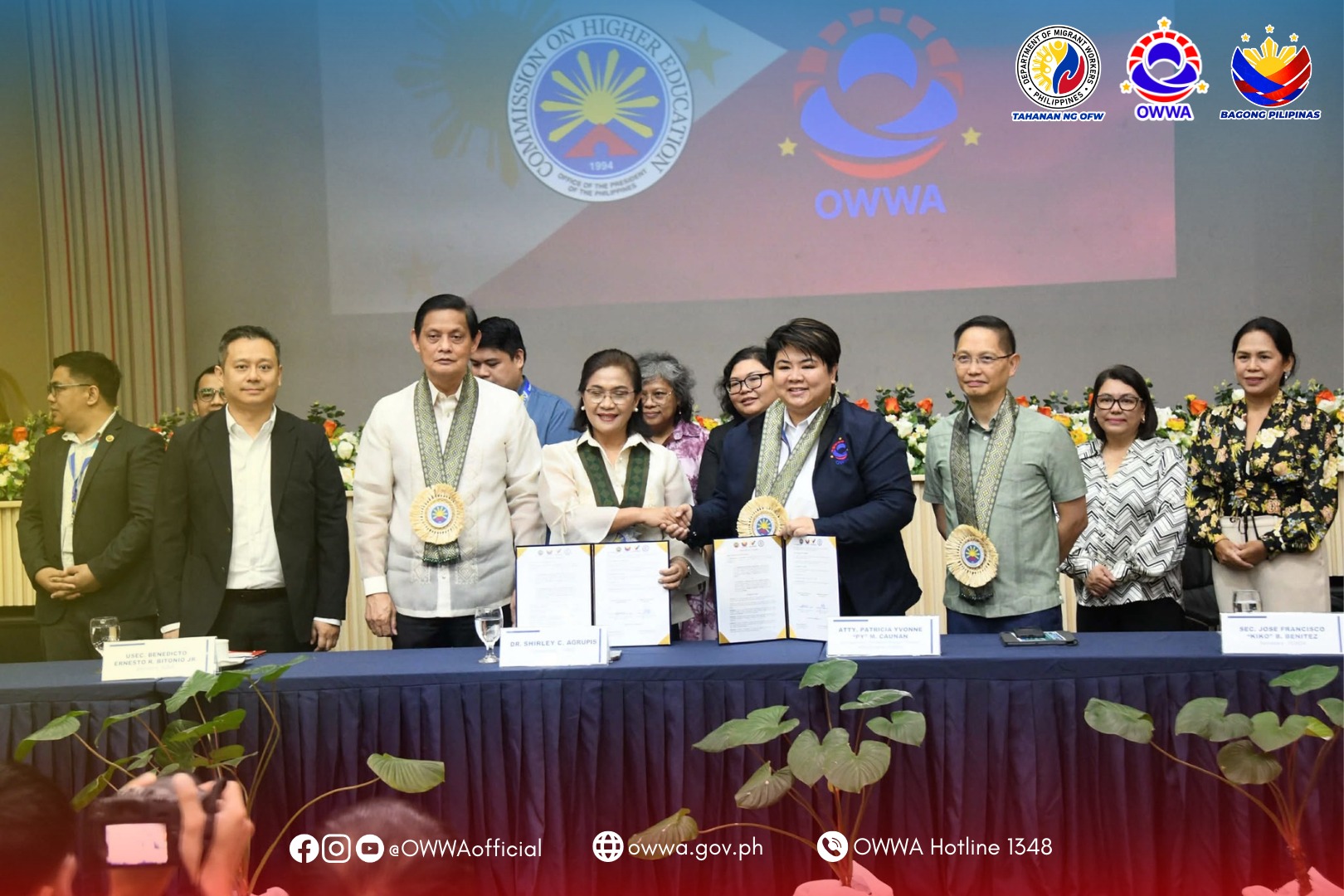
The Overseas Workers Welfare Administration (OWWA) on Wednesday announced that it will open 10,000 additional slots in its scholarship program for the children of Overseas Filipino Workers (OFWs), after it signed an agreement with the Commission on Higher Education (CHED).
“At dahil nakamit ng OWWA ang pinakamataas na pondo sa loob ng 44 years na, kasi after Labor Day, ay OWWA anniversary naman sa May, ay nagdesisyon po ang OWWA leadership na magdagdag ng 10,000 slots,” OWWA Administrator Patricia Yvonne Caunan said.
(And because OWWA has achieved its highest funding in 44 years, and with its anniversary coming up in May after Labor Day, the OWWA leadership decided to add 10,000 slots.)
“So from 15,000 this year, for the first time, 25,000 na ang matutulungan ng OWWA pagdating po sa anak ng OFWs,” she added.
(From 15,000 this year, for the first time, OWWA will be able to help 25,000 children of OFWs.)
According to its website, OWWA offers three scholarship programs: Education for Development Scholarship Program (EDSP), OWF Dependent Scholarship Program (ODSP), and the Congressional Migrant Workers Scholarship Program (CMWSP).
The EDSP is a scholarship grant for qualified dependents of OFWs, providing up to P60,000 per school year for a 4-5 year bachelor’s degree.
ODSP provides P20,000 financial assistance per school year to qualified dependents of OFWs who are enrolling, currently enrolled, or have been enrolled in a 4-5 year bachelor’s degree or an associate course at a Philippine college or university.
Meanwhile, the CMWSPA scholarship program supports qualified OFWs and their immediate dependents who intend to pursue courses in priority fields of science and technology.
Caunan made the statement during the signing of the Memorandum of Agreement on the Lifelong Learning Education Assistance Program for Overseas Filipino Workers (LEAP OFWs) with CHED in Quezon City.
Strengthen OFW reintegration
Caunan said LEAP-OFWs aims to provide academic degrees to OFWs without requiring them to go through the traditional classroom system, to strengthen reintegration, and to ensure that returning OFWs have access to meaningful opportunities.
“We are also strengthening coordination across institutions. This partnership between OWWA and CHED ensures that our OFWs receive not only scholarships or financial assistance but also guidance, monitoring, and support throughout their learning journey,” Caunan said.
In a social media post, OWWA said under LEAP-OFWs, OFWs may enroll in the Expanded Tertiary Education Equivalency and Accreditation Program, where their work experience can be credited as a way to complete a college degree.
OFWs may also receive financial assistance for their studies and access flexible learning options suited to their schedule and experience.
Labor education in tertiary curriculum
In the same event, CHED led the ceremonial signing of the Implementing Rules and Regulations of RA 11551, or An Act Integrating Labor Education in the Tertiary Education Curriculum, with the Department of Labor and Employment (DOLE) and Technical Education and Skills Development Authority (TESDA).
The law mandates the State to establish a mechanism to educate future workers, employers, and entrepreneurs about their rights and responsibilities in promoting workplace harmony and social progress in society.
“Sa ganito hong paraan, sinisigurado po natin na lahat po ng ating taumbayan, lahat po ng ating mamamayan ay malinaw po sa kanila ang kanilang karapatan, ang mga batas po para sa manggagawa na nasa Pilipinas,” TESDA Secretary Jose Francisco “Kiko” Benitez said.
(In this way, we ensure that all our people clearly understand their rights, as well as the laws that protect workers in the Philippines.)
“It also, perhaps most importantly, alleviates the pressure for us to constantly monitor. The more we can embed awareness and knowledge of the standards and the rights and privileges, as well as the obligations of the workers, the further we can go in ensuring industrial peace and good circumstances for our Filipino workers,” he added.
DOLE Undersecretary Benedicto Bitonio Jr, meanwhile, said the IRR allows education institutions flexibility on how labor education can be delivered.
“Students will go through key areas such as labor standards, labor relations, basic workplace practices, and an understanding of government programs and services. These are not abstract ideas. These are the things young workers will encounter early on, often in their very first job,” Bitonio said. —Mariel Celine Serquiña/RF, GMA News

