

 GMA Brandtalk
 Tracking
 Archives

Malacañang: ICC arrest warrant vs Bato dela Rosa 'valid'
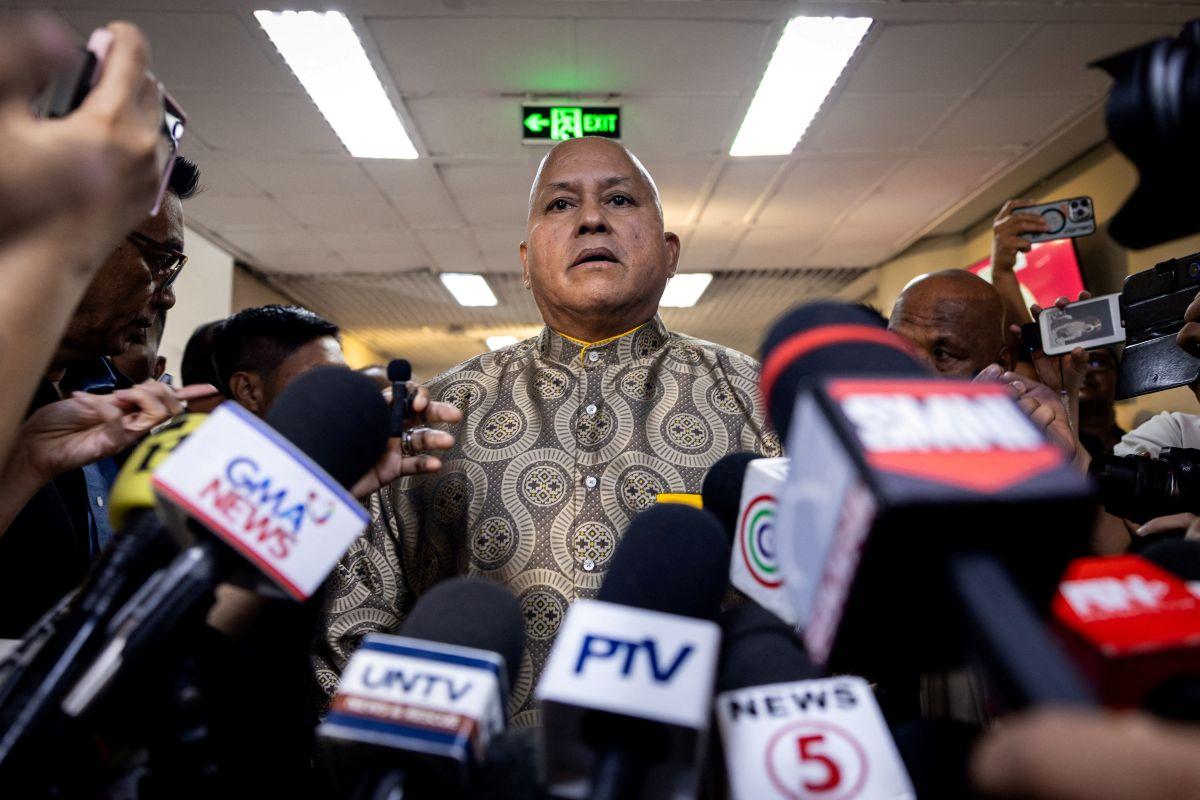
Palace Press Officer Usec. Claire Castro says the warrant of arrest issued by the International Criminal Court vs Senator Ronald “Bato” dela Rosa is “valid.” This, after the Supreme Court denied the senator’s TRO. @gmanewsbreaking @gmanews pic.twitter.com/NKkBFpAUG8
— Giselle Ombay (@giselleombay_) May 20, 2026
Malacañang said Wednesday the warrant of arrest issued by the International Criminal Court (ICC) against Senator Ronald “Bato” dela Rosa is “valid,” after the Supreme Court denied the lawmaker’s request for a temporary restraining order.
“Sa ngayon, masasabi po natin na ang warrant of arrest ay valid laban dito kay Senator Bato dela Rosa,” Palace Press Officer Usec. Claire Castro said in a short interview with Palace reporters.
(For now, what we can say is that the arrest warrant against Senator Bato dela Rosa is valid.)
She said all operational matters will now be left to the discretion of the Department of Justice (DOJ).
“Ang lahat ng maaaring interpretasyon at evaluation sa nasabing resolution ng Supreme Court ay ibabato natin kay [Justice] Secretary Fredderick Vida,” she added.
(We will leave all possible interpretations and evaluations of the said Supreme Court resolution to Justice Secretary Fredderick Vida.)
The SC said the En Banc, voting 9-5-1 during a special session, denied Dela Rosa’s prayer for interim relief.
In his manifestations before the High Court, Dela Rosa sought a TRO and/or status quo ante order to prevent several government agencies from arresting him based on any warrant issued by the ICC, any Interpol red notice or diffusion, or any foreign judicial or quasi-judicial instrument without a corresponding Philippine judicial warrant.
Asked if Dela Rosa can now be considered as a fugitive, the Palace official said, “‘Yan din po ang pananaw ng OSG (Office of the Solicitor General)—na siya po ay kinukonsidera na fugitive.”
(That is also the view of the OSG--that he is considered a fugitive.)
The Supreme Court clarified that it only resolved the requests for interim relief, particularly the TRO and SQAO, and has yet to rule on the main legal issues raised by the parties in the case.
Constitutional question
For Dela Rosa's lawyers, the constitutional question on whether a Filipino may be held under a "foreign process" without the intervention of a Philippine court remained even after the Supreme Court denied the senator's prayer for a TRO.
They said they would file a motion for reconsideration.
“We respect the Honorable Court’s action on the application for interim relief. At the same time, it must be emphasized, with equal clarity, that the Supreme Court itself has stated that it acted only on the prayers for provisional relief,” said The Law Firm of Torreon and Partners, which represents the senator, in a statement.
“The main case remains alive. The constitutional questions remain squarely before the Supreme Court–and those questions are grave: whether the liberty of a Filipino may be placed at the mercy of a foreign process without the intervention of a Philippine court," it added.
"[Whether] Philippine authorities may enforce or facilitate international criminal processes after the Philippines’ withdrawal from the Rome Statute; and whether the Constitution remains the supreme and controlling law within the Philippine territory,” the firm added.
Dela Rosa’s lawyers also said that his case is not just “merely personal” to him, but also “concerns the right of every Filipino to be protected by Philippine law, by Philippine courts, and by the guarantees of due process, liberty, and sovereignty enshrined in the Constitution.”
The National Bureau of Investigation (NBI) said it would study the Supreme Court's full resolution before determining its next course of action.
“We will not issue a warrant. As I said, we need to study and read the complete resolution first so that we will be able to plot all of our courses of action later on,” Mallari told reporters on Wednesday.
'No legal impediment'A lawyer for the victims in the war on drugs called on the Philippine government to fulfill its legal obligations and immediately execute the arrest warrant issued by the ICC following the SC resolution.
“With the Supreme Court’s May 20 denial of dela Rosa’s prayer for a TRO and/or status quo ante order, it means that there is no legal impediment for the Executive to implement the ICC arrest warrant against dela Rosa in accordance with Republic Act No. 9851,” Atty. Gilbert Andres said.
He said the arrest and surrender of Dela Rosa to the ICC would be “fully consistent with both Philippine law and the Philippines’ international legal obligations.”
“In Pangilinan v. Cayetano, the Supreme Court expressly recognized that the ICC retains jurisdiction over crimes allegedly committed while the Philippines was still a State Party to the Rome Statute notwithstanding the country’s later withdrawal,” Andres said.
“The Supreme Court emphasized that obligations and proceedings arising prior to withdrawal survive pursuant to Article 127 of the Rome Statute. The legal foundation for cooperation with the ICC therefore remains intact,” he added.
Andres said Republic Act No. 9851 or the “Philippine Act on Crimes Against International Humanitarian Law, Genocide, and Other Crimes Against Humanity” expressly recognizes crimes against humanity as a crime under Philippine law and provides Philippine authorities with the legal authority to surrender a suspect in the Philippines to the appropriate international court, which necessarily includes the ICC.
“Even the Supreme Court recognized in Pangilinan v. Cayetano that Congress passed RA 9851 which “safeguards a broader scope of rights, regardless of whether the Philippines formally joins the International Criminal Court through accession to the Rome Statute,” Andres said. —with Sherylin Untalan/RSJ/NB, GMA News

