

 GMA Brandtalk
 Tracking
 Archives

Food insecurity down 32.6% in 2025 but 3 of 10 Pinoys food insecure — DOST-FNRI
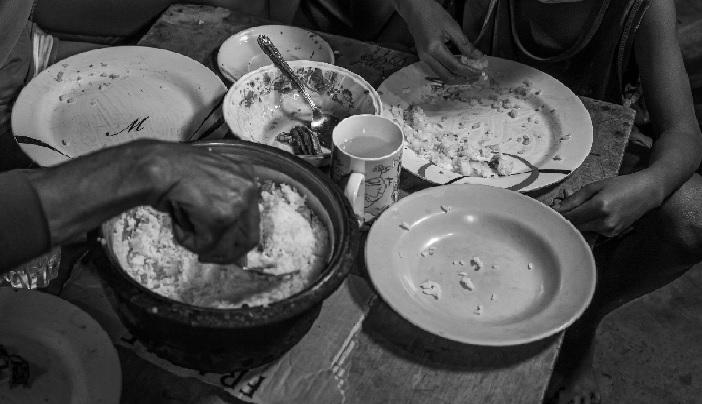
Food insecurity in the country decreased from 2023 to 2025 but three out of 10 Filipinos still experience moderate-to-severe food insecurity, or not having reliable access to enough safe and healthy food, according to a Department of Science and Technology - Food and Nutrition Research (DOST-NRFI) Institute study.
This is equivalent to 32.6%, based on DOST-FNRI 2025 Updating of the Nutritional Status of Filipino Children and Other Population Groups (2025 Updating Survey), which was presented during the 2026 National Nutrition Summit in Pasay City on Wednesday.
The study showed that food insecurity slightly decreased from 33% in 2023 to 32.6% in 2025.
Meanwhile, the Bangsamoro Autonomous Region in Muslim Mindanao (BARMM) has the highest prevalence of moderate to severe food insecurity at 60.4%, followed by SOCCSKSARGEN and Eastern Visayas Region at 44.0% and 43.8%, respectively.
Food insecurity is also prevalent among living in over five-member households, rural residents, and poorest households.
The survey revealed that 2.9% of Filipinos experience severe food insecurity.
According to DOST-FNRI, moderate food insecurity involves limited access to food and occasional skipped meals, while severe food insecurity involves going without food for a day or more.
Meanwhile, people who are food secure or mildly food insecure have little to no difficulty accessing safe and nutritious food.
The survey further showed that food purchase through credit and loan are the top coping strategies on food insecurity.
For food coping strategies, 64.9% households purchase food on credit, followed by producing or gathering their own food (59%), borrowing food from relatives or friends (56.5%), gathering food from surroundings (46.4%), and asking for food from relatives or friends (43.1%).
For non-food coping strategies, borrowing money from relatives was the most common (68.6%), followed by taking on side jobs (64.0%), borrowing from friends (48.3%), asking relatives or friends for money (39.2%), and migrating in search of work (27.1%).
Food coping strategies are actions people take when food is scarce or unaffordable, including changes in eating habits and non-food measures such as generating income or reducing expenses to meet basic needs, according to the Unites Stated National Institutes of Health.
Food security is measured in six interconnected dimensions: Availability, access, utilization, stability, agency, and sustainability.
DOST-FNRI explained that if one or more of these dimensions are inadequately supported, individuals or households become vulnerable to food security.
Addressing poverty
For DOST Secretary Renato Solidum Jr., ensuring food security also means addressing poverty in the country.
"I think beyond feeding, yung livelihood talaga ang kailangan nating palaguin (we need to strengthen their livelihoods," Solidum said in a press conference.
Mildred Guirindola, DOST-FNRI chief science research specialist and career scientist, said 50% of food insecurity is found in urban areas.
"Hindi lang naman sa pagkain, siguro yung services and health, tamang nutrition, ano ba yung tamang pagkain na pwede namang magtanim na masustansyang pagkain and still will be food secure," Guirindola said.
(It’s not just about food, but also about services and health, proper nutrition, and knowing what healthy foods can be grown to ensure access to nutritious food while maintaining food security.)
Conducted every two to three years, the Updating Survey serves as an interim monitoring mechanism to track progress, identify emerging concerns, and assess whether the country remains on course toward achieving its nutrition and health targets. —RF, GMA News

