

 GMA Brandtalk
 Tracking
 Archives

Marcos submits ₱7.2-T proposed 2027 national budget to Congress
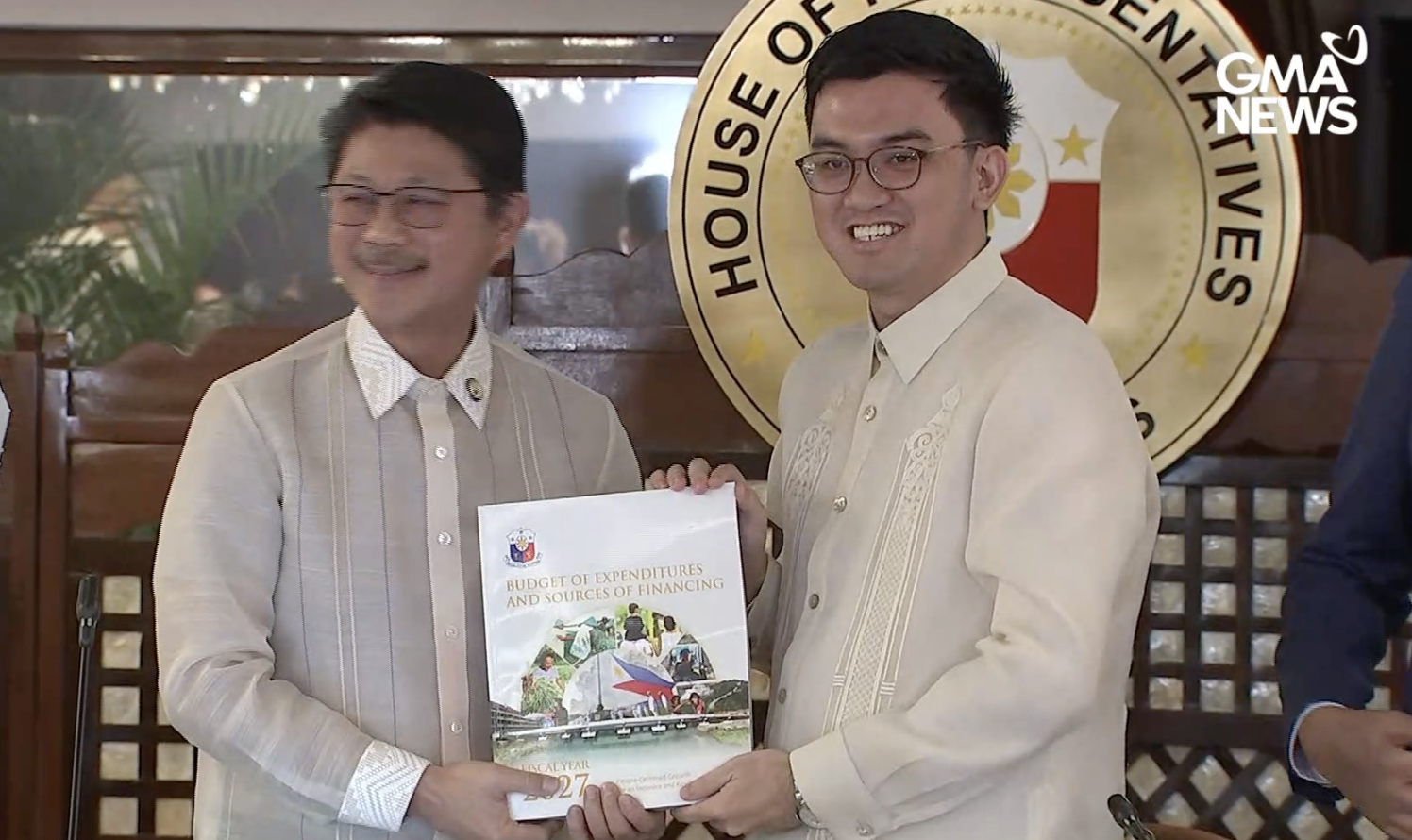
President Ferdinand “Bongbong” Marcos Jr. formally submitted on Tuesday to the 20th Congress the proposed ₱7.2-trillion national budget for fiscal year 2027, saying the spending plan seeks to sustain economic growth while maintaining fiscal discipline.
In his message, Marcos said the proposed budget was developed from ₱11.690 trillion in funding proposals submitted by government agencies.
The President said the government reviewed the proposed programs and projects based on their expected impact and alignment with the country’s development priorities.
“Throughout the budget preparation process, I directed all agencies to focus on measurable outcomes, align their proposals with our development agenda, eliminate unnecessary or inefficient expenditures, and ensure that every peso produce meaningful and lasting value,” Marcos said.
The proposed ₱7.2-trillion FY 2027 National Budget is anchored on the Philippine Development Plan 2023–2028 and the country’s long-term vision under AmBisyon Natin 2040, according to the President.
Marcos said the spending program is intended to support strategic infrastructure, human capital, food and energy security, and social protection, while strengthening transparency, accountability and the efficient use of public resources.
The budget was crafted amid what Marcos described as continuing global uncertainties, including geopolitical tensions, persistent inflationary pressures and volatile energy prices.
Beyond funding government programs, Marcos said the proposed budget aims to modernize public institutions, improve productivity and competitiveness, attract investments, create quality jobs and improve the delivery of public services.
He also emphasized that the measure of progress should go beyond economic indicators.
“Genuine progress is measured not only through stronger economic indicators, but through the lives we improve—families with greater opportunities, workers with more secure livelihoods, farmers and fisherfolk with stronger support, students with better education, healthier communities, safer neighborhoods, and a government that consistently earns the trust and confidence of its people,” Marcos said.
The President formally submitted the proposed national budget to the President of the Senate and the Speaker of the House of Representatives, in compliance with the constitutional requirement under Section 22, Article VII.
Congress will now deliberate on the proposed FY 2027 budget before the final appropriations measure is enacted.
DBM hands over budget to House
The Department of Budget and Management (DBM) on behalf of Marcos submitted the proposed ₱7.2-trillion national budget for 2027 to the House of Representatives on Tuesday.
DBM Acting Secretary Kim Robert de Leon said the proposed budget is ₱407 billion higher than the ₱6.8-trillion budget for 2026.
The proposed 2027 national budget is equivalent to 21.7% of the country’s gross domestic product (GDP).
De Leon explained that the increase is mainly driven by mandatory government obligations.
“About ₱316 billion, or nearly four-fifths of the total increase, comes from these mandatory obligations alone,” he said.
These include higher National Tax Allotment (NTA) for local government units, the fourth tranche of salary adjustments for civilian government employees under Executive Order No. 64, corresponding salary adjustments for military and uniformed personnel, and other existing fiscal obligations.
Beyond mandatory spending, De Leon said the proposed budget prioritizes investments in infrastructure, education, health, food security, and social protection.
₱976-B for DepEd
The Department of Education (DepEd) remains the agency with the largest proposed allocation at ₱976 billion.
The Department of Public Works and Highways (DPWH) follows with ₱644 billion.
Other agencies included among the 10 biggest recipients are the Department of Health, Department of the Interior and Local Government, Department of National Defense, Department of Transportation, Department of Agriculture, Department of Social Welfare and Development, the Commission on Higher Education and state universities and colleges.
The combined proposed allocation for CHED and state universities and colleges is ₱176.5 billion.
De Leon said the 10 sectors account for 51.4% of the proposed 2027 national budget.
National Tax allotment
The proposed budget also provides ₱1.32 trillion for the National Tax Allotment, which De Leon said would give local governments resources to deliver devolved services.
The government is also proposing ₱115.62 billion to support peace, self-governance and development in the Bangsamoro Autonomous Region in Muslim Mindanao.
Another ₱58.53 billion is earmarked for the Local Government Support Fund, including financial assistance to LGUs, the Growth Equity Fund and the Barangay Development Program.
De Leon said the proposed budget remains anchored on fiscal discipline and the “zero-sum principle,” under which spending priorities are weighed against the government’s limited fiscal space.
The DBM said the proposed 2027 national budget will now undergo deliberations in Congress.
House vows scrutiny
Speaker Faustino "Bojie" Dy III said Congress would closely scrutinize the proposed budget before it is finalized as the General Appropriations Bill.
“Tatanungin natin ang mga ahensya hindi lamang kung magkano ang kanilang hinihingi, kundi kung paano ito gagamitin at kung anong konkretong bunga ang maibibigay nito sa sambayanan.”
(We will ask agencies not only how much they are requesting, but how it will be used and what concrete results it will deliver to the people.)
Dy said the House would use the needs of ordinary Filipinos as a basis in determining its priorities.
“Sapagkat ang budget na ito ay para sa pamilyang umaasang magiging mas abot-kayang presyo ng pagkain, sa mga magulang na nangangailangan ng mas maayos na serbisyong pangkalusugan, sa mga kabataang nangangarap na makapagtapos, sa magsasakang nangangailangan ng suporta, at sa mga manggagawang naghahangad ng disenteng trabaho at mas patas na pagkakataon.”
(Because this budget is for families hoping for more affordable food prices, parents who need better healthcare services, young people who dream of finishing their education, farmers who need support, and workers seeking decent jobs and fairer opportunities.)
Dy also vowed to keep the budget process open and transparent.
“Ang budget ay para sa taong bayan. May karapatan silang malaman kung saan ito mapupunta, at sisikapin po natin na maging mas bukas pa ang pagbuo ng ating national budget.”
(The budget is for the people. They have the right to know where it will go, and we will strive to make the process of preparing the national budget even more open.)
Reforms
Dy cited reforms introduced by the previous Congress, including the budget amendments and review subcommittee, or PARC, and the livestreaming of bicameral meetings.
He also stressed that the government should show not only how much it spends but also what is achieved with every peso.
“Hindi sapat na sabihin kung magkano ang ginagastos. Dapat maipakita kung ano ang nagagawa ng bawat piso.”
(It is not enough to say how much is being spent. We must show what every peso accomplishes.)
He said every peso should have a clear purpose and translate into tangible benefits for Filipinos.
“Ang bawat piso ay dapat may katumbas na ginhawa sa bawat Pilipino.”
(Every peso should translate into better lives for every Filipino.)
Dy noted that lawmakers would closely examine the NEP in the coming weeks, with agencies expected to explain their proposed allocations and the concrete results these would deliver. —VAL/KG, GMA News

