

 GMA Brandtalk
 Tracking
 Archives

Choosing whom to love, when to separate are human rights - SC's Leonen
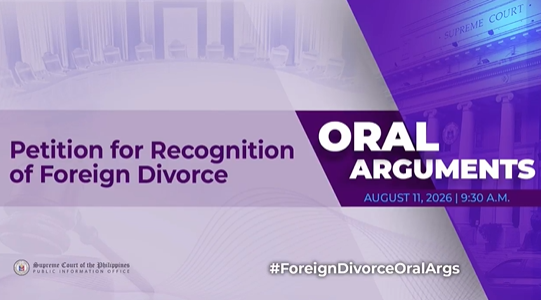
As the Supreme Court (SC) on Tuesday concluded its oral arguments on the recognition of foreign divorce between two Filipinos, Senior Associate Justice Marvic Leonen said that the choice of whom to love is a human right.
“Would you agree with me that our capacity to love and our choice of who to love and not love is a human right?” Leonen said during his interpellation of Solicitor General Darlene Berberabe, to which the latter agreed.
According to Leonen, there is an interpretation of the Constitution and the law that does not need oppression.
“So it is possible to interpret our Constitution as saying… that we do not need legislation to recognize the power of individuals in our country to choose when to separate. What we need legislation for is the effects of that fundamental human right to choose to separate,” he said.
Berberabe answered in the affirmative.
Leonen cited Article III, Section 1 of the Constitution, which states that “no person shall be deprived of life, liberty, or property without due process of law, nor shall any person be denied the equal protection of the laws.”
Citing a previous ruling, Leonen said that the Court found that life, liberty, or property should not be taken in a very narrow and technical sense.
He said that life and liberty could be for the pursuit of happiness.
“Life and liberty include the autonomous choice of every individual of how or who would be its intimate partner, correct? So the choice of a relationship and the choice of intimacy, the choice of the partner, all of this are part of life and liberty, correct?” Leonen said.
According to Leonen, if the state recognizes the autonomy of each individual, there must also be trust that they will try their best to go through a relationship despite its difficulty before breaking up.
He then asked Berberabe about the state’s interest in compelling couples to stay in a “troubled relationship” or a relationship that they no longer want to be part of.
Berberabe cited Article XV, Section 2, which states that “marriage, as an inviolable social institution, is the foundation of the family, and shall be protected by the State.”
Leonen, however, said that inviolable means to be protected against external forces. He added this means the State cannot interfere in marriage.
“It acknowledges the agency of individuals in it,” he said.
“I, of course, acknowledge that the interpretation now of the Republic is different. But I am just asking you whether there can be an alternative interpretation that does not pretend that every marriage, just because they were solemnized, are good foundations of the family,” he added.
According to Leonen, the State does not control how couples should be when the couple already decides that they should no longer be together.
What is a family?
Meanwhile, Leonen said that there can be strong families even without marriage.
“Filipino family and the family is defined by Filipinos. By Filipino, it does not mean that there is one model of what a Filipino family is,” he said.
“And if there are any persons in this room that acknowledge this, it is you and I. Because of our life histories, correct? That we can have strong families even without marriage, even after marriage, correct?” he added.
Leonen asked Berberabe if a widow and a child, a single parent, a single parent with a partner they are not married to, an unmarried couple with children, same-sex partners with adopted children, and an orphan being taken care of by his or her grandparents were considered family.
Berberabe answered yes to each one.
“Therefore, when we read family there, that is to be strengthened as an autonomous social institution. It does not mean… only a married couple with children,” Leonen said.
He cited Article II, Section 12 of the Constitution, which reads: The State recognizes the sanctity of family life and shall protect and strengthen the family as a basic autonomous social institution…
“Therefore, a family is not necessarily dyadic, meaning there is a man and a woman in it; heterosexual, meaning that there has to be a man and a woman; There can be mother and child, father and child; and blessed by the state,” he added.
Leonen stressed that there are families that are not “blessed” by the State.
“I use blessed here, I’m so sorry but in a very unreligious way. That the State recognizes the partnership by means of giving them benefits and burdens under the law,” he said.
The justice said that the basic social institution works and is the foundation of the State because it enhances and empowers rather than causes misery.
Leonen also said that the Constitution is “primordial” in the legal order.
Meanwhile, he also cited Article II, Section 11 of the Constitution: The State values the dignity of every human person and guarantees full respect for human rights.
He said that the State includes the Judiciary and the SC.
Oral argument concludes
Four sessions were held since the oral arguments began on August 19, 2025.
“We conclude our arguments,” Chief Justice Alexander Gesmundo said.
“Parties and amicus are requested to file their respective memoranda within 20 days from today,” he added.
The arguments stemmed from a petition filed by a dual citizen for the recognition of his foreign divorce. —AOL, GMA News

