

 GMA Brandtalk
 Tracking
 Archives

ADVERTISEMENT
Filtered By: Topstories
News
The lesson from a rare bonfire
Imagine 27 losses in a row over a period of two years, and in basketball, a sport that has been considered a national symbol. How do you survive this humiliation except to put a brave front that sports is irrelevant, and it is academic excellence that counts, except that the days when one can cockily claim that there are only two Universities in the country, the University of the Philippines and others, are long gone. After all, maroon is no longer the sole color for academic excellence. Green and blue have since made their marks too in many academic fields.
UP gradually woke up to the reality that it is now difficult to take pride in being the only home for the best and brightest, and of having a monopoly for excellence and critical social relevance, to sort of pep talk itself in recovering from the fact that its basketball team has for the most part, game after game, remained winless. This was because La Salle and Ateneo, schools that have since established their own supremacy in the UAAP, have also earned the honors of being top ranked in their own areas of academic excellence. And these schools and others have also now taken up the role of being breeding grounds for social activism.
Last season, the Green Archers won the basketball championship and emerged the over-all UAAP champion, even as Ateneo denied its arch-rival a complete victory by humiliating its women’s volleyball team in a fiercely contested and emotionally-loaded final game.
And UP’s claim of cornering the cheer dance competition as its territory, even if the points earned from which do not actually contribute to gaining the overall UAAP crown, stood on shaky grounds last year. A rather shaky performance of UP seen in its cheerers falling down from their pyramids led to the well-funded National University squad to steal from it the championship trophy it once held for several years.
And then August 9, 2014 happened.
It was the day that UP tasted its first victory in UAAP basketball in two years over Adamson University. After suffering 27 humiliating defeats, team maroon was able to claim a spot, even if only by virtue of one game, in the winning column.
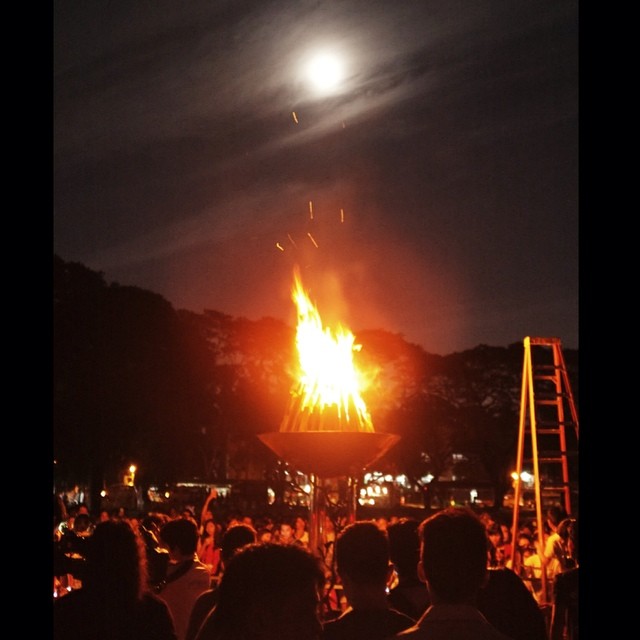
The victory pyre at the Sunken Garden. Karl de Leon
And for this, UP Diliman grounds became a witness to a victory pyre; a celebration that has been simply until that time a longing for the long lost days when it too was a champion, when Benjie Paras was still in college; an occasion where the Isko and Iska students, alumni and fans took part in what has been dubbed as the beginning of dreaming of UP going up once again, if not in basketball, in eventually bringing home the UAAP overall crown. It was a night where the burning wood of the bonfire has somewhat fueled the burning desire that could fire up the idea that winning is really still possible, even for perennial losers.
The victory was just too sweet and symbolic. It was almost like a spring in a desert to a thirsty traveler. So rare, that is why it is so treasured. And to a University so used to burning effigies to condemn, it was a time to burn to celebrate.
As an alumnus of UP, who also spent about two decades of my professional life teaching in its Los Baños Campus, but has since joined the UP alumni diaspora now that I am teaching in the realm of the Green Archers, I too celebrated the rare victory. I celebrated even if I am no longer wearing maroon during UAAP games, and has since traded it for green. After all, I am and will always be an Iskolar ng Bayan.
I celebrated even if I had to suspend my discomfort at the manner by which UP chose to celebrate. I find bonfires environmentally incorrect at a time when climate change has become a threat against humanity. Wood is consumed, and carbon is emitted everytime we have bonfires.
I celebrated even if it was only for one victory, and a victory that was earned by crushing a team which is a perennial cellar dweller too.
But just like any party, there are also party bashers and spoilers.
Some people, of whom a good number are from UP, made fun of the bonfire, but not in an insulting way, but more in jest. It was more in the spirit of “kantyawan.”
Even Manny Pangilinan, a well-known supporter of the Ateneo Blue Eagles, joined the fray, by ribbing UP, in half-jest I suppose, when he said that he is impressed with the spirit of UP when every time he watches the UP Maroons play basketball, that what comes out as remarkable is not their skills, but their kindness.
But others actually had negative issues against the bonfire, and even people from UP took a self-deprecating attitude, calling the celebration overblown and premature, and calling UP to task for celebrating a win over Adamson as if it is a big thing.
These people who seriously find issues with the celebration really don’t get the point.
The point is not the victory but the symbolic meaning attached to it. The issue is not the UAAP, but what the single victory meant to the larger picture of eternal hope.
What made me celebrate with them is not the victory itself, but what that victory could mean not only to UP, but to those unfortunate lives who have become hopeless. UP’s victory, even if only once, and even against another weak team, sent a powerful message—that it is not in the natural order of things for someone to always lose all the time. It is not fair that one is not given the chance to taste victory.
For one who has always tasted defeat, what could have been more invigorating than to savor the moment of a rare victory, if only to serve as a reminder of a life that needs to be lived in order to discover what lies beyond failure.
It is the opposite of one who always tasted victory, where experiencing a humiliating defeat can be the best reminder of a life that needs to be lived in order to discover the price of hubris, and not to forget the fact of one’s mortality and fallibility.
The La Salle Green Archers won the overall basketball championships last year, only to taste two consecutive defeats this season. Ateneo was the team to beat a few years back, but last season it was eased out of the finals. UST was La Salle’s serious threat last year only to lose to the Archers by double digits in their first round game this season, and in the hands of fresher faces at that.
And these teams are teams of champions in recent UAAP seasons.
UP may not be a champion right now, but God, or fate, or both must indeed have been kind to it, for it to have savored a moment of victory in the arena of sports if only to give the team hope, and the UP community an opportunity to go down from its self-ascribed academic high horse, and a moment to go beyond its higher self-ascription as the epicenter of critical thinking. UP has to taste this rare victory in order for it to have a glimpse of what it is missing, so that it can feel a sense of community with the rest of the Universities from which it would like to set itself apart. UP needs this victory so that it can stop using academic excellence, of which it is no longer having monopoly of, or a sense of activism and critical thinking, of which it no longer has a sole right, as excuses for poor performance in basketball.
Personally, I used to be not a fan of basketball, or any spectator sports. I even continue to have fundamental problems with organized sports events such as the UAAP, and consider them as exploitative of athletes more so now that such events are turned into commercialized extravaganzas. This is further worsened by charges of betting, game fixing and game selling, where the outcomes of games are now dependent no longer merely on skills of the players but on the desire of sports entrepreneurs and owners of sports arenas for profit.
This is an attitude the roots of which I attribute mainly to my UP education—of being critical of capitalist exploitation, of being skeptical of useless diversions in life. I found more meaning in the cerebral. And when I venture into the physical, I only do so to keep myself fit, and see it as an occasion to live my politics even in my sports. When I engage in sports, I do so because I feel good as a participant, and not as a spectator. When I play tennis, I savor not the competition and the winning, but the social nature of the game. When I teach aerobics, I use it as a venue for my advocacies on environment, gender equality, and respect for indigenous and human rights by using alternative music in lieu of the usual funky Latin sounds, and of choreographing my moves based on ethnic dance steps in what I call as ethno-aerobics, instead of being fixated on the Zumba.
Thus, when I moved to La Salle, I initially found the whole basketball and UAAP fever as alien to me.
It was only when my daughter became a member of the Animo Pep Squad that I had the interest of watching the live games, initially not to watch the basketball game, but to watch her perform in half-time. But soon, I began to acquire the feel of becoming a fan. I began to absorb the Animo spirit, and momentarily forget my problematization of commercialized spectator sports everytime I watch a game.
And it was a life-changer. I began to understand the power of the experience, of how it is to yell and shout, and be ecstatic in moments of victory, and to wail and groan, and be depressed in moments of defeat.
The experience made me realize that beyond the rallies I used to join, outside the books that I love to theorize about, lie a world so open to different possibilities. There, lost in a sea of sports fans, I just became a member of a community rooting for its sons and daughters fighting for the color green. It made me savor my being a father not only to a beautiful cheer leader but to all Green Archers fighting for the school to which I now belong.
Strangely, I refuse to sing the Alma Mater song of La Salle during graduation, even when I was Dean of its College of Liberal Arts, for the simple reason that I am not an alumnus. As a sign of respect, I just stand up to pay homage, but not to sing a song I am not entitled to even hum. But I am so deeply moved during post-game moments, when win or lose, the schools get to sing their Alma Mater songs that I ended up joining all the rest of the green crowd in singing the song of La Salle, with my right fist clenched and raised.
Yet, amidst this, there is pain that I have to endure when I reflected that deep in my heart I should have been doing this for the UP Maroons long time ago. It pains me that the last time I ever got to sing UP Naming Mahal with my fists clenched and raised was in 1985 when I graduated from my master’s degree.
Fortunately, I have never watched a live game between UP and La Salle. This spared me from the agony of being forced to watch a massacre involving my adoptive University, and the University I shall remain to call my Alma Mater.
This is the point of that bonfire on that momentous evening of August 9 when UP had its taste of its first victory after being humiliated by defeat 27 times.
It is not the victory that counted. It is the opportunity for the UP community to come to terms with the possibility that it is just like any other University. It is a challenge to its alumni to pump up the support. It is an open call to its Administrators not to take its athletes for granted.
And for those fellow UP alumni, students and supporters, and those who remain in the dreamland of exclusivity and special status, those who still believe that this is just sports and this is just basketball, and UP has better things to do, and that there are more important things in life than winning the UAAP crown, and for those who continue to embrace the myth of exclusive proprietary rights over academic excellence and social activism, it is perhaps time to get real and come down from Mt. Olympus.
Here, in the world of fans and mortals, you will have the pleasure of the realization that you simply don’t know what you are missing.
The author is a former dean of De La Salle University. The views expressed in this article are those of the author and do not necessarily reflect the position of this website.
The author is a former dean of De La Salle University. The views expressed in this article are those of the author and do not necessarily reflect the position of this website.

