

 GMA Brandtalk
 Tracking
 Archives

Sagada villagers remember the dead with panag-apoy
SAGADA, Mountain Province – An old practice of remembering the dead with fire, panag-apoy (literally, “to produce fire"), remains an enduring tradition among the northern Kankanaey residents of Sagada. It is not a purely indigenous practice, but one overlaid with a strong Western religious influence. On Sunday, November 1, Anglican priest Prencell Balitog held a liturgical service as usual at the Church of Saint Mary’s the Virgin. As the mass ended at 3 p.m. residents walked hand-in-hand to the nearby Sagada cemetery to witness the priest bless the graves. Almost every resident brought a handful of saeng - long thin splinters of pitched pine – earlier presented at the church for blessing. At sunset, residents lighted their saeng to produce many small bonfires on the ground near the graves of their loved ones. The individual fires from the many graves lit up the darkening cemetery, enveloping the surroundings in a thick veil of smoke. Sagada folk say the practice is done every November 1 as “pananglagip sin minatey (a way of remembering our dead kin)." Interestingly, the Sagada Kankanaeys use saeng instead of conventional candles that are available in the modern stores in the town center.
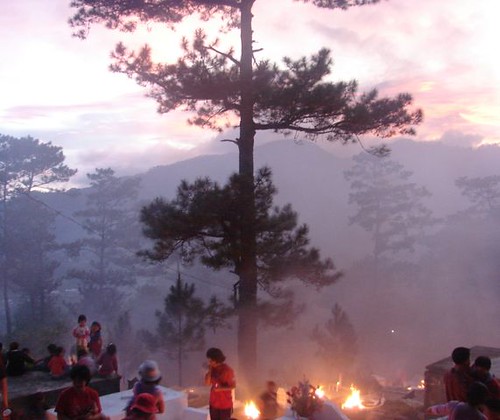
Use of saeng as tradition Mary Umaming, a native of Nangonogan, a village of Sagada, explained that local folk used saeng as part of their old tradition. “Maid kandila ad kasin (There were no candles before)." Saeng are locally available and easy to use, said village elder Dorothy Y. Kiley, 67, a retired principal of Saint Mary’s School. In villages where electricity or even flashlights with batteries remain costly, saeng are used by residents to light their way in the dark, especially to travel by foot at night, to start a cooking fire, and to do other domestic chores. The saeng comes from the wood of an old pine tree with thick resin, which is very flammable. It is chopped into long thin splinters that can be held conveniently by hand, like a torch.
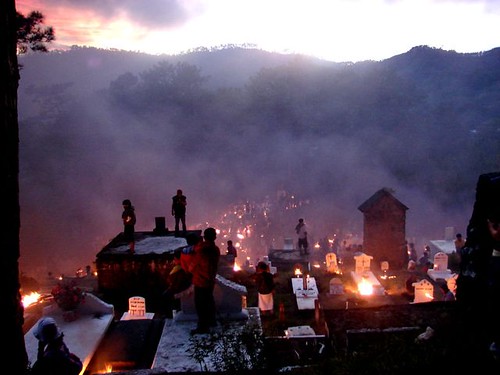
Panag-apoy as a church practice Tracing the origin of panag-apoy, Sagada folk say the activity was introduced by the Anglican Church when they started to evangelize the mountainous region in the early 20th century. “It is a church activity. Hence after the blessing of the saeng, the priest goes to the cemetery and blesses the graves there too," explained Umaming. Mrs. Kiley recalls that panag-apoy was already practiced by the people in the ili (village) since her childhood days. The two priests – Anglican Rev. Balitog and Saint Mary’s chaplain Rev. Rex Reyes - agree. Fr. Reyes explained that panag-apoy is celebrated every November 1 and is anchored on the Christian celebration of All Saints’ Day. But although it is western influenced, he said, "we do not have witches and goblins, and huge pumpkins. We have revered kin who stay by us till kingdom comes." The persistent use of saeng despite the availability of modern candles in every local store expresses the Sagada people’s assertion of their indigenous Kankanaey roots. Indigenous All Souls’ day Tigan-o Dugao, an elder and barangay head of Ankileng, a southern Sagada barangay, agrees that panag-apoy is a church tradition with an indigenous flavor. Tigan-o points out that panag-apoy is not an indigenous practice, since the truly indigenous way of remembering the dead is continuous, and not only done during Undas or All Saints’ and All Souls Days. “In every household occasion for instance, the anito (spirits) of the villagers’ ancestors from both sides of the family are invited to partake in the occasion. Whether that occasion is related to death or sickness, marriage or some other happy occasion, as long as a family performs a ritual, the spirits of their ancestors are invited," explained Tigan-o. The rituals are either performed at home or in sacred ritual areas called papatayan or a-ayagan. “Residents do not go to the caves, our indigenous cemetery, for their offertory. They can do it at home and call on the spirits of their ancestors to be present," Tigan-o said. He added that elders believe their ancestors’ spirits are always present and will always do good for their kin. But whether the commemoration of the dead is done in the cemetery (as introduced by the church) or at home or in other ritual areas, Tigan-o emphasized, what is important is to ask the spirits to help the living enjoy good health and do good for neighbors and the village. That’s the indigenous value, said Tigan-o, that led the people of Sagada to be among the first to rush to Tadian and help in the rescue of villagers trapped under a massive landslide caused by Typhoon Pepeng. - GMANews.TV

