

 GMA Brandtalk
 Tracking
 Archives

Nickel mining in Zambales blamed for mud-flood in typhoon’s wake
Environmental advocates and residents of Sta. Cruz town in Zambales in Central Luzon on Friday blamed nickel mining operations in the province for the thick reddish-brown mud-flood covering streets in some barangays there.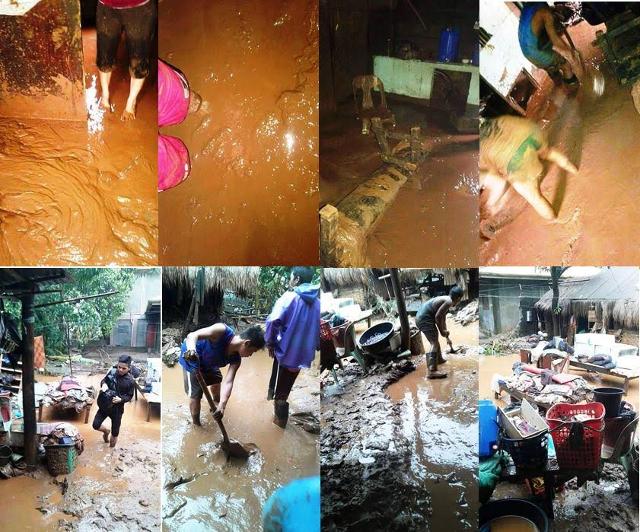
Photo collage from the Facebook page of Dr. Molino
In a statement on Friday, the Concerned Citizens of Sta. Cruz (CCOS)—a local anti-mining group—said the mud-flood came from destroyed or failing ponds of the four leading mining companies in the town.
Typhoon Lando's torrential rains had caused flooding as the cyclone barreled through the Luzon landmass earlier this week.
Locals believe that the mud-flood came from the settling ponds of the Zambales Diversified Metals Corp., the Benguet Corp. Nickel Mines Inc., the Eramen Minerals Inc., and the LNL Archipelago Minerals Inc.
CCOS chairperson Doctor Benito “Doc Ben” Molino said, “With the rain that poured in our province, flooding was highly possible, but the volume of red mud is a different case. We think nickel laterite may have mixed with floodwaters hounding some parts of the province."
He said the recent mud-flood hitting some barangays is the second since July this year, and that the possible destruction of mining ponds resulted in the flow of mud into the river systems in the area.
Moreover, he said the reddish-brown mud entered the homes of residents and covered farmlands and waterways.
But in an interview on Oct. 19, a day after Typhoon Lando made landfall in Casiguran, Aurora, Zambales Governor Hermogenes Ebdane denied claims that mining ponds were the source of the flood and instead blamed the releases of excess water from huge dams in northern Luzon.
For his part, Jaybee Garganera, national coordinator of Alyansa Tigil Mina, said the incident "is proof that mining aggravates host communities' vulnerability to disasters. If there was no mining here, no nickel laterite mudslide would occur and the floodwaters should have easily receded.”
“This is not the first time that we see mining worsening impacts of typhoons and causing further damage to communities and their sources off livelihood, such as the Marcopper disasters in 1993 and 1996 in Marinduque, and the Philex mine spill in 2012," he added.
On October 20, Doc Molino called on Mines and Geosciences Bureau (MGB) director Jasareno to order an investigation into the samples from the flood and the possible impacts of the mud to the health of the people in affected barangays.
On Oct 22, a team from the Environment Management Bureau-Region 3 went to Sta Cruz to investigate.
Results of the MGB probe were not yet available as of posting time.
Earlier, operations of the four nickel mining companies had been suspended twice due to “unsystematic methods of mining” and its impacts to the environment. But the MGB lifted the suspension of mining operations.
The CCOS claimed that political pressure was behind the lifting of he suspension of mining activities in Sta. Cruz.
Residents and supporters are calling on DENR-MGB to cancel the mining contracts of big firms in the province. — LBG, GMA News

