

 GMA Brandtalk
 Tracking
 Archives

Silliman University, Dumaguete City govt ink MOA to develop eco-park
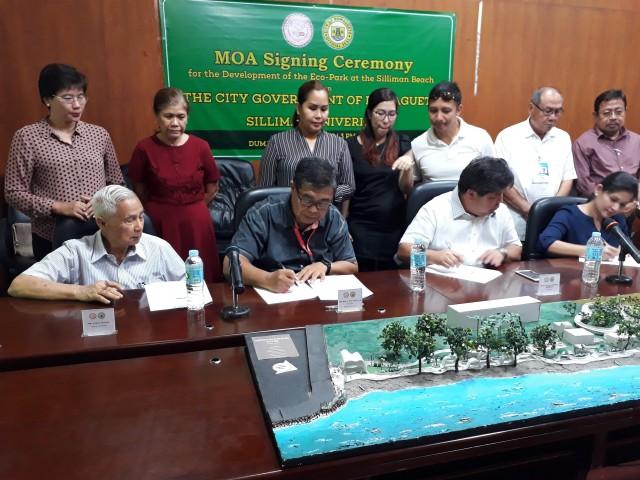
DUMAGUETE CITY — Silliman Beach, the city's lone remaining public beach located in Barangay Bantayan, will soon become an eco-park, as the city government signed a memorandum of agreement (MOA) with Silliman University (SU) on Tuesday.
The eco-park, estimated to cost around P8 million, will be a tourist attraction that will showcase environment-friendly practices.
"We have to learn from Boracay, which was once basking in glory and commercialism. It's because the people who put up their businesses there forgot their basic environmental regulations," Dumaguete City Mayor Felipe Remollo told reporters during a press conference on Tuesday.
Remollo signed the MOA with SU President Dr. Ben S. Malayang III while a model of the future eco-park designed by SU architecture students was presented to the public.
The eco-park is designed to mitigate the problems that plague Silliman Beach, such as improper garbage disposal, coliform contamination, among others.
The park will have an information area, view decks, a boardwalk that extends up to SU's mangrove garden, huts for vendors and tourists, and a cove for fishermen.
Talks on the project were already underway as early as 2016, Dumaguete City Tourism Officer Jacky Antonio told GMA News.
One of the measures SU is planning to implement to address water pollution at the Silliman Beach is to control the flow of contaminants from the Mojon Creek, which flows from the outskirts of this city out to the Tañon Strait, particularly between Silliman Beach and the runway of the Dumaguete Airport.
Malayang said research teams in SU are eyeing "biological mediation," or the introduction of certain kinds of plants that would sequester the contaminants from the water flowing from Mojon Creek.
"The problems (of Silliman Beach) have accumulated there over time, and the solutions we have must be based on time. We cannot solve these problems overnight," Malayang added.
While SU will take charge of the eco-park's funding and the scientific research to address Silliman Beach's environmental problems, the city government will maintain take charge in implementing strict security measures, Remollo said.
"We also plan to install CCTV cameras in the beach area," the mayor added.
On the tourism aspect, Malayang said the proposed eco-park aims to promote "educated and value-oriented tourism," or making visitors feel that they are learning more about nature during their stay rather than simply enjoying the area.
"While people will be walking on the boardwalk enjoying the mangroves, we hope to let them learn and appreciate the mangroves' important role in coastal resources. Mangroves may be trees, but without those, we have no fish," Malayang pointed out.
Construction of the eco-park project is slated to begin by June this year and end after Mayor Remollo's term on 2019. — BAP, GMA News

