To real-life Kubrador, life is worth jueteng for
By STEPHANIE DYCHIU, GMANews.TV Special Correspondent
Published December 10, 2010 12:20pm
Add GMA on Google Make this your preferred source to get more updates from this publisher on Google.
Beginning this month, GMANews.TV brings you Jueteng Nation , a series of special reports on the widely popular but illegal numbers game jueteng. In this first installment, a look inside the world of the real cobrador behind the film Kubrador brings fresh perspective to the role a jueteng operation plays in a community, and why millions of people across the nation are firmly caught in its thrall. (First of two parts, second part is
here .) Days before the premiere of the film Kubrador (The Bet Collector) in 2006, an old woman from Metro Manila’s nether regions was invited to join the glitterati at the Cultural Center of the Philippines to watch the unveiling of her life story. The woman, sly in her sixties but with the motherly mien of a nun, was the real-life
cobrador on whom the lead character of the movie was based. She and her cabo (supervisor) had opened their jueteng operations to the film’s production team, and supplied the trove of inside information that gave Kubrador its award-winning realism. Aling Amelita (not her real name) even had a secret cameo in one scene. But she refused to attend the premiere.
“Baka raw mahuli siya (She said she might get arrested)," says Kubrador screenwriter Ralston Jover, Aling Amelita’s former neighbor and main liaison for the project.
“Huli. Yan ang pinakatakot nila (Being arrested. That’s what they are most afraid of)."
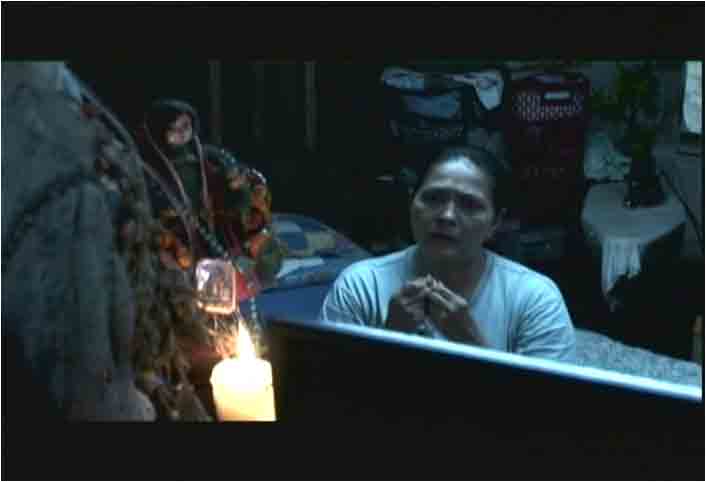
A cobrador’s greatest fear The fear of being caught is a cobrador’s greatest fear, and a jueteng protector’s greatest opportunity. Aling Amelita (played by Gina Pareno) prays everyday not to get arrested before heading out. Images from the movie Kubrador courtesy of producer Atty. Joji Alonso-Antonio .
The fear of being caught is a
cobrador’s greatest fear, and a jueteng protector’s greatest opportunity. Exactly when jueteng became illegal in the Philippines is somewhat indeterminate, but the Spanish-era Penal Code of 1887 already carried a general prohibition against playing games of chance for money. The predominance of Spanish terms in jueteng phraseology suggests the game evolved during colonial times. In 1907, jueteng was specifically declared illegal in the gambling law enforced by the American colonial authorities, Act No. 1757. A hundred years since, the wages of sin have been generous.
click to see larger view PAGCOR’s “evil twin" Jueteng’s annual underground revenues today are worth P38 billion across the nation, according to a July 2010 estimate of the Department of Interior and Local Government (DILG) and the Philippine National Police (PNP). This amount is comparable to the P30 billion total revenue earned in 2009 by the government’s own gambling operation, the Philippine Amusement and Gaming Corporation (PAGCOR). PAGCOR is also one of the government’s lead sources of income, along with the Bureau of Internal Revenue (BIR) and the Bureau of Customs (BoC). Of the three, PAGCOR stands a shoulder above because it is capable of generating incremental revenue without wreaking a tax burden on the general public. PAGCOR’s “evil twin", in contrast, brings no income to the government. What PAGCOR pays in franchise tax and mandatory contributions, jueteng pays in protection money. Neighborhood gambling Kubrador writer Ralston Jover never knew his old neighbor Aling Amelita was involved in jueteng until he took note of her daily activities for a scriptwriting assignment in 2005. Jover at that time was still an unknown writer living in one of the ramshackle hives of Metro Manila. The place to him is “not a typical squatters’ area," because it is unusually quiet, almost provincial, surrounded by religious sects like the El Shaddai. Vice and virtue dwell harmoniously side by side in the crammed enclave, as tambays (loafers) chat idly about pananampalataya (faith) and pagbabagong-buhay (reformed life), while the clacking of mahjong tiles ricochets from home-based gambling dens nearby, including Aling Amelita’s. “Binuhay sila ng jueteng" Kubrador writer Ralston Jover never knew his old neighbor Aling Amelita was involved in jueteng until he took note of her daily activities for a scriptwriting assignment in 2005.
cobrador for about thirty years. “Yun na yung pinagtayo ng bahay nila, at pinagpaaral niya sa tatlong anak niya (That’s how she was able to build a house, and send her three children to school)," he says. “Binuhay sila ng jueteng (Jueteng kept them alive)." Originally an informal settler from Mindoro, with not even a high school diploma to her name, Aling Amelita became the family breadwinner many years ago after her husband permanently hurt his leg while working at a construction site. Her children are now fully grown, and land short-term blue-collar jobs on occasion. But with family members still dependent on her, and a lifetime spent roaming the streets as a cobrador , jueteng cannot be purged out of Aling Amelita’s system. The high-level criminality associated with the game did not seem to be an issue with her and her cohorts. “Okey lang (It’s okay)," they would say. “Naambunan naman kami sa baba (We get a sprinkling of the perks at the bottom)." “Tsaka protektado naman (And it’s protected)," Jover says meaningfully. “Alam ng pulis, may ‘blessing’ (The police know, so there is a ‘blessing’)." Casino of the poor Jueteng is a type of unregulated community lottery where the taya or bettor chooses two numbers between 1 and 37, hoping to hit the winning combination at the bolahan or draw, where bulilyos or tiny numbered balls are placed inside a bottle and shaken out. Every number from 1 to 37 represents something in jueteng numerology. For instance, 1 means “earth" or “king", 6 means “pregnant", 33 means “cross-eyed", and so on. A cross-eyed pregnant woman walking down the street could mean it is a good time to bet on the combination 6-33. The probability of guessing the winning combination in jueteng — assuming no human interference flouts the mathematical laws that govern the universe, and bulilyos in bottles suspiciously wrapped in masking tape — is 1 out of 1,369 (37 x 37). The minimum bet can be as low as P1. Prize payoffs vary, but every P1 bet placed on the winning combination usually yields P700 to P900 in prize money. A winning P10 bet thus earns P7,000 to P9,000. Draws are typically held three times a day, one in the morning, one in the afternoon, and one in the evening. Jueteng power structure In a report on illegal gambling presented during the term of former President Joseph Estrada, retired general Wilfredo Reotutar of the Philippine National Police (PNP) outlined the jueteng hierarchy and revenue-sharing scheme. At the base of the jueteng pyramid are the cobradores, who are each assigned a specific area called a “cell". Each cobrador belongs to a sales network managed by a supervisor (cabo). As collection agents, they earn a 15% commission on bets procured. (Aling Amelita resisted a promotion to cabo because cabos are under pressure to meet a sales quota, says Jover.) The cabos report to the operator or maintainer (in Aling Amelita’s case, the “TM" or table manager), who manages overall operations in the community. He is answerable to the banker or capitalista , who finances the jueteng syndicate’s operations. The capitalista takes 25% of total collections for overhead expenses and profit. He allocates an additional 30% for prizes, and reserves the remaining 30% for payments to mayors, police chiefs, congressmen, and other government officials on the protection payola. Support staff of the jueteng operation include checkers (revisadores ), cashiers (cajeros ), informants (inteligencia ), accountants, lawyers (for bailing cobradores out of jail), PR agents (for securing media protection), and hit men. “Para siyang may calculator sa utak" Punta ka dito. Eto ang number ko, babayaran kita mamaya ’ (‘Come here. I’m betting on this number, I’ll pay you later’)." Without writing names down, Aling Amelita could keep track of who-bet-how-much-for-which-combination by folding her papelitos into separate columns, and assigning each column to a specific hour. The first column could be 7 to 8 am, the second column 8 to 9 am, and so on. Based on this, she could remember whom she talked to in her rounds. “Para siyang may calculator sa utak (It’s as if she has a calculator inside her head)," Jover remarks. “Walang pangalan kasi karamihan regular bettors. ‘Pag nagkahulihan, walang paper trail (There are no names on her list because most are regular bettors. If there’s a raid, there’s no paper trail)." Cobrador ethics A cobrador may be a felon in the eyes of the law, but he or she ironically trades on credibility, and would be blacklisted in the community if known to steal. A strong system of trust is practiced between cobradores, cabos, and their table manager.
cobrador is examined by the revisador . Any discrepancies are charged to the cobrador. In Aling Amelita’s circles, discepancies usually stem from human error, not a conscious intent to filch. A cobrador may be a felon in the eyes of the law, but he or she ironically trades on credibility, and would be blacklisted by the community if known to be dishonest or error-prone. “May system of trust sila (They have a system of trust)," says Jover. “Kapag may nawawalang taya, pwedeng mag-apply ng emergency loan sa table manager (If there is a missing bet, they can get an emergency loan from the table manager)." The loan is then paid back in daily installments. Cobrador ethics also dictate that if the misplaced bet matched the winning combination at the draw, the cobrador will honor the commitment to the bettor and still pay the prize money. The cost of the prize is then added to his or her loan obligation. Such stringent standards make seasoned cobradores some of the most reliable members of the community. Jover says they are often tasked to collect donations when somebody dies or gets sick, because they can be trusted with money. “At may network na kasi sila. Kilala ng kumare, kapatid, inaanak (And they already have a network. They know all the friends, the siblings, the godchildren)." Clandestine draws Once the revisador is finished sorting the bets, the draw is conducted in a secret location. Cabos are present at the draw, but cobradores are normally not allowed for security reasons. The draws are held in safehouses, cemeteries, and sometimes, inside moving vehicles. Jover details how: “Kunwari, may dumaan [na jeep] sa isang kanto. Sakayan ang mga cabo. Akala mo pasahero. Tatlong ikot sa tatlong kanto. Naganap na yung draw. Babaan sa isang kanto. Tapos na . (For instance, a jeep passes by a street. The cabos climb onboard, like they’re ordinary passengers. The jeep goes around three times on three streets. The draw is being done. They get off at another street. Finished)." During the draw, a facade of transparency is curiously maintained even though all parties are aware the winning combination may not be selected by chance. As retired police general Wilfredo Reotutar stated in his report, “How else can the syndicate raise the 30% protection money if not [through] the holding of mock draws?" “May rigging talaga" A common method for rigging a draw is to use a bottle wrapped in masking tape. The bet with the lowest monetary value is pre-selected as the winning combination, so the jueteng capitalista can maximize profit.
May rigging talaga, kaya may mga watchers sa bolahan, parang eleksyon (Rigging definitely happens, that’s why there are watchers at the draw, like an election)," Jover affirms. “Sasabihin ng boss, ‘Magkano ba ang pinakamaliit na taya? Yun ang patamain mo (The boss will say, ‘How much is the smallest bet? Make that one win’)." Filtering out the smallest bet is one of the tasks of the revisador during the audit right before the draw. The reason for the rigging can be explained in economic terms. The jueteng capitalista must maximize profit to make his investment in the protection racket of police and local government officials worthwhile. Protection is multi-layered and expensive, consuming nearly a third of total collections. To net an acceptable rate of return over the cost of protection, plus other overhead costs such as fixed salaries of revisadores , accountants, bagmen, money counters, cashiers, and other support staff, the capitalista must minimize the expense of paying prize money. By rigging the draws, he ensures the cost of the prize will not exceed the level necessary to meet his target profit. A common method for effecting the rigging is to use a bottle wrapped in masking tape. As the bolero shakes the bottle, the winning numbers identified by the table manager are already hidden in a compartment. Or, the winning combination is simply announced through a text message. An open secret At the bolahan or draw, losing bets are marked with a slash, while winning bets are encircled.
cabos assembled around him quickly peer into their crumpled lists to see if any of their cobradores have a match. In a blur of twitching fingers and pens, losing bets are marked with a slash, while winning bets are encircled. Cabos who get a bilog (circle) receive a bonus equal to 5-10% of their client’s winnings. Even among bettors, the specter of rigging is an open secret, and not necessarily a source of discouragement. Winning is no longer about the fickle whims of the universe, but a matter of guessing which combination the capitalista will favor next. Avid bettors regularly summon their cobradores and stare intently, foreheads furrowed like stock market analysts, at the cotejo—charts that track the winning combinations from recent draws—to forecast where the “trend" is headed next. To Jover’s knowledge, not all draws are rigged. “’Pag sobrang higpit, nagpapatama sila ng normal (When the situation is really tight, they let the draws proceed normally)." Sucker’s game? Retired police general Reotutar, meanwhile, flatly called jueteng a “sucker’s game" in his report, noting that even the capitalista , not just the bettor, can be defrauded by rigged draws. “Cheats or hustlers in the employment of an ignorant or gullible capitalist or banker make use of third parties, usually their trusted aides, to bet for them on a winning combination which they will manipulate to come out during the draw." Once a draw is completed, the cobrador who solicited the winning combination troops solemnly to the doorstep of the lucky winner to deliver the prize. “Si Aling Amelita, pupunta yan sa nanalo , with escorts and watchers (Aling Amelita goes to the winner with escorts and watchers)," says Jover. “Protektado dapat, kasi may mga hold-upper diyan at snatcher na maloko (Security is necessary because there are muggers and thieves)." Stories of winners Word spreads in the community about the winning bettor’s good fortune, enticing more people to place bets for the next draw. The sagging spirits of those who have lost interest in betting because they never win can be jolted back to circulation by tales of friends and neighbors who happened to win. Not all these stories are true. Some are purely fabricated for buzz marketing. Reotutar cautioned in his report, “[Some] operators intentionally make somebody in a crowded section [win], usually the marketplace of the locality, to convince people that the draw is really honest. When a big bet wins, the operator immediately delivers the payment to show everybody that the bank can pay any amount of bet. This is scripted, with the big bettor planted by the operator." The unflagging popularity of jueteng for more than a century, however, suggests there are more than enough people who believe—rightly or wrongly—that the chances of winning are real. Certainly enough to keep the jueteng industry in rude health. - GMANews.TV TO BE CONTINUED Part two is here. AUTHOR'S NOTE: The jueteng practices described in this report are based on the experiences of the real bet collector whose life story was adapted for the film Kubrador.  Practices of other jueteng operators may vary slightly.  Due to confidentiality concerns, the cobrador’s account in this report is told through her former neighbor who wrote the screenplay of the film. 

 GMA Brandtalk
 Tracking
 Archives

 The fear of being caught is a cobrador’s greatest fear, and a jueteng protector’s greatest opportunity. Exactly when jueteng became illegal in the Philippines is somewhat indeterminate, but the Spanish-era Penal Code of 1887 already carried a general prohibition against playing games of chance for money. The predominance of Spanish terms in jueteng phraseology suggests the game evolved during colonial times. In 1907, jueteng was specifically declared illegal in the gambling law enforced by the American colonial authorities, Act No. 1757. A hundred years since, the wages of sin have been generous.
