Kindergarten on Wheels. Claire Delfin
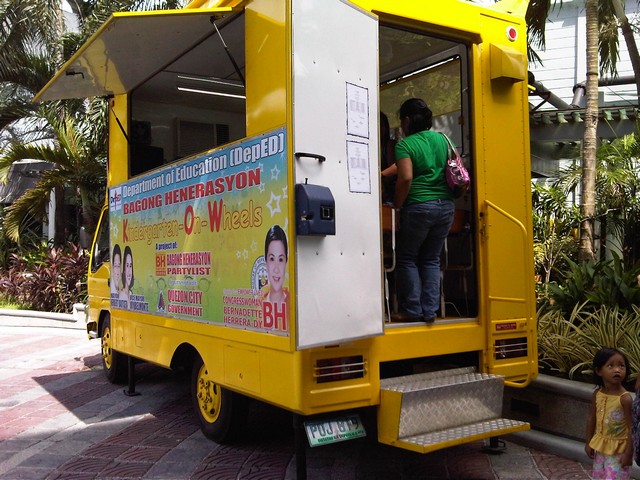
It’s the first day of classes, and five-year-old Joseph Abuso and his classmates were having classes -- inside a parked bus.
The bus, called a
Kindergarten-on-Wheels or mobile classroom, is equipped with the materials you typically see in a classroom like a blackboard, chairs, teacher’s table, and colorful cardboard bearing letters and numbers. It can accommodate up to 24 kids.
The kids spend up to three hours inside the bus, learning the alphabet, songs, rhymes, as well as values.
“Joseph likes it. He seems to be playing inside a bus,” said the child’s mother, Nonette Abuso.
The Kindergarten-on-Wheels project is one of the immediate measures taken to cover the shortage of classrooms at President Corazon Aquino Elementary School in Quezon City.
The school has consistently been overpopulated with pupils, since the area is located in one of in Quezon City's most populated villages.
And the entry of kindergarten kids has made the classroom shortage problem even worse.
Building one classroom in Metro Manila will cost about P650,000. But it’s not only the budget shortfall that hinders the construction of more classrooms. It’s also because there’s just no more space to build land on.
And so party-list group Bagong Henerasyon (New Generation) figured out that a bus would make a good alternative classroom.
“At least for the bus, you just park it in one corner and that’s okay. You can now hold your classes,” said Suzette Lee, the chief-of-staff of Bagong Henerasyon.
At the President Corazon Aquino Elementary School, the mobile classroom services four shifts of kindergarten classes or for 12 hours a day starting at six in the morning.
Lee said this Kindergarten-on-Wheels, which costs P800,000, is the first in the Philippines.
“Another good thing with this mobile classroom is that you can bring it to remote villages where there are no schools during weekends and hold your classes there,” Lee added.

Inside the Kindergarten on Wheels during recess. Claire Delfin
1.6 million kindergarten kids
Kindergarten (a German word for children’s garden) is said to be the first step in the formal education process. It is also given at a time when the child’s mind is most active and behaves like a sponge, fast absorbing any information fed to the child.
It is for this reason that the Philippines enacted the Kindergarten Law.
Signed into law in January 2011, Republic Act 10157, otherwise known as “An Act Institutionalizing Kindergarten Education into the Basic Education System and Appointing Funds Thereof,” mandates that kindergarten be mandatory for five-year-olds starting this school year.
Its first year of
implementation attracted some 1.6 million children to enroll in kindergarten.
“Kindergarten is now compulsory in all public schools to better prepare pupils for the rigors of regular schooling," the Department of Education (DepEd) said in a statement. “It is among the components of our thrust to push for serious education reforms.”
Compulsory kindergarten forms part of the government's efforts to upgrade Philippine basic education under the so-called "
K (kindergarten) plus 12" program.
Apart from making kindergarten mandatory, two more years have now been added to the previous 10-year primary and secondary basic education system.
The program aims to produce more competent Filipino high school graduates and will also put Philippine education at par with those in other countries, DepEd claimed.
But whether the Philippines is ready for universal kindergarten or not is another question, said Benjie Valbuena, vice president of the Alliance of Concerned Teachers.
He said that while teachers welcome universal kindergarten, there are simply no sufficient manpower and resources for the additional new students because even before its implementation, the country already faces big shortages in facilities, classrooms, and even teachers.
“How would the government accommodate these additional enrollees without sacrificing the quality of education?” Castro asked.
More than 30,000 teachers will have to be hired to serve these new kindergarten students, he said. Classroom backlog is still at a high 66,000.
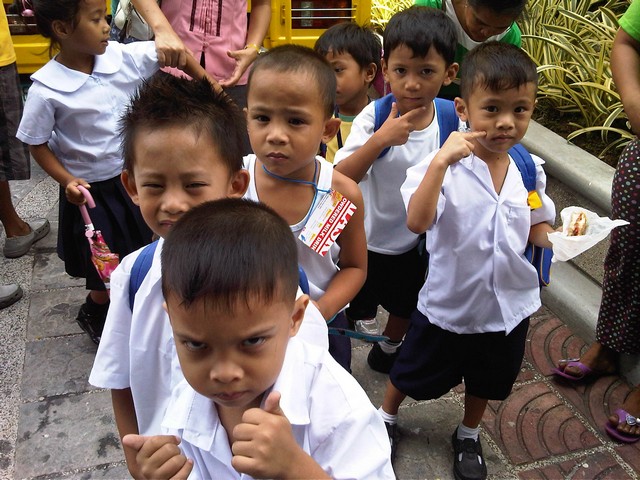
Some of the five-year-old kindergarten kids. Claire Delfin
Political will
How kindergarten education started in PHL Preschool education started during the Spanish regime when young Filipinos mostly coming from the bourgeois class were taught Christian doctrine. It was a predominantly religious class which utilized certain textbooks that contained the alphabet and prayers.
In 1924, the opening of kindergarten education at Harris Memorial School Manila (Harris Memorial College) pioneered preschool education.
But government recognition did not come until 1940 when the Bureau of Private Schools authorized 129 kindergarten classes, getting an enrolment of 6,449 kids. World War II, however, disrupted the growth of the program. After the war, preschool education in the country has mostly been associated with the Bureau of Private Schools, especially those run by religious groups. It was not until the 1950s that preschool education started in government schools. Pangasinan Normal School was the first to offer it. In 1956, the Manila Health Department introduced the concept of modern preschool “play centers” in Manila. In the mid-1960s, the Department of Social Welfare started including nursery and kindergarten education in its program. From 1978 to 1989, the Department of Education, Culture and Sports (DECS) encouraged the operation of preschools in public elementary schools. From 1993 to 1994, there were 1,892 DECS-recognized and registered private schools in the country with 416,894 enrolled preschoolers Three reform programs were initiated from 1995 to 2000 in response to the growing number of preschoolers needing education:
- Education for All
- Congressional Commission on Education
- Implementation of Local Government Code
–Eloisa Gelito-Bautista/KG, GMA News Education Secretary Armin Luistro said political will and cooperation from all sectors are needed to put in place all necessary education reforms.
Despite existing problems concerning the country’s education system, there is no better time to implement the programs but now.
In fact, it has been long delayed if one were to compare the country’s system of preschool education with that of other countries. The Philippines was one of only two countries in the world with only a 10-year basic education system.
And kindergarten education used to be accessible only to kids whose parents can afford to send them to private schools, as there were so few public schools that offered it.
The law is also meant to provide equal opportunities for all children.
“With the Kindergarten Education Act, DepEd believes that it can achieve more in delivering quality education to the school children in line with its commitment to Millennium Development Goals on achieving Education for All by the year 2015,” Luistro said.
The law also lays down the various teaching methods for kindergarten. These include storytelling, small-group discussion, and the use of manipulative games.
And to make kindergarten easier for little kids, DepEd has adopted the
mother tongue-based multilingual education method. The students’ mother tongue shall be the primary medium of instruction for teaching and learning at the kindergarten level.
If the students are in Cebu, they will be taught primarily in Cebuano. Or if they are in Ilocos, it’s Ilocano. English and Filipino will still be used too.
The Aquino administration has allocated a total of P2.4 billion this year for mandatory kindergarten education.
At the same time, DepEd is also exploring ways to increase the wages of kindergarten teachers in order to attract more qualified people to do the work.
Kindergarten teachers in public schools currently receive an allowance of P3,000 per four-hour shift. DepEd said it intends to provide them up to at least P12,000 in monthly compensation.
Providing some 27,000 new kindergarten teachers with better salaries already requires DepEd to pool an annual budget of P5.7 billion for that purpose alone.
And that is why DepEd has been partnering with local government units, other government agencies, and the private sector to address the urgent needs that come along in pushing education reforms, even if that means holding classes inside a bus. –KG/HS, GMA News


 GMA Brandtalk
 Tracking
 Archives


