

 GMA Brandtalk
 Tracking
 Archives

ADVERTISEMENT
Filtered By: Topstories
News
Pork Chopped: Road projects are legislators' favorites
This article is an introduction to a series of special reports drawn from our analysis of the discretionary funds at the disposal of congressmen and senators.
When we started this project, we posed to ourselves only one question: where do pork barrel funds go?
GMA News Research built a database to find an answer.
For more than a year, we reviewed thousands of project entries to find out how pork barrel funds, of both senators and House members, were allocated.
We processed five years’ worth of congressional allocations posted on the Department of Budget and Management (DBM) website – the priority development assistance fund (PDAF), the Department of Public Works and Highways (DPWH) lump-sum allocations for Congress identified infrastructure projects, and financial subsidies to local government units (FSLGU).
The DBM data on pork barrel funds contain project descriptions, project amounts, and agencies assigned to implement the projects. We further classified the DBM data according to project type, fund use, and geographical location.
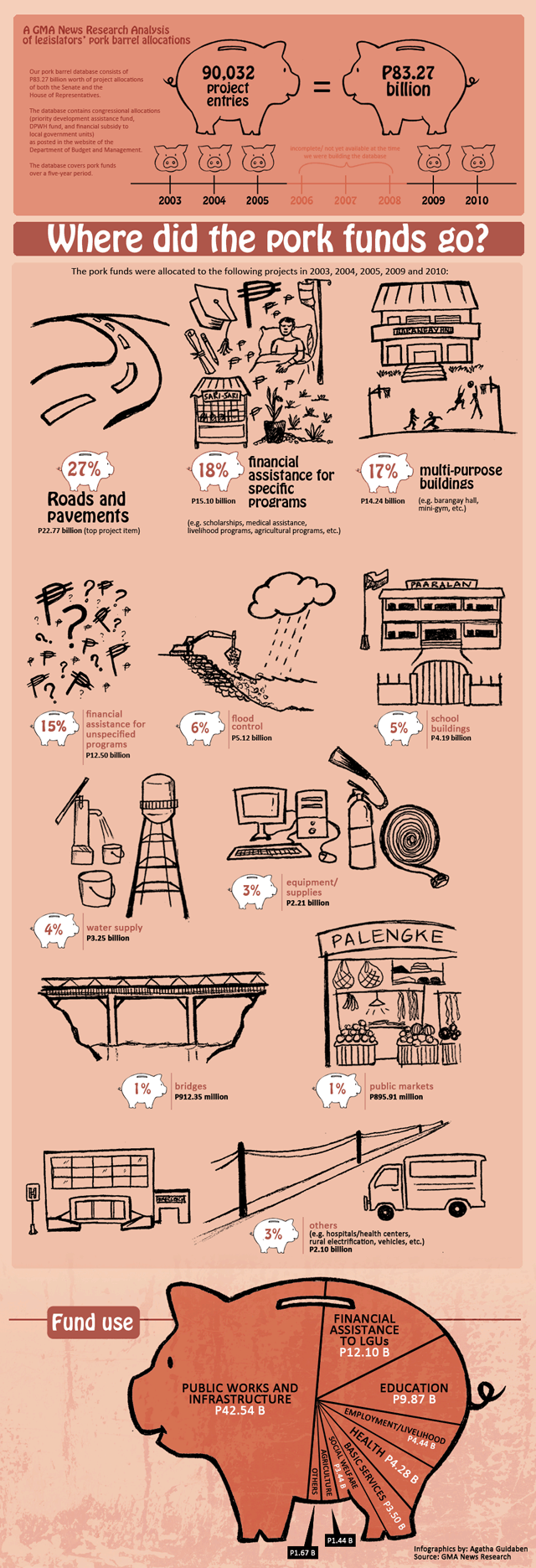
Our database contains 90,032 project entries equivalent to P83.27 billion from five non-consecutive years — 2003, 2004, 2005, 2009 and 2010. The sample years span the 12th to the 15th Congress.
An analysis of the data indicate that roads and pavements got the biggest slice in the pork pie: such projects accounted for 27 percent (P22.8 billion) of the pork allocations in our database.
Financial assistance for specific programs came in second, accounting for 18 percent (P15.1 billion) of total pork allocations.
Multi-purpose buildings ranked third, accounting for 17 percent (P14.2 billion) of the pork pie.
Our findings cover only the years included in the study period. Though indicative, our findings do not extend to data beyond the scope of the study.
The origin of the term “pork barrel” dates back to a time when refrigerators had not yet been invented. It was an old Western custom to preserve meat in actual wooden barrels for future consumption.
Connoting fat and grease and stored resources, the term has since seeped into ordinary conversations as a metaphor for political largesse.
Continue reading here
Roads
That infrastructure projects, particularly road and paving projects, emerged as the top item in the database is expected, according to the parties concerned and among political observers as well.
Deputy House Speaker Lorenzo Tañada III cites parts of his district as an example. “May mga bundok kami na inaccessible by vehicle, so you have to walk for two to three hours to get to a certain barangay.”
Tañada is on his third and last term as representative of the fourth district of Quezon province. The district is composed of 10 partially urban municipalities, four of which may be considered as poor (5th class municipalities which have an average annual income of P15-25 million).
Quezon province is one of 56 provinces in the country where roads and pavements are the top pork project.
Dr. Milwida Guevara, one of the founding members of the non-government advocacy group Movement for Good Governance and a former finance undersecretary, has travelled to far-flung places that can only be reached by horseback because roads are non-existent.
“May kasalanan din ang national government eh kasi di sila responsive dun sa mga pangangailangan ng tao para sa daan. Ang hirap mo rin kasing puntahan yung DPWH, parang ang layu-layo nya. So talagang ang resort ng mga tao, pumunta sa mga congressman at humingi ng daan,” Guevara says.
Prof. Alvic Padilla of the UP National College of Public Administration and Governance, states an obvious point. “I’m not surprised na all roads kasi amount wise, it’s more costly of course to build a road as compared to a project like subsidy for health insurance,” he says.
The DPWH is the main implementing agency of pork barrel-funded infrastructure projects or so-
called “hard” projects. A portion of the department’s fund is earmarked for projects to be identified by legislators.
DPWH Undersecretary for Regional Operations Romeo Momo agrees that roads should be a priority infrastructure program.
“What really helps the community is connectivity – there are barangays that are not connected to the national highways,” Momo tells GMA News Research in an interview.
Padilla notes that indeed, there are still a lot of areas in the countryside that need infrastructure to transport agricultural products from rural areas to commercial centers. However, “di naman porke roads e OK na,” he cautions. “San ba yung road na yan? Where does that road lead to?” he asks.
Guevara raises another issue: “Yung infrastructure kasi malaki yung pwedeng komisyon dun at malaki yung kickback... pwede mong i-jack up yung presyo. Tapos sa imprastraktura, sisikat yung kongresista o yung senador kasi syempre andun yung pangalan nya, litrato nya. Itong daan na ito ay posible at programa ito ni congressman.”
Multi-purpose buildings
Multi-purpose buildings (MPBs) are the second biggest infrastructure item in the pork pie.
Among all the types of projects in our database – PDAF, DPWH, FSLGU – MPBs ranks third, just a few percentage points behind financial assistance for specific programs in terms of share to total pork funds.
MPBs topped the list of pork projects in 12 provinces: Batanes, Bohol, Bukidnon, Capiz, Cotabato, Davao Oriental, Lanao del Norte, Marinduque, Sarangani, South Cotabato, Sultan Kudarat and Surigao del Sur.
The examples of multi-purpose buildings include those described as barangay halls, municipal halls, mini-gyms, health centers, classrooms, etc.
Like roads, MPBs are important pork projects, says Rep. Tañada.
“It can be used for other purposes – barangay halls, evacuation centers, kung minsan dance halls,” he says. “I think nakakatulong naman ito sa barangay kung meron silang pagpupulungan, meron rin ho silang matatakbuhan pag may kalamidad.”
Guevara likewise sees the usefulness of MPBs. She, however, notes the lack of standards against which one can measure such structures.
“Ang problema sa pork, di mo alam kung anong klaseng MPB... masyadong open-ended. Ano ba dapat yung istruktura? Magkano ba dapat yung gagastusin at sa anong activities sya dapat magamit?” she asks.
For Padilla, the issue with MPBs is maintenance: electricity, water connection, toilets; even the
furnishings, supplies, equipment and manpower needed for the building to be operational should also be considered. “Baka kino-consider ng congressman, basta natayo na, it’s a contribution... napinturahan na ‘courtesy of congressman so-and-so’ and that’s it. But that doesn’t necessarily mean na nakapag- benefit na yung mamamayan just because may building. Dapat nagagamit talaga, nabibigyan ng serbisyo,” he says.
Financial assistance for specific programs
GMA News Research classified the different types of non-infrastructure projects in the database into two broad groups – financial assistance for specific programs and financial assistance for unspecified programs.
The bigger group is financial assistance for specific programs. This group got the second biggest slice in the pork pie, accounting for 18 percent (P15.1 billion) of pork allocations in our database.
Examples of financial assistance under this group are doleouts like medical assistance for indigent patients, scholarships granted to students, and an assortment of specific programs such as livelihood programs, agricultural modernization programs, etc.
Three provinces had financial assistance for specific programs as their top pork project: Camiguin, Palawan and Zambales.
“Hindi mo naman maiiwasan yan dahil sa kahirapan,” says Tañada. For instance, in the case
of those who seek medical assistance, “nahihirapan pong magpagamot ang ating mamamayan so kailangan may allocation ka sa ospital – sa district hospital or in the main public hospitals – a certain fund for your constituents to access,” he says.
But again, as with MPBs, experts critique financial assistance-type pork projects for lack of standards.
Padilla cites scholarship programs to illustrate his point. “Again, ano ang criteria for selecting kung sino ang makikinabang? Nagpapaexam ba tapos pataasan ng score? Definitely hindi lahat ng gustong mag- aral ay mabibigyan ng scholarship,” he asks.
Guevara thinks constituents themselves have wrong notions about their elected representatives.
“Yung mga tao... hingi lang sila nang hingi ng tulong sa mga congressman. Panlibing, pangkasal, mga medalya,” Guevara says. “Yun yung criterion natin—madaling hingan,” she says.
Financial assistance for unspecified programs
Aside from financial assistance for specific programs, GMA News Research also encountered another form of financial assistance in the course of building the pork barrel database.
We called this group of pork projects “financial assistance for unspecified programs” due to the lack of information about the nature of the project.
Examples of projects under this group are entries simply stating that “financial assistance” or “financial assistance for priority development programs and projects” was extended to a particular municipality or to a particular agency.
The description as mentioned is redundant since the very nature of pork barrel makes all projects funded by it “priority development projects.”
Financial assistance for unspecified programs takes up 15 percent or P12.5 billion of the total pork allocations in our database.
It’s the fourth largest slice in the pork pie, and is the top project item in seven provinces — Aurora, Compostela Valley, Ilocos Sur, Lanao del Sur, Negros Oriental, Tawi-Tawi, and Zamboanga del Sur — in the five-year sample period.
Rep. Tañada offers a possible explanation for the vague descriptions. “For example, tulong sa mga barangay tanod sa buong distrito... kung minsan, mahirap naman kasi it becomes too tedious e. Sa paper work, talo ka na dahil lahat ng barangay imemention mo,” he suggests.
Padilla also has an alternative explanation. “Different municipalities call for different types of programs or support. Minsan kailangan talaga ng district pero di kasama sa menu,” he says. “Ok lang yan na may loose ends to accommodate peculiar situations ng iba’t ibang lugar.” he adds.
But given the billions of pork funds approved for financial assistance to “unspecified programs” as shown in our database, Padilla is unsatisfied with the level of detail provided in the DBM website.
“It’s a challenge for those na nagdedemand ng transparency, kasi as much as possible gusto nyo full and detailed accounting kung ano ba ang pinaggamitan nito. It’s frustrating to see such amounts na di pa rin klaro. It’s already reported, pero yung report doesn’t give you much details on the purpose ng pinaggamitan,” Padilla says.
In our own experience as we were building the database, we noted that the level of detail provided on the DBM website was not consistent. There were incomplete project locations; there were cases when the breakdown of allocations are not provided and the projects are just lumped under one amount.
GMA News Research set aside projects where the given data are insufficient; these projects were worth around 2 percent of the total amount in the database.
Table scrap allocations
Other types of projects consumed the less than one fourth of the pie that remained.
Flood control accounted for 6 percent (P5.1 billion) of the total pork allocations in the database.
Two provinces had flood control projects as their top pork barrel-funded projects: Albay and
Catanduanes, both in the Bicol region, an area that lies in the path of tropical cyclones crossing the Philippine Area of Responsibility and is usually the first to bear the brunt of a typhoon once it makes landfall.
The following project types were at the bottom of the list of pork allocations: school buildings, water supply equipment, bridges, and public markets.
Pork’s purpose
Tañada explains the purpose behind the pork barrel system.
“Mas nakalubog ang mga congressman sa kanilang distrito, mas alam nila ang pangangailangan ng bawat LGU,” he says, adding that by themselves, some municipalities do not earn enough income. “Kung walang mapagkukunan ang mga mayor ng tulong para sa kanilang proyektong pang-bayan e talagang mapag-iiwanan sila ng kaunlaran, kaya ang tinatakbuhan ng mayor, ng councilor, ng barangay captain o anumang informal, sectoral organization ay yung congressman,” he says.
Senate President Juan Ponce Enrile believes it is wise to give legislators a certain allocation to cover areas that are not prioritized by the national government.
“If you leave it to the national government and budgeting agencies to provide the money for certain projects, there are many areas of the country that would not get any improvement,” Enrile explains in a brief interview with GMA News Research. “The national government is into big ticket items like highways, development of harbors and airports... for things like farm-to-market roads and local irrigation and electrification, these are not national priorities of the national government.”
Then again, Enrile – who has been a legislator since 1978 — also thinks the pork barrel system could use some improvement.
“I think the implementation must be done by the agencies of government with strict adherence to the specs in order to prevent a topsy-turvy and lousy implementation of these projects — this will become a source of wastage,” the Senate President said.
Enrile referred to the menu of projects that Congress has to conform with when deciding on pork barrel allocations. This menu is contained in the annual General Appropriations Act. (see sidebar)
But as both Padilla and Guevara repeatedly pointed out during our separate interviews with them, pork barrel projects lack standards against which their efficiency and necessity can be measured.
“Although may menu – mahaba-habang menu yan na makikita sa special provisions ng budget – it is left to the congressman the power to identify; the power to identify kung anong project ang popondohan, the power to identify kung saan sa distrito nya, at kung sino ang beneficiaries na gustong nyang makinabang dun sa mga programa na i-iidentify nya,” Padilla notes.
Guevara stresses the importance of setting standards. “Dapat may sukat. Dapat may detalye. Magkano ba yung ginastos sa bridge na ito? Kung gumastos sya ng , let’s say, P10 million. Yun ba ay tamang sukat ng gastos sa bridge? Baka naman ang gastos sa bridge ay P5 million lang. Ibig sabihin, nag-overspend sya,” she illustrates. “Wala tayong ganun e, talagang hindi natin masusukat.”
Tañada thinks it’s up to agencies like DPWH to set these standards. “It’s not to Congress to do that; wala naman kaming technical know-how,” he says.
Then again, the DPWH merely implements what legislators identify. DPWH USec. Momo shares that while some legislators do consult with them and follow the agency’s recommended priority projects, many others do not go by DPWH’s suggestions and go ahead with their own identified pork projects. “The listing does not come from us, it comes from them – so kahit kami ang mag sasuggest, kung ayaw nila, wala kaming magagawa,” Momo explains. — with GMA News Special Assignments Team/ HS

