

 GMA Brandtalk
 Tracking
 Archives

Millionaires, not marginalized Pinoys, dominate party-list seats in Congress
Purging the party-list system: Part 1 of a GMA News Online exclusive  With a net worth of over P130 million, Rep. Catalina Bagasina would hardly strike anyone as someone who represents the interest of laborers in the legislative branch of government. Yet, the former mayor is not the only millionaire who occupies what was intended as a noble position for marginalized groups at the House of Representatives. In fact, Bagasina is merely the richest among the 47 party-list representatives in the 15th Congress who have a declared net worth of at least two million pesos. Together, they account for a whopping 80 percent of the current batch of 56 party-list representatives, a number that has been rising in the past five congressional terms. 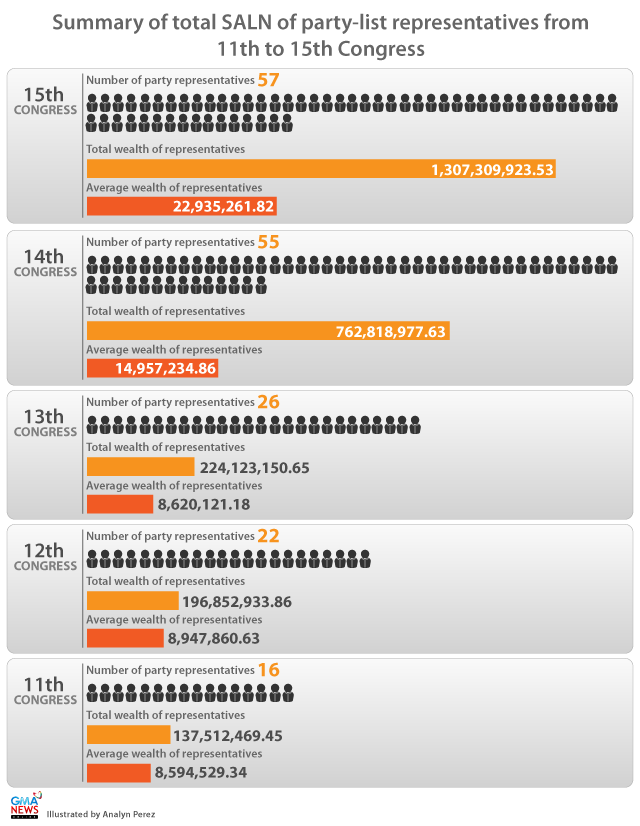 How did a rich politician like Bagasina manage to get into a representational system that was supposed to be reserved for the marginalized and underrepresented? The answer may lie with the Commission on Elections (Comelec), whose members have differing interpretations of the law that created the party-list system. Rene Sarmiento, the longest-serving Comelec commissioner, says the party-list system is meant to level the playing field in the elite-dominated legislature. He recalls that his fellow member at the 1986 Constitutional Commission, Christian Monsod -- who later became Comelec chairman -- first introduced the party-list system during their deliberations on the charter. The original intent of the system was to open the political arena to “sectors or groups that have a national constituency, without specific reference to the marginalized and underrepresented sectors or groups,†according to Sarmiento. However, when the Party-List System Act of 1995 or RA 7941 was passed, the words “marginalized†and “underrepresented†were inserted into Section 2 of the law, reserving seats for sectors or groups such as labor, peasant, fisherfolk, urban poor, indigenous cultural communities, elderly, handicapped, women, youth, veterans, and overseas workers. The system was first implemented in the 1998 presidential elections. But through the years, the proliferation of millionaire party-list reps has tainted the noble ideal of getting marginalized sectors represented in Congress. Sectoral representatives have become richer and richer, as seen in their declared statements of assets and liabilities net worth (SALN). Politicians turned party-list reps Before she became the party-list representative of the Association of Laborers and Employees in 2010, Bagasina served as the mayor of Sasmuan town in Pampanga for three terms. The second richest party-list representative is also from Pampanga, former 2nd district congressman Juan Miguel Arroyo of Ang Galing Pinoy, who gave up his seat in favor of his mother, former president Gloria Macapagal-Arroyo. At the other end of the spectrum is Nueva Ecija farmer Rafael Mariano of Anakpawis, the poorest congressman with a net worth of P61,328. The second poorest is another legislator from militant groups, Teodoro Casiño of Bayan Muna with P91,000. Arroyo and Bagasina are not the only former government officials who morphed into party-list representatives as a continuation of their political career. Bernadette Herrera-Dy, who served as Quezon City councilor for nine years, now sits for Bagong Henerasyon which claims to represent the urban poor, women, and elderly. Reena Obillo, a senior program officer of the Department of Agrarian Reform, represents Una ang Pamilya while former Agrarian Reform secretary Nasser Pangandaman has taken a congressional seat for AA Kasosyo. In the same vein, political families have found the party-list system a convenient entry point into Congress. Robert Raymund Estrella and Francisco Emmanuel Ortega III, both from prominent political families in the Ilocos Region, both sit as representatives of the farmers’ party-list group Abono. “Naging wake-up call ito sa Comelec dahil marami sa party-list napansin naming magkakamag-anak,†Sarmiento said. “Sobra na ito. And then merong mga pulitiko na gustong bumalik sa Kongreso through a party-list. For me, this is making a mockery of the party-list system. This has to end,†he added.
Last Nov. 29, the Comelec released its “semi-final†list of approved party-list groups for the 2013 polls. Despite the poll body’s efforts to supposedly cleanse the system of groups that fail to represent the marginalized and underrepresented sectors, however, a cursory look at the list shows groups affiliated with government officials, millionaires, and well-entrenched political families.
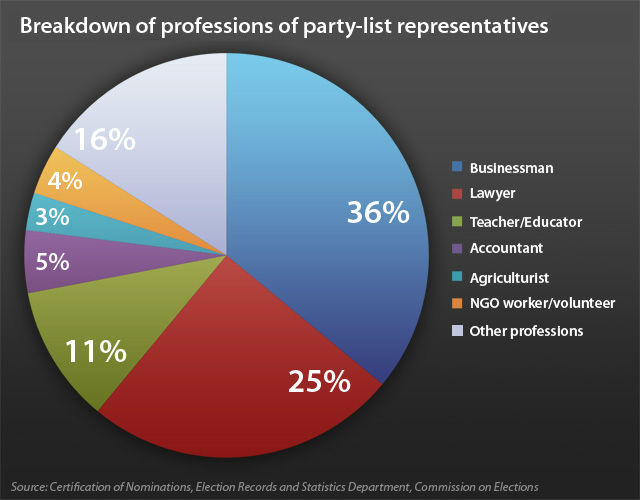 Among them is Teodorico Haresco of Ang Kasangga, who is supposed to represent micro entrepreneurs in Congress. Hardly a small-time businessman, Haresco is the chairman of Winsource Solutions, a service provider for call center agencies and other business process outsourcing companies. He is also currently the third richest party-list representative, with a net worth of P92.8 million. There’s also Julieta Cortuna, who sits as representative of A Teacher and supposedly teaches health, wellness, and livelihood programs for unspecified institutions. She is also the president of a trading and milling company, general manager of Dreamland Travel and Tours, and proprietor of Worldwide Marketing of RLE Squalene Product Essential Life Corp. With the entry of multimillionaires and politicians, the party-list system has been “subverted by traditional politics†and its landscape now hardly differs from its richer counterparts in district representation, said Bobby Tuazon, policy analyst of the Center for People Empowerment in Governance. “It is not the social justice tool that it was designed to be by the crafters of the Philippine Constitution in 1987,†Tuazon added. “It increasingly threatens the need to give equal opportunities to the marginalized sectors to be represented in Congress.†– Multimedia produced by Candice Montenegro and Wayne Manuel/YA, GMA News In Part 2: Have the party-list legislators done anything for the sector they are supposed to represent? Note: This report is based partly on the undergraduate thesis of the two authors when they were still journalism students at the University of the Philippines College of Mass Communication, under the supervision of Prof. Yvonne Chua. The main references used were the SALN summaries of the legislators available at the PCIJ library. Cayabyab is now a reporter for GMA News Online covering the Comelec, while Flores works for VERA Files. Their investigative report won the best thesis award for 2012.
