

 GMA Brandtalk
 Tracking
 Archives

ADVERTISEMENT
Filtered By: Topstories
News
How the senators performed during the 15th Congress
Last in a 2-part series
GMA News Online also looked into how much legislative work the senators were able to accomplish during the 15th Congress.
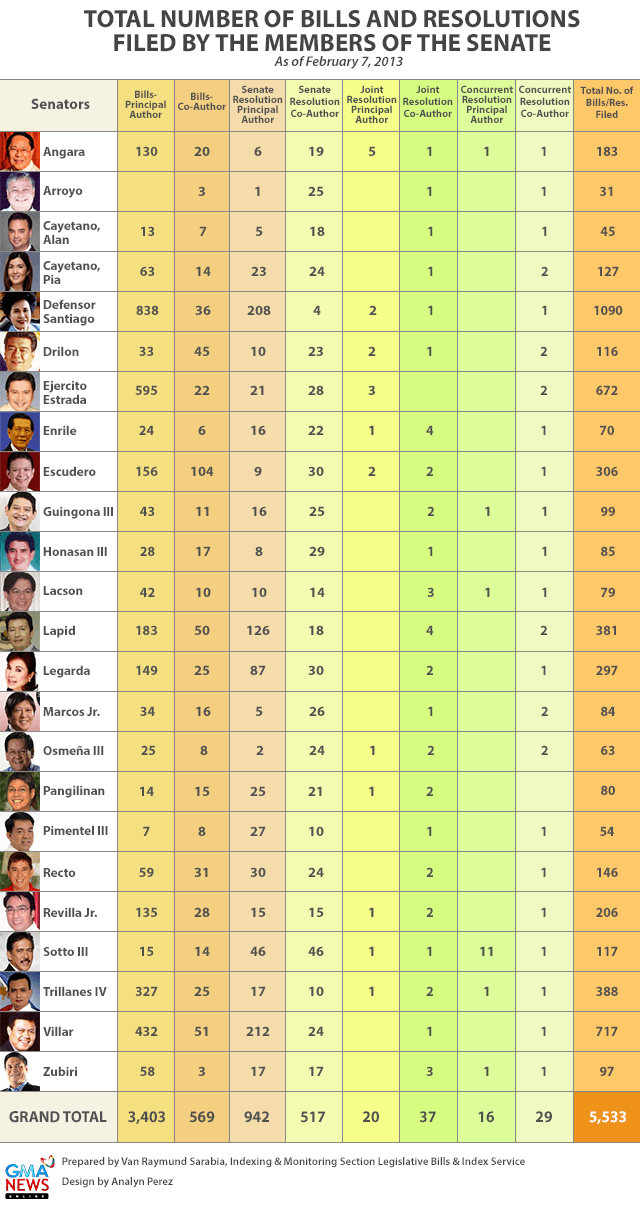
Data from the Senate Legislative Bills and Index Service showed that Joker Arroyo authored and co-authored the least number of bills and resolutions (31) for the 15th Congress as of February 7, 2013.
Following him were Alan Peter Cayetano with 45 and Pimentel with 54.
Pimentel, however, was only able to assume his post on Aug. 8, 2011 during the second regular session, after former Senator Juan Miguel Zubiri resigned from his post.
On the other hand, Miriam Defensor Santiago authored and co-authored the most number of bills and resolutions (1,090) for the 15th Congress.
Behind her were Manny Villar with 717 and Jinggoy Estrada with 672.
Villar's term will be expiring in 2013 but his wife, former Las Piñas Rep. Cynthia Villar, is seeking a Senate seat in May. Meanwhile, Estrada's term will expire in 2016.
But these measures may not always be attributed to the senators since, according to the Senate website, legislative proposals originate from a number of sources.
It said senators "develop" ideas for legislation but assistance in research and drafting is available at the Senate Legislative Technical Affairs Bureau. Senators also have their own legislative officers to help with this task.
A legislative officer who has worked for two incumbent senators confirmed with GMA News Online that senators don't usually craft these bills on their own.
The officer explained that sometimes, groups approach them to lobby for a legislation, or their legislative team comes up with an idea for a bill and proposes it to the senator. The same Senate source said that sometimes, a senator gets an idea and tells them to execute it.
The Senate website said "special interest groups — business, religious, labor, urban and rural poor, consumers, trade association, and the like — are other fertile sources of legislation."
"Sa amin, senator [ang] nag-aapprove pag convinced [na] siya [na[ okay na," said the legislative officer.
A staff of another senator noted that majority of their bills are "born out of constant discussion" with their boss.
"Yung tipong nagdi-discuss kami and bigla siyang, ba't di kayo gumawa ng bill about this, about that. Minsan naman he's got something in mind na kaya he'd just say: I want a bill like this," he said.
According to the legislative officer, it is also quite easy to be a co-author of a certain bill. All you have to do, the officer said, is manifest on the floor or through a letter to the Senate President and Senate majority floor leader that you want to be co-author of a measure.
Only 26 bills became law
According to the Senate website, there is no limit to the number of bills a member of the Senate may introduce in the upper chamber.
A look into the 3,403 Senate bills filed during the 15th Congress, however, showed that only 26 have so far been enacted into law as of Feb. 6, 2013.
Among these were the controversial GOCC Governance Act, Cybercrime Prevention Act, Sin Tax Reform Act, and the Reproductive Health Act.
Sen. Franklin Drilon, as chair of the Senate finance committee and previously of the ways and means committee, sponsored and pushed for the GOCC and Sin Tax Acts. The GOCC Governance Act was co-authored by Senators Drilon, Angara, Ralph Recto, and Ramon "Bong" Revilla Jr. while the Sin Tax Act was co-authored by Lacson, Santiago, and Recto.
On the other hand, the Cybercrime Prevention Act was co-authored by Senators Trillanes, Angara, Enrile, Estrada, Santiago, Revilla, Lito Lapid, Bongbong Marcos, and Legarda. It was sponsored by Angara as chair of the science and technology committee.
The Reproductive Health Act was co-authored by Santiago, Lacson, and Pia Cayetano. Santiago and Pia Cayetano, as chair of the health and demography committee, co-sponsored the measure.
However, the Cybercrime and Reproductive Health Acts were both challenged before the Supreme Court. The Sin Tax Reform Act likewise faced great opposition from several sectors. Also signed into law last February 25 was the Human Rights Victims Reparation and Recognition Act, a landmark measure offering compensation to victims of human rights violations under Martial Law.
At least four other measures that were approved by Congress, meanwhile, were vetoed by President Benigno Aquino III.
Impeachment court, flurry of inquiries Taking time out from legislative work, the Senate last year held a grueling five-month impeachment trial for Supreme Court Justice Renato Corona. Voting 20-3, the impeachment court on May 29, 2012 convicted the former chief magistrate for betrayal of public trust and culpable violation of the Constitution.
Likewise, the Senate conducted several inquiries on controversial issues in the past three years.
Among these were the following:
- Senate blue ribbon committee hearings on the controversial plea bargain deal involving accused plunderer and former military comptroller Ret. Gen. Carlos Garcia;
- the alleged corruption in the Armed Forces of the Philippines (AFP);
- the alleged anomalous acquisition of choppers by the Philippine National Police in 2009;
- the donations made by the Philippine Charity Sweepstakes Office to the so-called "Pajero bishops";
- the alleged anomalies in the implementation of Palawan projects funded by Malampaya royalty.
The Garcia investigation was initiated by Alan Peter Cayetano; the AFP corruption probe by Trillanes; the chopper inquiry by Guingona and Lacson; and the Malampaya probe by Guingona through resolutions.
Aside from this, Guingona and Senate electoral reforms committee head Aquilino "Koko" Pimentel III also looked into alleged fraud during the 2004 and 2007 elections.
The inquiry stemmed from the resolution filed by Lacson and Cayetano.
On the other hand, Guingona and Sen. Sergio Osmeña III, chair of the Senate committee on banks, financial institutions, and currencies conducted at least nine hearings on the alleged behest loans granted by government banks to businessman Roberto Ongpin.
Osmeña, on his own, also held at least five hearings on the alleged overpricing of bridges supplied to the Philippine government during previous administrations. He had a delivered a privilege speech on the issue.
The Senate agriculture committee, led by its chair, Francis Pangilinan, also conducted at least 11 hearings on the problem of rice smuggling in the country. The inquiry stemmed from a privilege speech delivered by Enrile. - RSJ/YA, GMA News Read Part 1 here: Roll call - attendance of senators in 15th Congress

