

 GMA Brandtalk
 Tracking
 Archives

ADVERTISEMENT
Filtered By: Topstories
News
Pork patrons: 47 reps gave nearly a billion pesos to dubious NGOs
In the past few weeks, the GMA News Research and Special Assignments Teams have come up with a series on a web of individuals and non-government organizations dubbed the “Godofredo Roque group.” Named after the person with the most ties to the eight foundations in the group, this cluster is among the 82 NGOs that the Commission on Audit has questioned for various irregularities in the way they obtained and used pork barrel funds.
This report looks at the members of the House of Representatives that gave government funds to this group.
Anyone who places second is usually forgotten, but when that someone ranks next to trader Janet Lim-Napoles in having the most number of NGOs linked to anomalies in pork barrel funds, the public might do well to remember his name.
Based on past government audit reports, GMA News Research discovered a separate group of eight foundations that have been questioned for similar wrongdoing. A network of eleven people are incorporators and officers in at least two foundations in this cluster, among them Godofredo Roque, who has the most connections to this group.
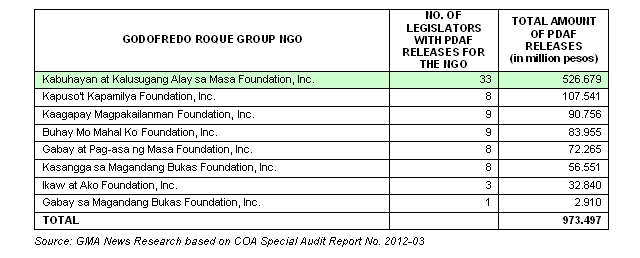
In the Commission on Audit's special report on pork barrel funds from 2007 to 2009, GMA News Research found that the group received close to a billion pesos in Priority Development Assistance Funds (PDAF) from 47 members of the House of Representatives.
Together, the Godofredo Roque group accounts for P973 million out of the estimated six billion pesos in pork barrel funds transferred to NGOs that the COA has questioned due to numerous irregularities.
A much bigger chunk, more than P2 billion, went to 10 NGOs that whistle-blowers have linked to Napoles, the COA said in a press release.
GMA News Research and the GMA Special Assignments Team located Roque at his address in Pampanga, but he refused to be interviewed or to comment on these findings.
Among the legislators that gave funds to the group, two former congressmen from Bohol—2nd District Rep. Roberto Cajes and 1st District Rep. Edgardo Chatto—gave substantial amounts worth more than a hundred million pesos to the most number of NGOs in the cluster.
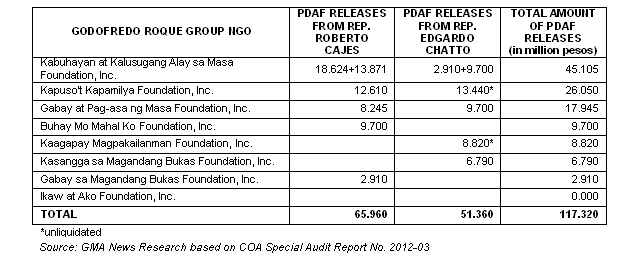
Sought for verification, the two Bohol legislators denied committing their PDAF to questionable NGOs. They are among 22 legislators who told the audit agency that their purported signatures on most, if not all, the documents submitted by the NGOs who used their PDAF are fake.
“I’m sure the signatures appearing in most of the documents submitted by these NGOs in my name are not my genuine signatures,” Cajes said in a text message sent to the GMA News Special Assignments Team.
“I was surprised to discover that the many names of the beneficiaries who received the items/trainings were not the same names submitted by some NGOs to the implementing agencies,” he added, noting that he has complete records of the beneficiaries of his PDAF.
Chatto, who is currently the Governor of Bohol, also strongly denied involvement in any PDAF irregularity.
“In a letter sent to the concerned agencies BEFORE project implementation, I have categorically stated that NGOs must comply with the standard auditing rules and regulations, policies and guidelines prescribed by law and by the appropriate agencies to qualify as project implementer,” Chatto explained in a statement e-mailed to the GMA News Special Assignments Team.
“Such a condition, if not satisfied, is a categorical objection to the NGOs' participation,” wrote the former three-term representative.
As for the documents presented by the NGOs that used his PDAF, Chatto said, “I have sought the assistance of experts to examine the supporting documents which on its face are spurious.”
Still in government
Based on the annexes of the COA special audit report, 47 members of the lower house had PDAF releases that went to the Godofredo Roque group of NGOs.
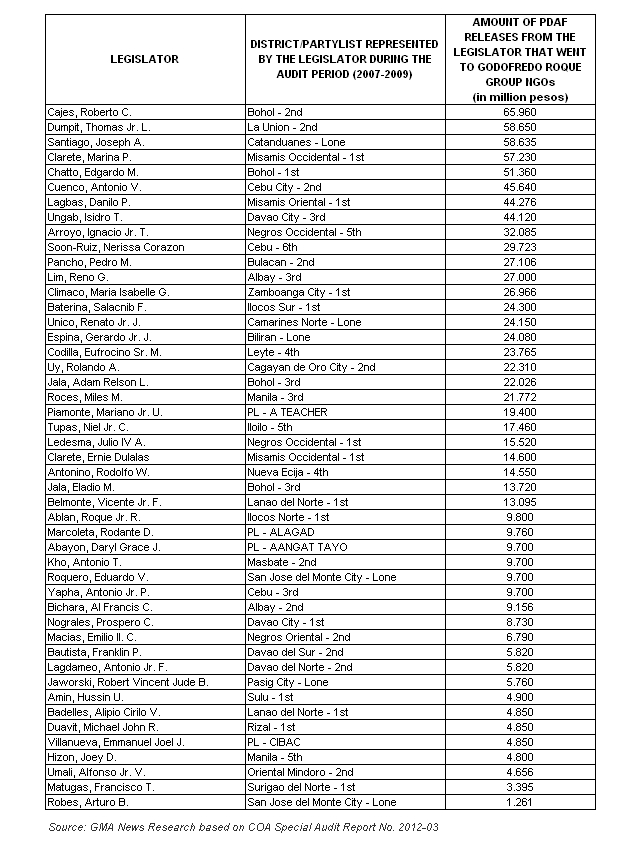
Eleven of them are once again in the 16th Congress:
Four others are now local chief executives:
One remains in government as an appointive official: Technical Education and Skills Development Authority director general Emmanuel Joel Villanueva, who was previously the CIBAC partylist representative.
Former Davao City 1st District Rep. Prospero Nograles, who served as House Speaker during the latter half of the audit period, and 30 other legislators on the list are no longer in government.
Half a billion pesos for one NGO
Among the eight NGOs, the Kabuhayan at Kalusugang Alay sa Masa Foundation, Inc. (KKAMFI) appeared to be a favorite conduit, getting more than five hundred million pesos from dozens of legislators.
In its 2012 General Information Sheet filed with the Securities and Exchange Commission, KKAMFI is described as a group primarily engaged in “livelihood development projects, community mobilization, agricultural support services, rural infrastructure projects, per by Laws.”
The amount channeled through the group purportedly covered the purchase of fruit-bearing seedlings, farm implements, and livelihood technology kits, as well as the conduct of livelihood trainings. Although based in Metro Manila, the foundation is supposed to have implemented projects in Misamis Occidental, Bohol, Davao del Sur, and Cebu.
However, COA is doubtful if KKAMFI carried out the projects at all, based on the auditors' interviews with suppliers and target beneficiaries.
A plant nursery that supposedly provided seedlings denied having any transactions with the foundation. A supplier of livelihood technology kits presented questionable receipts as proof of its transactions with KKAMFI. Furthermore, many of the beneficiaries COA managed to track down denied receipt of the items supposedly distributed by KKAMFI. Many others were not known at their given addresses; hence, COA could not verify if they actually benefited from the foundation’s supposed projects.
In the special audit report, COA noted that KKAMFI "did not also reply in writing to the team's request to confirm the validity of these transactions and did not submit additional documents requested."
Similar observations were made for the other NGOs in the Godofredo Roque group, which all have office addresses in Metro Manila. Only one – Ikaw at Ako Foundation – had a provincial branch in Camarines Norte. Yet, these NGOs obtained funds mostly from legislators who represented districts outside Metro Manila, with 40 of them representing provinces or cities in Luzon, Visayas, and Mindanao.
Govt agencies as conduit
Under the pork barrel system, legislators allocate their PDAF for specified projects, and the funds are released directly to government agencies that are supposed to implement those projects.
In the case of the Godofredo Roque group of NGOS, the funds were coursed through the National Agribusiness Corporation, National Livelihood Development Corporation, and Technology Resource Center.
According to COA Chairperson Maria Gracia Pulido Tan, the responsibility of monitoring how the PDAF is used lies with the implementing agencies, but some of them reported finding themselves in a peculiar predicament.
“A lot of the implementing agencies told us -- and these are in writing -- karamihan sa kanila nagsasabing wala kaming hold dyan, wala kaming intervention, kasi ang mga legislators mismo ang nagsasabi na ibigay nyo sa ganitong foundation,” Tan told GMA News.
But COA does not accept such excuses. “Kaya nga implementing agency sila e. Primarily accountable sila dun sa perang natanggap nila,” Tan clarified.
Read: How pork barrel funds are misused
What about the legislators – are they liable if the NGOs end up squandering their PDAF?
“I really wouldn't know,” Tan said. “That's for the DOJ [Department of Justice] and the OMB [Ombudsman] to determine.” – With the GMA Special Assignments Team/YA
This report looks at the members of the House of Representatives that gave government funds to this group.
Anyone who places second is usually forgotten, but when that someone ranks next to trader Janet Lim-Napoles in having the most number of NGOs linked to anomalies in pork barrel funds, the public might do well to remember his name.
Based on past government audit reports, GMA News Research discovered a separate group of eight foundations that have been questioned for similar wrongdoing. A network of eleven people are incorporators and officers in at least two foundations in this cluster, among them Godofredo Roque, who has the most connections to this group.
In the Commission on Audit's special report on pork barrel funds from 2007 to 2009, GMA News Research found that the group received close to a billion pesos in Priority Development Assistance Funds (PDAF) from 47 members of the House of Representatives.
Together, the Godofredo Roque group accounts for P973 million out of the estimated six billion pesos in pork barrel funds transferred to NGOs that the COA has questioned due to numerous irregularities.
A much bigger chunk, more than P2 billion, went to 10 NGOs that whistle-blowers have linked to Napoles, the COA said in a press release.
GMA News Research and the GMA Special Assignments Team located Roque at his address in Pampanga, but he refused to be interviewed or to comment on these findings.
Among the legislators that gave funds to the group, two former congressmen from Bohol—2nd District Rep. Roberto Cajes and 1st District Rep. Edgardo Chatto—gave substantial amounts worth more than a hundred million pesos to the most number of NGOs in the cluster.
Sought for verification, the two Bohol legislators denied committing their PDAF to questionable NGOs. They are among 22 legislators who told the audit agency that their purported signatures on most, if not all, the documents submitted by the NGOs who used their PDAF are fake.
“I’m sure the signatures appearing in most of the documents submitted by these NGOs in my name are not my genuine signatures,” Cajes said in a text message sent to the GMA News Special Assignments Team.
“I was surprised to discover that the many names of the beneficiaries who received the items/trainings were not the same names submitted by some NGOs to the implementing agencies,” he added, noting that he has complete records of the beneficiaries of his PDAF.
Chatto, who is currently the Governor of Bohol, also strongly denied involvement in any PDAF irregularity.
“In a letter sent to the concerned agencies BEFORE project implementation, I have categorically stated that NGOs must comply with the standard auditing rules and regulations, policies and guidelines prescribed by law and by the appropriate agencies to qualify as project implementer,” Chatto explained in a statement e-mailed to the GMA News Special Assignments Team.
“Such a condition, if not satisfied, is a categorical objection to the NGOs' participation,” wrote the former three-term representative.
As for the documents presented by the NGOs that used his PDAF, Chatto said, “I have sought the assistance of experts to examine the supporting documents which on its face are spurious.”
Still in government
Based on the annexes of the COA special audit report, 47 members of the lower house had PDAF releases that went to the Godofredo Roque group of NGOs.
Eleven of them are once again in the 16th Congress:
- Bichara, Al Francis - representative, Albay 2nd District
- Uy, Rolando - representative, Cagayan De Oro City 1st District
- Ungab, Isidro - representative, Davao City 3rd District
- Lagdameo, Antonio Jr. - representative, Davao Del Norte 2nd District
- Bautista, Franklin - representative, Davao Del Sur 2nd District
- Belmonte, Vicente Jr. - representative, Iligan City Lone District
- Tupas, Niel Jr. - representative, Iloilo 5th District
- Ledesma, Julio IV - representative, Negros Occidental 1st District
- Piamonte, Mariano Jr. - representative, A TEACHER Partylist
- Robes, Arturo - representative, San Jose Del Monte City Lone District
- Matugas, Francisco - representative, Surigao Del Norte 1st District
Four others are now local chief executives:
- Former Biliran Lone District representative Gerardo Espina Jr. is now Biliran governor
- Chatto is now Bohol governor
- Former Oriental Mindoro 2nd District Rep. Alfonso Umali Jr. is now Oriental Mindoro governor
- Former Zamboanga City 1st District Rep. Maria Isabelle Climaco is now the mayor of the city.
One remains in government as an appointive official: Technical Education and Skills Development Authority director general Emmanuel Joel Villanueva, who was previously the CIBAC partylist representative.
Former Davao City 1st District Rep. Prospero Nograles, who served as House Speaker during the latter half of the audit period, and 30 other legislators on the list are no longer in government.
Half a billion pesos for one NGO
Among the eight NGOs, the Kabuhayan at Kalusugang Alay sa Masa Foundation, Inc. (KKAMFI) appeared to be a favorite conduit, getting more than five hundred million pesos from dozens of legislators.
In its 2012 General Information Sheet filed with the Securities and Exchange Commission, KKAMFI is described as a group primarily engaged in “livelihood development projects, community mobilization, agricultural support services, rural infrastructure projects, per by Laws.”
The amount channeled through the group purportedly covered the purchase of fruit-bearing seedlings, farm implements, and livelihood technology kits, as well as the conduct of livelihood trainings. Although based in Metro Manila, the foundation is supposed to have implemented projects in Misamis Occidental, Bohol, Davao del Sur, and Cebu.
However, COA is doubtful if KKAMFI carried out the projects at all, based on the auditors' interviews with suppliers and target beneficiaries.
A plant nursery that supposedly provided seedlings denied having any transactions with the foundation. A supplier of livelihood technology kits presented questionable receipts as proof of its transactions with KKAMFI. Furthermore, many of the beneficiaries COA managed to track down denied receipt of the items supposedly distributed by KKAMFI. Many others were not known at their given addresses; hence, COA could not verify if they actually benefited from the foundation’s supposed projects.
In the special audit report, COA noted that KKAMFI "did not also reply in writing to the team's request to confirm the validity of these transactions and did not submit additional documents requested."
Similar observations were made for the other NGOs in the Godofredo Roque group, which all have office addresses in Metro Manila. Only one – Ikaw at Ako Foundation – had a provincial branch in Camarines Norte. Yet, these NGOs obtained funds mostly from legislators who represented districts outside Metro Manila, with 40 of them representing provinces or cities in Luzon, Visayas, and Mindanao.
Govt agencies as conduit
Under the pork barrel system, legislators allocate their PDAF for specified projects, and the funds are released directly to government agencies that are supposed to implement those projects.
In the case of the Godofredo Roque group of NGOS, the funds were coursed through the National Agribusiness Corporation, National Livelihood Development Corporation, and Technology Resource Center.
According to COA Chairperson Maria Gracia Pulido Tan, the responsibility of monitoring how the PDAF is used lies with the implementing agencies, but some of them reported finding themselves in a peculiar predicament.
“A lot of the implementing agencies told us -- and these are in writing -- karamihan sa kanila nagsasabing wala kaming hold dyan, wala kaming intervention, kasi ang mga legislators mismo ang nagsasabi na ibigay nyo sa ganitong foundation,” Tan told GMA News.
But COA does not accept such excuses. “Kaya nga implementing agency sila e. Primarily accountable sila dun sa perang natanggap nila,” Tan clarified.
Read: How pork barrel funds are misused
What about the legislators – are they liable if the NGOs end up squandering their PDAF?
“I really wouldn't know,” Tan said. “That's for the DOJ [Department of Justice] and the OMB [Ombudsman] to determine.” – With the GMA Special Assignments Team/YA

