

 GMA Brandtalk
 Tracking
 Archives

Heartbroken world comes to Tacloban to help Yolanda survivors
TACLOBAN CITY – Except for a few trees, there is little left standing in the once lively coastal community of Barangay 88, which Typhoon Yolanda wiped out in a matter of minutes on November 8.
A pile of concrete slabs, pieces of wood and tin sheets make up the rubble where homes used to stand.
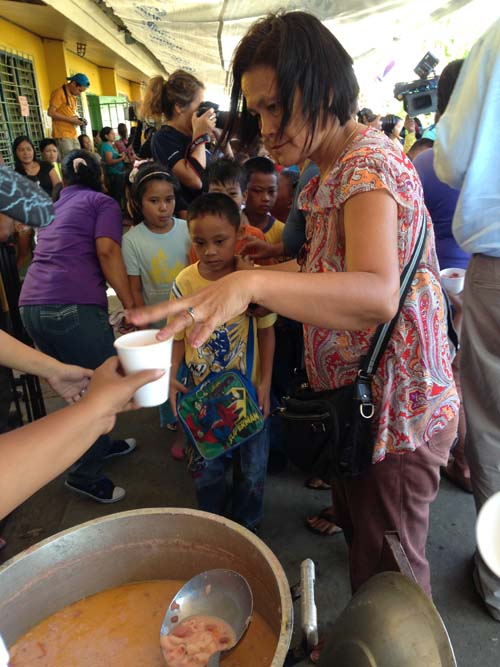
Across the road are white tents to give temporary shelter to the scores of families left homeless by the super typhoon, subsisting mostly on relief goods.
Ever, a father of seven, is now looking beyond mere survival.
“Schools are opening next month. I have two children in college. They need money for their transportation, for their needs. I cannot just rely on relief goods. I have to start standing up on my feet,” Ever said.
Luckily, the boat lent to him by a friend from Samar has arrived.
“I cannot waste time,” he says. “I have to go back to fishing.”
In the neighboring Barangay 89, Mary Ann Agujero, like Ever, also wants to bring a semblance of normalcy back to their lives.
From the cash-for-work program of the Taiwanese organization, Tzu Chi Foundation, where she earns 500 pesos a day for cleaning debris on the streets, Mary Ann has been reviving her small sari-sari (variety) store. This time around, she sells the goods from her tent.
“We have to toughen ourselves. We have to move on,” she said.
Signs of recovery
Making landfall on November 8, supertyphoon Yolanda (known internationally as Haiyan) caused the death of 6,069 people as of last count, with 1,779 people still considered missing. 4.1 million people were displaced and 1.1 million houses destroyed as the storm tore across central Philippines.
In just a month’s time though, many of the affected areas, including devastated Tacloban, have already shown signs of revival. The airport is operational, fuel is available, city hall is open, major hospitals are functional, and street vendors are in business.
And then there are people like Ever and Mary Ann, who are engaged in the daily struggle to survive.
“The people of the Philippines are known the world over for their resilience. You just have to see Tacloban and how the recovery of the city, which was so badly damaged, is underway,” said Luiza Carvalho, the United Nations Resident and Humanitarian Coordinator in the Philippines.
In support of the government-led response, humanitarian partners have reached 3 million people with food assistance, projects were launched to provide cash-for-work schemes, and more than 20,000 families received rice seeds in time for the planting season.
A total of 181 medical teams (65 foreign, 116 local) are covering 25 municipalities to give timely intervention on the victims’ health.
Destination for dignitaries
With the outpouring of international support, Tacloban has become a destination for dignitaries as well as celebrities who want to help.
Marking the first month, Canadian pop star Justin Bieber surprised his fans in Tacloban. To their delight, Justin performed for them, played basketball with them and hugged some of them during his two-hour visit at two evacuation centers in the coastal city.
Local showbiz star and presidential sister Kris Aquino also made a quick visit and gave away some doughnuts to children.
Then came one after the other important persons who have major roles in the humanitarian and rehabilitation programs.
Secretary of State John Kerry announced in Tacloban the Unites States’ decision to provide an additional 24.6 million dollars in humanitarian aid to one of its closest Asian allies. This brings the total US assistance package to $86.6 million.
“This is a devastation unlike anything that I have ever seen on this scale,” Kerry said at a temporary USAID headquarters here.
“It looks like a war zone in every respect.”
The top US diplomat also praised Filipinos’ resilience and determination to recover.
“Last month’s typhoon broke the world’s heart, but what is certain is that it didn’t break the spirit of the people here.”
Former senator Panfilo Lacson, who is the newly appointed Presidential Assistant for Rehabilitation and Recovery, visited Tacloban and other places in the region to assess the devastation. He said the rehabilitation plan, which President Noynoy Aquino said would cost 361 billion pesos, will be ready to be implemented by February.
Two United Nations bosses arrived in Tacloban on the same day but visited different locations simultaneously. They came a week ahead of the scheduled trip to the city of UN Secretary General Ban Ki-moon.
Dr. Babatunde Osotimehin, United Nations Undersecretary General and Executive Director of United Nations Population Fund (UNFPA), came in order to raise awareness of the urgent needs of women and girls.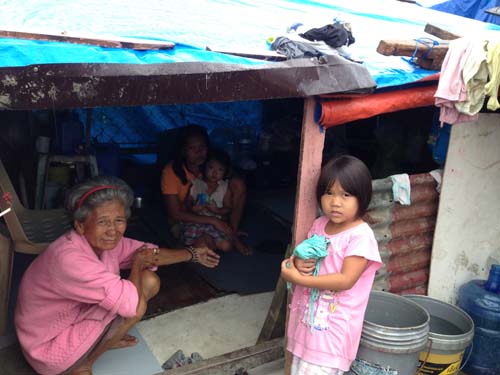
During his visit, Osotimehin handed over to local authorities in Palo the first of three “hospitals in containers” to be provided by UNFPA in the region. These facilities will provide emergency obstetric care including caesarian-sections—a first in the Philippines.
“We have to provide services for mothers' health. Of course, when the mother is well, the child is also well,” he said.
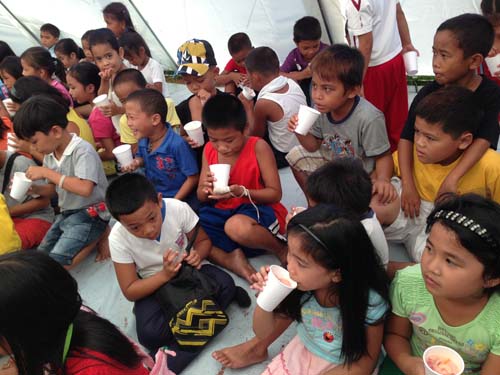
United Nations Children’s Fund (UNICEF) Executive Director Anthony Lake, meanwhile, visited child-friendly spaces set up in evacuation centers and read books to the kids.
He was particularly concerned about the 70 kids orphaned in five coastal cities and municipalities. These kids are now in the custody of their extended families who have also been provided the necessary support to give them the capacity to love, care and raise the children well.
“These children suffer so much pain. If they don't overcome it, the pain will not only limit their ability to be happy but also limit their ability to succeed in life,” Lake said.
Donors' response
A total of $511 million has been contributed as a response to Typhoon Yolanda (Haiyan) as of December 16, according to the Financial Tracking Service. Of this total, 240 million dollars was contributed for the Typhoon Haiyan Action Plan by over 80 entities including member states, the Central Emergency Response Fund, multilateral institutions, private companies and individuals.
From $348 million, the Strategic Response Plan for Typhoon Yolanda raised the request to $791 million over the next 12 months for projects that will form an integral part of the government-led Yolanda Recovery and Response Plan.Over the next six months, more than 100,000 children up to two years of age, as well as pregnant women and new mothers, will be assisted with feeding programs.
Shelter and livelihoods will remain a significant priority for the humanitarian community to get people back on their feet. Four million galvanized iron sheets will be required for housing. Inputs for farmers and fishers will be procured to enable them to recover their livelihoods. Damaged schools and public buildings will be reopened and services restored.
With many foreign medical teams also preparing to leave within the next month or two and others arriving, the World Health Organization (WHO) is working with the Department of Health to ensure a smooth transition.
“We must ensure that essential health services are not interrupted and that in the months to come, the Philippine Government as well as humanitarian aid organizations and other key partners have adequate resources to restore health services across the affected regions,” said Dr. Julie Hall, WHO Representative in the Philippines.
When ambassadors and representatives of eight donor countries arrived together in Tacloban and Palo in Leyte to assess the humanitarian efforts, they seemed happy to see where their money has gone.
“I am impressed with the work that has been done, helping the people get back on their feet faster than expected,” said Ivo Sieber, Switzerland Ambassador to the Philippines, adding that the Swiss have already poured an aid worth P2 billion for the typhoon victims.
“The Swiss people are committed to stay on until people have returned to their productive and healthy life.”
The commitment is indeed reassuring especially for eight-year-old “Gilbert,” who, despite losing his parents and all his siblings to the storm, remains hopeful, counting as a real blessing that his 59-year-old grandmother emerged alive to take care of him.
“I miss my mother but I still thank God we are alive,” said Gilbert. “I still look forward to celebrating Christmas.” — KBK/HS, GMA News

