

 GMA Brandtalk
 Tracking
 Archives

ADVERTISEMENT
Filtered By: Topstories
News
‘I thought it was our end’: A journalist’s account of surviving Yolanda
On the dawn of November 7, we started a back-breaking, 20-hour trip from Manila to Tacloban.
We were assigned to stand by and cover GMA Kapuso Foundation's relief operations after Typhoon Yolanda had gone through the region.
On the road, not once did I see the sun. The gloomy weather felt like a premonition of what was about to happen the next day.
That evening, our team—including veteran video journalist Danilo Fausto and two Foundation staff members—prepared the things that we might need after the storm: food, water, etc. Inside the grocery store of a mall, everything seemed normal. Residents were going about their daily chores. People were busy buying their dinner. Some were laughing. There was no sense of panic and fear.
The storm
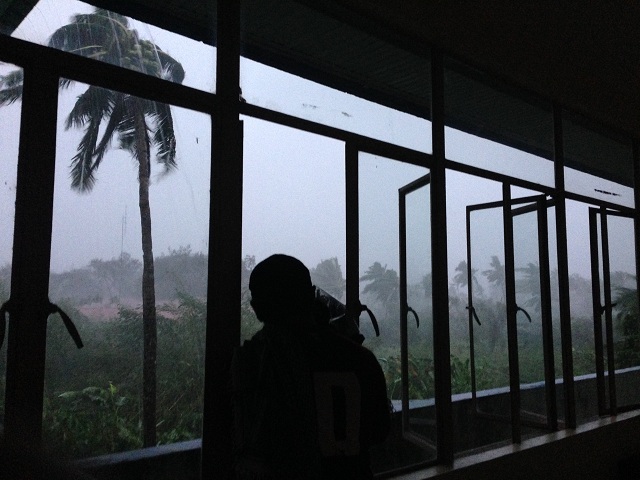
Cameraman Dani Fausto shoots early footage of Typhoon Yolanda.
I even told our "24 Oras" executive producer that I didn’t want to sleep for some reason.
Since all the hotels in Tacloban were fully booked, we stayed at The Oriental in Palo together with GMA reporter Micaela Papa and her team. It was right beside the sea.
As I listened the sound of the wind and the waves, I kept thinking about what kind of coverage we were going to do.
A few more hours into the dawn, and still I couldn’t sleep.
It was around 4 a.m. in the morning that the wind started to become stronger. And right outside, the waves were getting higher.
At exactly 5 a.m., my cameraman and I decided to go outside the hotel and get some early footage of Yolanda's landfall.
We thought it would be better to go outside the town, but on every street, fallen trees and posts blocked our way.
The strong winds started to tear apart the roofs of buildings. They started to howl as if signaling the start of a nightmare.
I told my team that we should find safer ground; adrenaline kept us alert.
My cameraman saw the Department of Education Leyte division office ahead of us. We ran to it and asked for help, and the guards allowed us to enter.
Inside the building we found entire families, praying as the storm raged on.
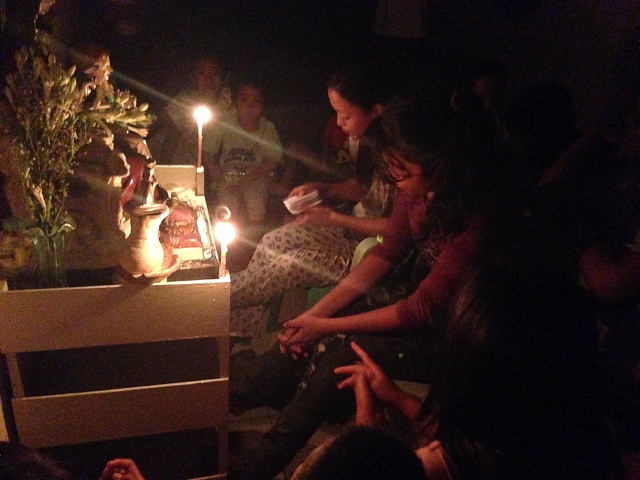
Sheltering from the storm, residents prayed to be saved as the winds grew stronger and the waters rose.
At around 8 a.m., the winds were so strong it was hard for us to walk. The winds were so strong they also broke all the glass inside the building.
And just when we found a room that we thought was secure, the water started to rise on the first floor, forcing us to go up to the second floor.
For at least four hours that was our situation. I was already shaking. Scared and terrified is an understatement. I thought it was our end. We had to keep our camera rolling to document the storm, though; the journalist’s instinct had kicked in.
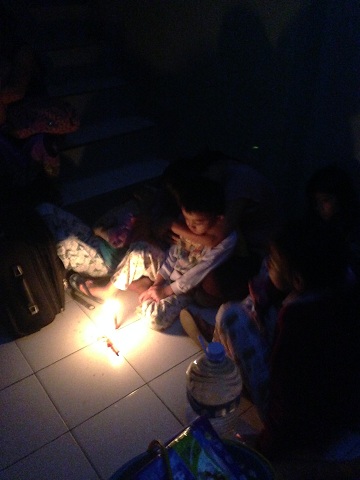 But we knew we were no match for the deadly storm surge that had started to engulf the city.
For the first time in my three years as a journalist, I couldn’t find the answers, when the other people inside the building asked us how long the storm would last.
The only thing that I was able to tell them was: let's keep on praying for the storm to pass.
At around 11 a.m., more families came. Kids were crying and babies were shivering due to the cold. The gymnasium they had evacuated to had collapsed.
It took another two hours before the wind started to weaken and the water began to subside.
For me and my team, the biggest question was: how would we find the other members in our group?
I was grappling with one of my worst fears after seeing bodies strewn on the road and washed away by the waves: were our colleagues still alive?
The search
And just when we found a room that we thought was secure, the water started to rise on the first floor, forcing us to go up to the second floor.
For at least four hours that was our situation. I was already shaking. Scared and terrified is an understatement. I thought it was our end. We had to keep our camera rolling to document the storm, though; the journalist’s instinct had kicked in.
A woman clutches a child to her in the dark.
For the first time in my three years as a journalist, I couldn’t find the answers, when the other people inside the building asked us how long the storm would last.
The only thing that I was able to tell them was: let's keep on praying for the storm to pass.
At around 11 a.m., more families came. Kids were crying and babies were shivering due to the cold. The gymnasium they had evacuated to had collapsed.
It took another two hours before the wind started to weaken and the water began to subside.
For me and my team, the biggest question was: how would we find the other members in our group?
I was grappling with one of my worst fears after seeing bodies strewn on the road and washed away by the waves: were our colleagues still alive?
The search
Our hotel the day after the storm passed through the region.
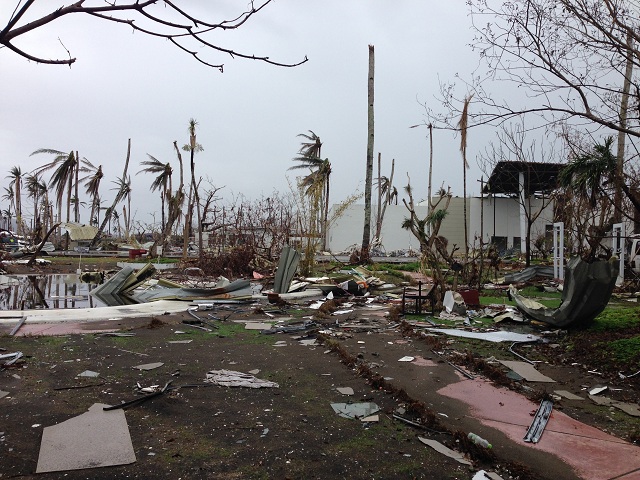
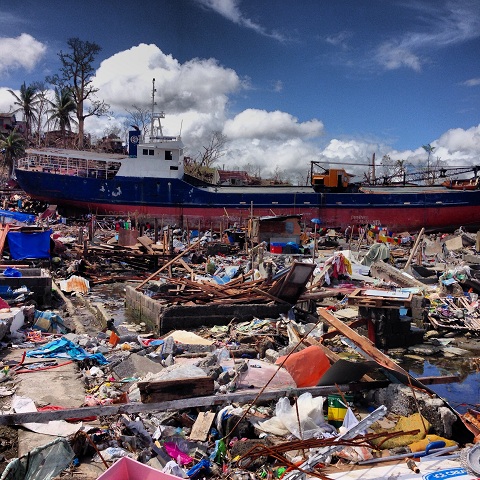
As we waded through knee-deep waters to return to our hotel, we were shocked by the devastation the typhoon wrought.
Dead bodies of children were hanging on tree branches. There were families trapped in their cars. Not even a single house was spared.
People who had walked to Palo told us that there were also a lot of dead people in a nearby coastal barangay.
As we reached our hotel, we discovered that the rooms we stayed in the night before had been washed out. There was nothing left for us to recover.
Our question remained: where were our colleagues?
My cameraman and I decided to walk to Tacloban.
On our four-hour walk, we witnessed more of the typhoon's wrath—more dead bodies, people who had not expected the deadly storm surge.
It was already evening when we reached Tacloban. We didn’t have any means of communication, but a man approached us and told us that we could stay with them.
An old maternity hospital served as our safe haven for the night.
The day after the storm
 In Tacloban, the sound of a chopper overhead was like music to our ears. I had never felt so relieved.
There was desperation everywhere we looked. But the flying chopper was a sign that we were not alone…and that there was hope.
It was another great relief to find our other team members; they had gone to another hotel, the one where GMA's Jiggy Manicad stayed.
It was like an apocalyptic movie scenario, with people destroying establishments and even climbing buildings just to salvage whatever they thought would be useful.
Indeed, it was survival of the fittest. Relief goods did not arrive for another few days because of impassable roads.
But you will be amazed to learn that even in the midst of unimaginable desperation, people were still sharing what little food and water they had.
But our team's own resources—biscuits and water—could no longer sustain us. They were quickly depleted. We knew if we stayed there any longer there was no way we would survive the thirst and hunger. We felt like victims too.
Death march
 At around 4 a.m. on the day of November 11, our team started walking, together with other hotel guests.
Then suddenly a bus stopped us and warned us that we should not continue because there were some who would rob and harass us.
We stopped for a while, but eventually came to the consensus that we should continue.
After an hour of walking, the rain started to pour. But instead of feeling disappointment, we felt relief. We faced the heavens and opened our mouths, hoping that a few raindrops would ease our thirst.
There were a lot of dead bodies on the road on our way to the airport. They were from the coastal town of San Jose. Some of them were turning green and the smell was getting worse.
A group of bodies caught my attention: a man, hugging two kids. They had probably struggled against the waves. They chose to die as a family.
At the airport, we were fortunate enough to be able to get on a plane retuning to Manila. But I made a promise to myself that I will return to Tacloban.
I have survived the strongest typhoon in the history, one that left thousands of people dead and millions homeless. One that showed that in the battle between man and nature, nature always has the upper hand.
I wrote this for me not to forget what really happened on that fateful day of November 8, 2013.
This is to remind me that I, too, was a victim and a survivor of the world's strongest typhoon.
This is to remind me that there is hope. — BM, GMA News
Tristan Nodalo is a segment producer for GMA News' "24 Oras".
Dead bodies of children were hanging on tree branches. There were families trapped in their cars. Not even a single house was spared.
People who had walked to Palo told us that there were also a lot of dead people in a nearby coastal barangay.
As we reached our hotel, we discovered that the rooms we stayed in the night before had been washed out. There was nothing left for us to recover.
Our question remained: where were our colleagues?
My cameraman and I decided to walk to Tacloban.
On our four-hour walk, we witnessed more of the typhoon's wrath—more dead bodies, people who had not expected the deadly storm surge.
It was already evening when we reached Tacloban. We didn’t have any means of communication, but a man approached us and told us that we could stay with them.
An old maternity hospital served as our safe haven for the night.
The day after the storm
A barge sits on land amid the wreckage.
There was desperation everywhere we looked. But the flying chopper was a sign that we were not alone…and that there was hope.
It was another great relief to find our other team members; they had gone to another hotel, the one where GMA's Jiggy Manicad stayed.
It was like an apocalyptic movie scenario, with people destroying establishments and even climbing buildings just to salvage whatever they thought would be useful.
Indeed, it was survival of the fittest. Relief goods did not arrive for another few days because of impassable roads.
But you will be amazed to learn that even in the midst of unimaginable desperation, people were still sharing what little food and water they had.
But our team's own resources—biscuits and water—could no longer sustain us. They were quickly depleted. We knew if we stayed there any longer there was no way we would survive the thirst and hunger. We felt like victims too.
Death march
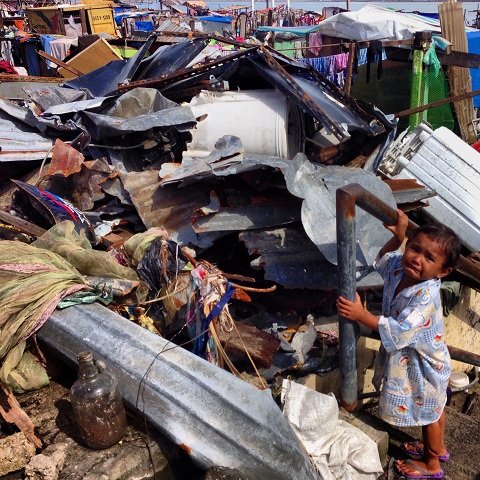
Anibong, Tacloban.
Then suddenly a bus stopped us and warned us that we should not continue because there were some who would rob and harass us.
We stopped for a while, but eventually came to the consensus that we should continue.
After an hour of walking, the rain started to pour. But instead of feeling disappointment, we felt relief. We faced the heavens and opened our mouths, hoping that a few raindrops would ease our thirst.
There were a lot of dead bodies on the road on our way to the airport. They were from the coastal town of San Jose. Some of them were turning green and the smell was getting worse.
A group of bodies caught my attention: a man, hugging two kids. They had probably struggled against the waves. They chose to die as a family.
At the airport, we were fortunate enough to be able to get on a plane retuning to Manila. But I made a promise to myself that I will return to Tacloban.
I have survived the strongest typhoon in the history, one that left thousands of people dead and millions homeless. One that showed that in the battle between man and nature, nature always has the upper hand.
I wrote this for me not to forget what really happened on that fateful day of November 8, 2013.
This is to remind me that I, too, was a victim and a survivor of the world's strongest typhoon.
This is to remind me that there is hope. — BM, GMA News
Tristan Nodalo is a segment producer for GMA News' "24 Oras".

