

 GMA Brandtalk
 Tracking
 Archives

ADVERTISEMENT
Filtered By: Topstories
News
The fight vs. polio: Only 3 countries have it now, yet the threat remains
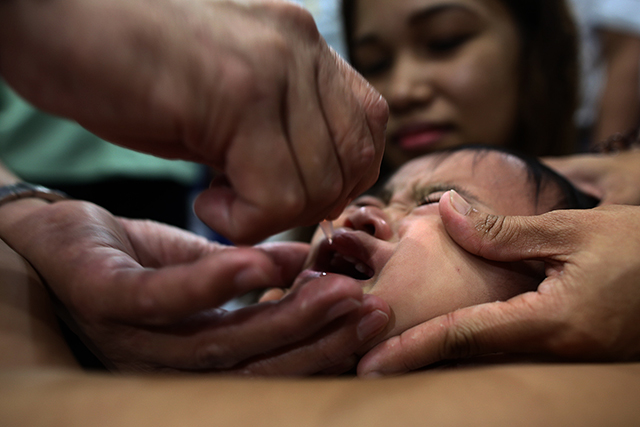
A health worker administers the polio vaccine to a child in San Fernando City, La Union during the Department of Health's Ligtas Tigdas free vaccination program in this photo taken September 1, 2014. Vic Alhambra Jr.
And it was not just because there were no scientists in attendance who may have studied the virus under a microscope. Most people have not seen a live poliovirus in recent times because it has been targeted for global eradication and has thus become uncommon. So uncommon it is that only three countries still have polio cases today, and in few numbers: Nigeria, Afghanistan, and Pakistan, according to the World Health Organization.
Nigeria has only three cases so far this 2015, and Afghanistan's three out of a total of four cases in 2014 were traced to Pakistan, information from the Global Polio Eradication Initiative revealed. And India, once identified as the most technologically-challenging place to eradicate polio, is free of the virus.
Here in the Philippines, the last reported case of the wild poliovirus was in Cebu in 1993, Dr. Eric Tayag, Director IV of the Bureau of Local Health Systems Development of the Department of Health, told the same audience in Hanoi last Friday. It was in 2000 when the Philippines was declared polio-free, along with other countries in WHO's Western Pacific Region.
But the fight remains, here in the country and elsewhere around the world.
“Why do we still give polio vaccine in the Philippines if we have been polio-free since 2000? It’s because we have not eradicated it,” Tayag said.
“The risk of polio importation remains. That means there is a risk of emergence of the wild poliovirus and vaccine-derived poliovirus,” he added.
Risk of polio importation remains in PHL -- Dr. Eric Tayag in Hanoi, Vietnam @gmanews pic.twitter.com/gVLBpX397f
— Karen Galarpe (@kgalarpe) June 12, 2015
Eradication vs. elimination
There is a difference between eliminating a virus and eradicating one.
“Elimination means to keep outside the limits. It is regional and may apply to disease or causative agent,” John said.
“Eradication means to pull out by the root. It applies to a global level and to the causative agent. The agent must not transmit to any person. Eradication happens when there is zero incidence of infection worldwide,” explained John, also former head of the Department of Virology and Pediatrics at the Christian Medical College in Vellore, India.
So the truth of the matter is the wild poliovirus (types 1, 2, and 3) has been successfully eliminated through oral polio vaccines (OPV) in all but three countries—Nigeria, Afghanistan, and Pakistan, said John.
The wild poliovirus (WPV) type 2 has been eradicated in 1999 using trivalent OPV (tOPV) vaccine, he said. However, WPV types 1 and 3 have only been eliminated, not eradicated, in the Americas, Western Pacific, European and Southeast Asian region years ago through the use of tOPV or inactivated polio vaccine (IPV), and in India through the use of tOPVs, mOPVs (monovalent OPVs), and bOPVs (bivalent OPVs).
WPV type 2 was last seen in November 2012, said John, but the coast is not yet clear.
Simply put, the threat of young children catching polio is still present in the world.
The numbers
In fact, a total of 359 cases have been reported globally in 2014, said John, and these were all WPV type 1: 306 in Pakistan, 28 in Afghanistan, and six in Nigeria.
And these countries had been reported to have importation of the poliovirus: Somalia, Equatorial Guinea and Cameroon, five cases each; Iraq, 2; Ethiopia and Syria, one, for a total of 19 WPV type 1 incidences in all.
The Independent Monitoring Board of the Global Polio Eradication Initiative, in its May 2014 report, pointed out the possible reasons why it was not easy to eradicate polio in these areas: those doing the polio vaccination in Pakistan were targeted to be killed, the Taliban has banned polio vaccination in Pakistan, vaccinators in Nigeria also lost their lives tragically, and the al-Shabab banned vaccination in Somalia.
John, meanwhile, said polio is still endemic in Pakistan, Afghanistan, and Nigeria because of socio-cultural problems including a quasi-religious guided philosophy, lack of accessibility, and heavy migration.
No cure for polio
There is no cure for polio. This crippling disease is highly contagious and is spread mainly through the fecal-oral route, according to the Johns Hopskins Medicine Health Library website.
“The result in 99 percent of infections is nothing,” said Dr. John, “but one in 200 children will get paralysis. If the kid is lucky, the paralysis will set in in one to two days.”
Infants and young children are the ones greatly at risk for polio, the Johns Hopskins website said.
But although there is no cure for polio, the risk of contracting it can be prevented through vaccination.
Fighting polio, one vaccine at a time
Although OPVs are inexpensive and easy to give, there is a risk of genetic reversion, said Dr. John.
That means the OPV may, in rare cases, cause a virus to “go wild,” so to speak, and cause polio, the very disease it meant to prevent.
So Dr. John is advocating for the use of the inactivated polio vaccine (IPV), an injectable which kills the virus, not weakens it. It is said to protect a person from all WPV types 1 and 2, as well as the vaccine-derived virus.
The GPEI in May 2013 launched the Eradication and Endgame Strategic Plan which calls for countries to introduce at least one dose of IPV by the end of this year to, among others, provide protection against WPV type 2 in case it is reintroduced, and boost immunity against WPV types 1 and 3, and hasten eradication.
The said plan also calls for the “big switch” in 2016 from tOPV which targets all three types of WPV (and thus can in rare cases cause vaccine viruses that may cause polio, as discussed), to bOPV which does not contain WPV type 2. Eventually, the plan is to end the use of OPV entirely by 2019-2020.
Is the Philippines on track?
The WHO has a team called the Strategic Advisory Group of Experts on Immunization (SAGE) which regularly looks at countries as they introduce IPV.
Dr. Tayag said the Philippine national plan is in line with SAGE’s recommendations to withdraw the type 2 component of the OPV from routine immunization program and introduce one dose of IPV into the program by the end of 2015.
“The country is introducing IPV in phases,” Dr. Tayag said. The DOH first introduced it in October 2014 as part of its expanded program on immunization.
“NCR, Regions 3, 6, 10 in the second quarter of 2015, and the remaining regions in the third and fourth quarter of 2015,” Dr. Tayag said.
The national recommended schedule calls for giving a baby aged at least 3.5 months the third dose of OPV and one dose of IPV at the same time, he said.
Eradication, the end goal
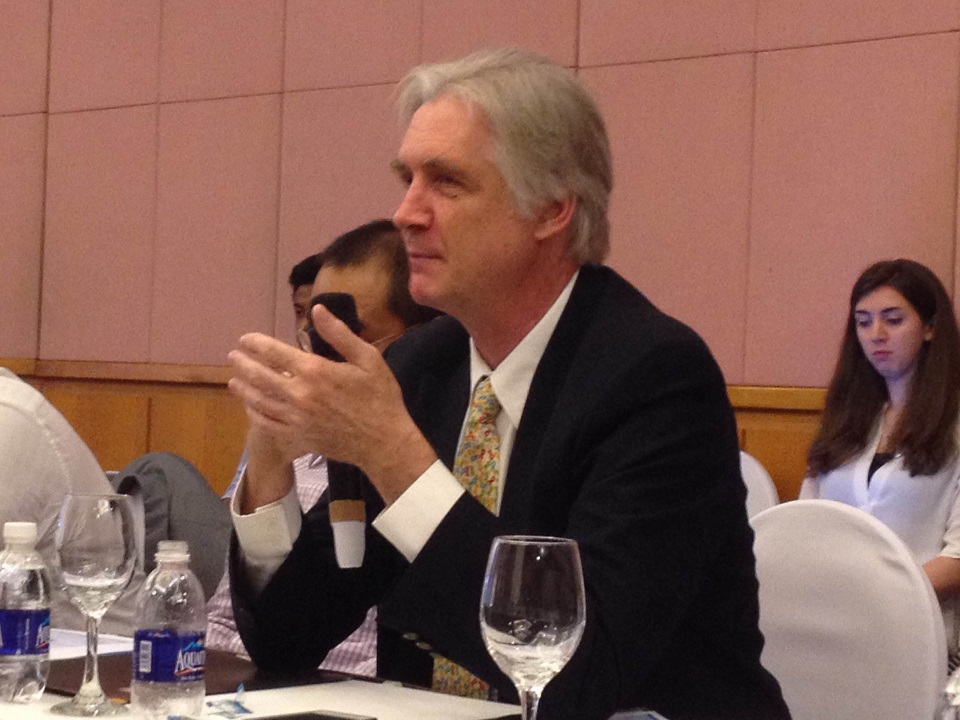
Prof. Tony Nelson speaks at a forum on polio in Hanoi, Vietnam on June 12, 2015. Karen Galarpe
He added that Yogyakarta in Indonesia completely switched already from OPV to IPV and there have been no problems in the past six to seven years.
In February 2015, Nigeria became the first polio-endemic country to introduce IPV in its immunization program.
In March 2015, Bangladesh launched IPV in its Expanded Program on Immunization.
Curiously, there is also no opposition worldwide to IPV, Dr John said.
Asked for comment on the introduction of IPV in the Philippines, Dr. Lulu C. Bravo, president of the Immunization Partners in Asia Pacific, said, “I am proud.”
But while things are looking rosy, it is wise to see the whole picture. “No vaccine is 100 percent effective. No vaccine is 100 percent safe. However, vaccines correctly manufactured, stored, and administered are very effective,” Prof. Tony Nelson, who teaches at the Department of Pediatrics of the Chinese University of Hong Kong, said at the same Hanoi event. — BM, GMA News

