

 GMA Brandtalk
 Tracking
 Archives

ADVERTISEMENT
Filtered By: Topstories
News
SPECIAL MULTIMEDIA REPORT
Worsening El Niño brings back nightmares of past drought
El Niño, a global weather pattern that mainly causes drought in the Philippines, is expected to intensify and induce a prolonged dry spell in particular areas across the globe.
This condition is expected to take a toll on the economy, probably even worse than what happened in 1997-1998.
"Unlike last year, this time around the El Niño is not a false alarm. All key meteorological agencies state with relative certainty that El Niño conditions have been met and that its intensity will surpass the last destructive El Niño in 1997 to 1998," HSBC Global Research said in a Flashnote.
El Niño arises from the periodic warming of surface temperatures in the central and eastern equatorial Pacific Ocean, according to Philippine weather bureau PAGASA.
The phenomenon hits the Philippines just when the planting season starts in the country's biggest rice-producing regions. For those who were affected by the El Niño in 1997 and 1998, the prospect of another drought brings back nightmares.
The 2015-2016 El Niño translates to warmer-than-usual waters in the Pacific, which affects weather patterns including the development of rain-bringing cyclones.
While it brings about higher incidence of rainfall in other parts of the world, in the Philippines, the phenomenon brings less-than-normal amount of rainfall and consequently drought.

The phenomenon hits the Philippines just when the planting season starts in the country's biggest rice-producing regions. For those who were affected by the El Niño in 1997 and 1998, the prospect of another drought brings back nightmares.
South Cotabato in Mindanao was among the many areas hardest hit by El Niño. Farmer George Palacio, 80, recalls how the rice fields literally dried up in 1998. He says the drought brought famine and he and his family went hungry.
His daughter Arlene, 46, still remembers that experience.
"Tag-gutom nung 1998, kasi walang makunan ng pagkain ang mga farmers dito (There was famine in 1998, because the farmers here had no way of sourcing food)," she says.
She starts crying as memories of the drought were summoned back during an interview with GMA News.
"At isa pa ay 'yung mga lupa ay nagkabiyak-biyak (And also the ground cracked up)," she said. "So, kung wala kaming mautang na pera hindi kami makakain (So, if we couldn't borrow any money we won't be able to eat)."
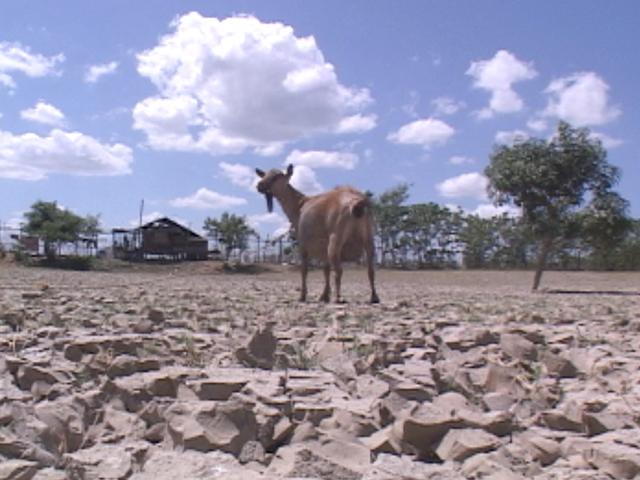
In 1997 to 1998, as much as 68 percent of the Philippines experienced drought for about seven months, according to a report by the National Center for Atmospheric Research (NCAR) and United Nations Environment Programme (UNEP).
"El Niño caused negative impacts on agricultural outputs in the first three-quarters of 1998. Palay, as well as other cash crops like coconut and sugarcane posted double-digit declines in the fourth quarter," the report read.
The Palacios went into debt at usurious rates, as unscrupulous lenders wouldn't give them any money unless they promised to repay every P1,000 borrowed with a sack of rice on top of the cash payment.
As water was scarce, Palacio says it took longer for the crops to mature for the harvest.
"Kaya mahirap sa farmers kung mangutang ka ng tag-init (That's why it's difficult for farmers to borrow money when there's drought)," Arlene says. "Tapos pagka-harvest mo ng may tubig na, parang kasya lang na ipang-bayad mo ng utang noong nakalipas na tag-init (And then after you make a harvest when the water has returned, it's just enough to pay for the debt you incurred in the past drought)."
In many ways, the Palacios were lucky as the source of water for their backyard pump didn't dry up.
"'Yung amin, 'yung poso na pingalalabahan at pinagkukunan ng tubig ay hindi talaga nawalan ng tubig. Pero 'yung mga kapitbahay namin nawalan talaga ng tubig (Our pump where we wash clothes and get water from didn't really dry up. But our neighbors didn't really have any water)," says Arlene.
As far as Palacio is concerned, the 1997-1998 El Niño was the worst crisis he ever experienced.
Data from the Philippine Statistics Authority show that rice production in Central Luzon declined by 33 percent to 1.37 million metric tons (MT) in 1998 from 2.07 million in 1997. Cagayan Valley also recorded a 27 percent decline to 1.11 million MT from 1.54 million MT.
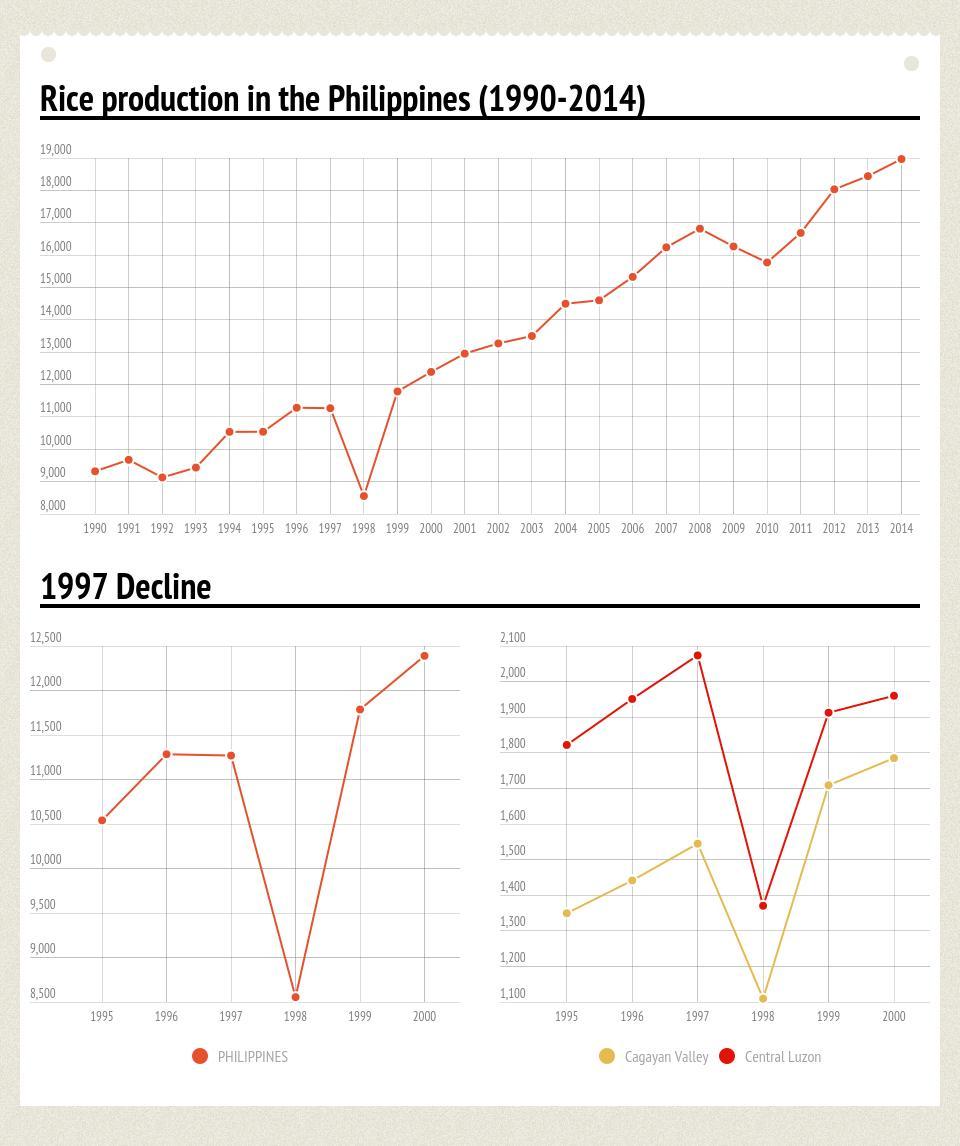
The Philippine Institute of Development Studies noted up to 292,000 hectares of rice and corn plantations were completely damaged. In peso terms, around P3 billion worth of crops was lost.
In the case of fisheries, El Niño ravaged the sector by drying ponds, disrupting production cycles and accelerating the mortality rate due to poor water conditions. By November 1998 the sector registered losses amounting to P 7.24 billion, according to ENCAR and UNEP. —VS/JST, GMA News
To be continued

