

 GMA Brandtalk
 Tracking
 Archives

ADVERTISEMENT
Filtered By: Topstories
News
Eight provinces may deliver more than 10M votes in May 2016 polls
The election period officially began only on January 10 but many national candidates have been on the campaign trail for some time now, visiting some of the country's so-called “vote-rich provinces.”
Officially, the campaign period will start on February 9 but sorties have been held in “battleground provinces” with a high number not only of registered voters but also actual voters in the previous elections.
These battleground areas include eight provinces that could deliver some 10.87 million votes in the 2016 elections and decide the fate of the presidential and other national candidates: Cebu, Pangasinan, Negros Occidental, Cavite, Bulacan, Laguna, Batangas and Iloilo.
Based on an analysis of GMA News Research on voter turnout in the past five elections, these eight provinces could yield at least one million votes each in the 2016 polls or about 26 percent of the votes for that election.

In the 2013 elections, these eight provinces delivered more than a million votes each.
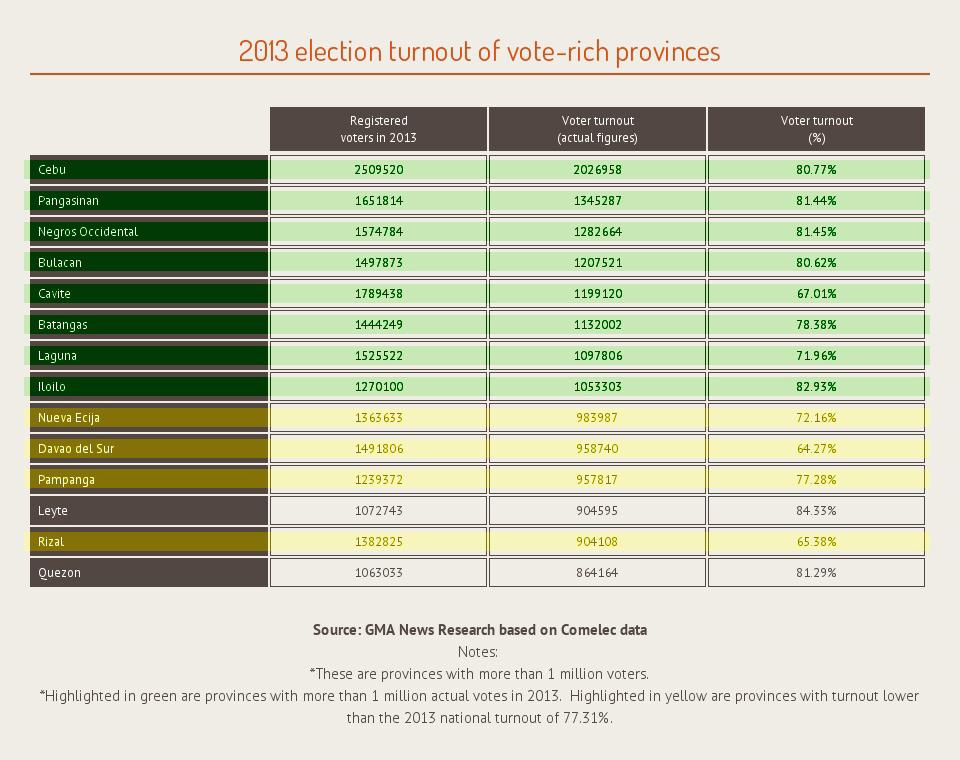
Dr. Aries Arugay, a Political Science professor at University of the Philippines, said the data show where the bulk of the voters are and this is is helpful in devising campaign strategies.
“If I were a candidate, I will still pour resources sa mga lugar kahit vote-poor, but I will calibrate. Between Cebu and Batanes, there will be more value for my money if I concentrate on Cebu, even if kalaban ko ang may hawak nito,” Arugay said.
However, Arugay said knowing where the votes are is just one thing. It is equally important to be aware of how these vote-rich provinces actually voted, he said.
“Nakikita sa data niyo kung saan naka-concentrate yung mga boto, saan maraming botante. But malaking factor na dapat tingnan at tinitingnan ng mga botante ay ang voting pattern. Kumbaga sino ang ibinoboto sa mga lugar na ito,” Arugay said.
The number of registered voters who actually voted in the last five elections varies across the provinces. However, election data show that some vote-rich areas had low turnouts while vote-poor provinces usually had high turnouts. Read more
Binay vs. Roxas
The voting pattern in vote-rich provinces can be gleaned from the tight race for the vice presidency in 2010, when former Makati Mayor Jejomar Binay defeated former Senator Mar Roxas by a slim margin of 727,084 votes.
Binay and Roxas both won in four of the eight provinces that have a potential on million voters each.
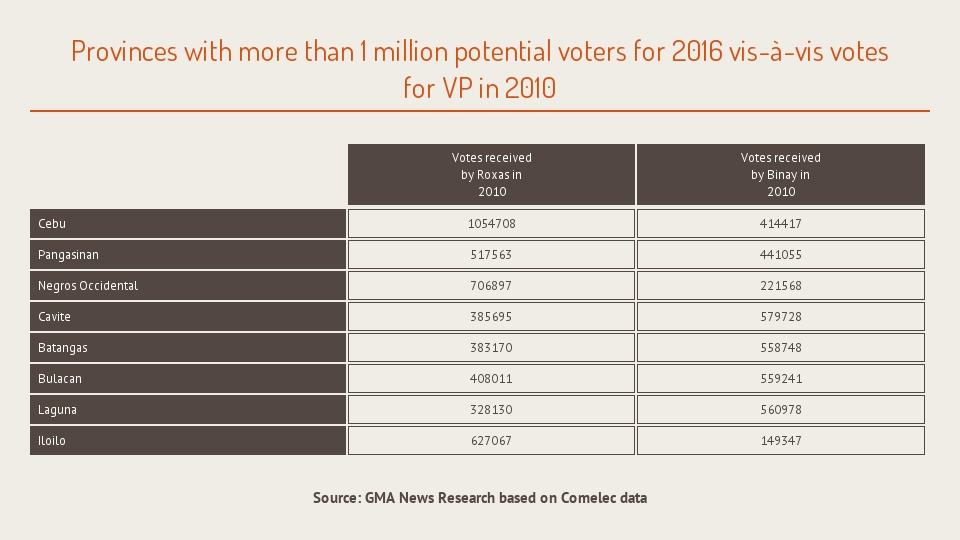
In 2010, most voters from Cebu chose former Senator Benigno Simeon Aquino III for president. He received almost one million votes from the province with the biggest number of registered voters: Cebu, including Cebu City.
His runningmate at that time, Roxas also won overwhelmingly in the province, receiving more than one million votes. The eventual winner – Binay, received only 400,000 votes in Cebu.
Roxas, who hails from the Visayan province of Capiz, also had a big lead over Binay in the other vote-rich Visayan provinces of Negros Occidental and Iloilo.
Roxas also won in Pangasinan but that was the only Luzon “million-vote province” that chose him over Binay.
Binay, a Batangueño, won in Batangas, Cavite and Laguna in Southern Luzon as well as Bulacan in Central Luzon.
2.7M votes in Cebu
Binay and Roxas are competing with each other again in the 2016 elections, this time for president.
These candidates have given special attention to Cebu, with 2.72 million registered voters as of December 2015. It is the only province in the country that breached the two-million voter mark.
Both Binay and Roxas as well as another presidential candidate, Senator Grace Poe, have visited Cebu at least once after announcing their candidacies.
In fact, all three happened to be in the province on the same day, August 24 last year, on separate engagements.
Arugay noted that Cebu is important as it has a high number of registered and actual voters. In the last five elections, voter turnout in the province averaged 79.45 percent, higher than the national average of 75.74 percent.
Cebu's numbers translate to about 2.16 million potential voters for the May 2016 elections.
Arugay attributed the high voter turnout to Cebu's leaders. “In Cebu, local leaders are really able to pull voters to actually vote. Yung mga political networks dito talagang may hila sila sa mga botante nila,” Arugay said.
Other provinces
Aside from Cebu, the other provinces that had voter turnouts higher than the national average of 75.74 percent in the last five elections were Iloilo, Negros Occidental, Pangasinan, and Batangas.
Arugay explained that the 75.74 percent voter average turnout in the country is high compared to Western democracies. This implies that that Filipinos regard election as an important political exercise.
Cebu, Iloilo, and Negros Occidental are urban centers in the Visayas.
Pangasinan is the most populous province in Northern Luzon. Five out of eight provinces that had each delivered one million votes in the 2013 elections are in Luzon.
Batangas is an urban sprawl outside of Metro Manila, similar to the provinces of Bulacan, Cavite, and Laguna.
However, Arugay said being vote-rich allegedly implies these provinces are also most at risk for fraud and manipulation. “Siyempre kung may hahabulin akong bilang ng boto sa vote-rich provinces ako titingin kasi malaking numbers ang pinag-uusapan dito,” he said.
Senatorial votes
In the 2013 senatorial elections, the winners who are seeking higher office in the 2016 polls sourced one-fourth of their votes from Cebu, Pangasinan, Negros Occidental, Cavite, Batangas, Bulacan, Laguna and Iloilo.
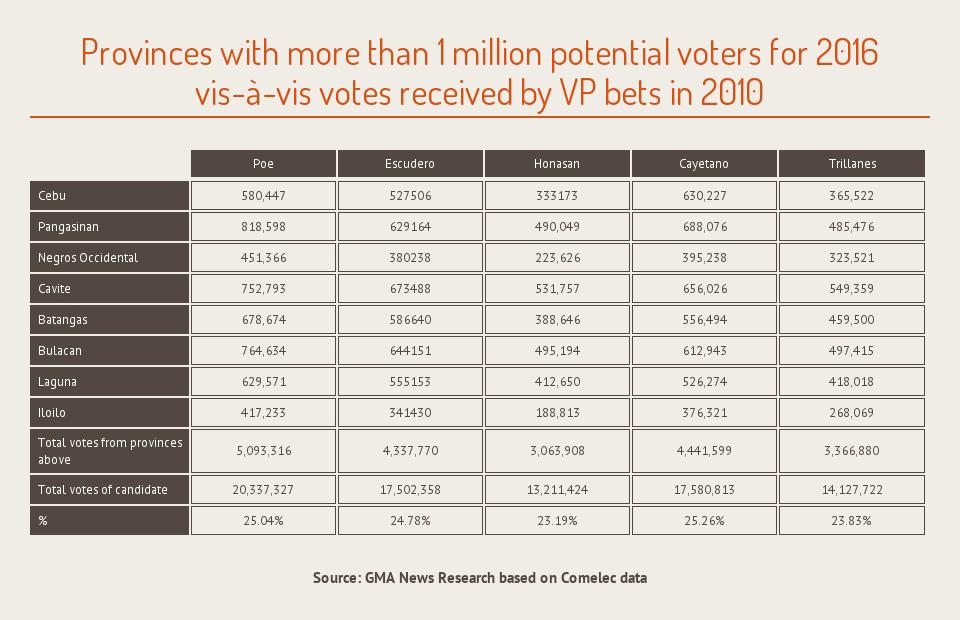
Poe, who topped the 2013 senatorial elections, received 20.34 million votes nationwide. On the other hand, Honasan, who clinched the 12th spot, received 13.21 million votes.
A leading contender for President in the May 2016 polls, Poe received more than five million votes from the eight vote-rich areas in the 2013 elections..
Meanwhile, vice presidential candidates Senators Francis Escudero, Gregorio Honasan, Alan Peter Cayetano and Antonio Trillanes all gained votes ranging from 3 to 4 million from the eight vote-rich provinces.
Metro Manila turnout
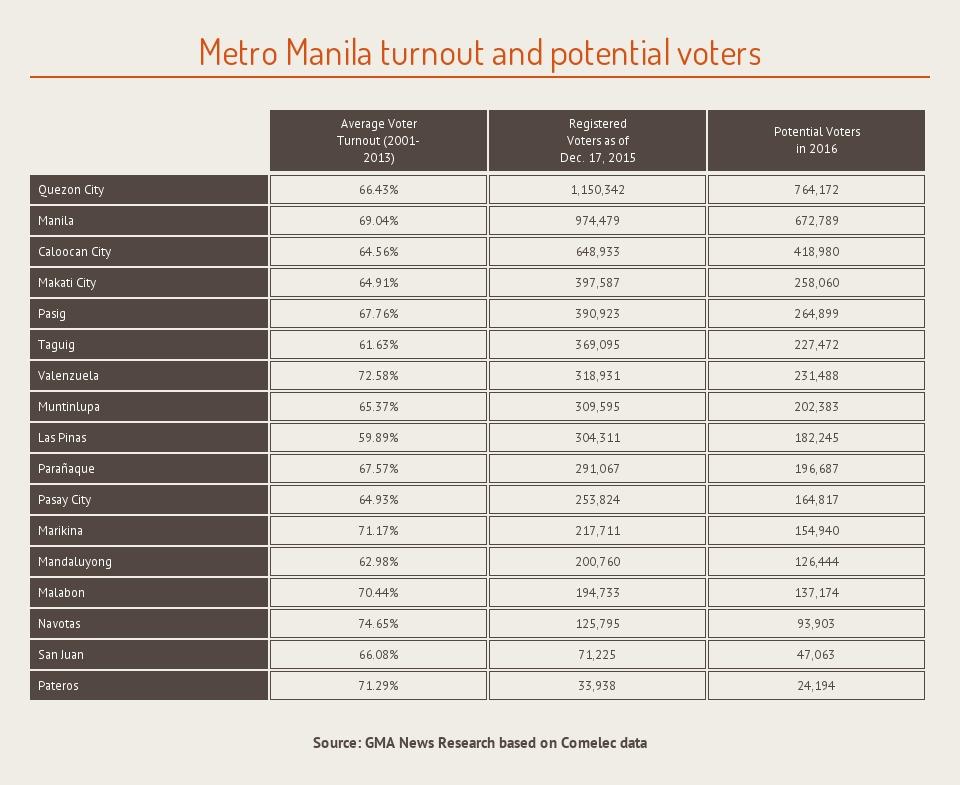
Based on data on voter turnout, registered voters in Metro Manila are less inclined to cast their votes compared to the rest of the country.
All Metro Manila LGUs have lower than national average turnout. Voter turnout in the National Capital Region from 2001 to 2013 was 66.52 percent, below the national average of 75.74 percent.
Numbering 6.25 million as of December last year, Metro Manila registered voters comprise 12 percent of all registered voters in the country.
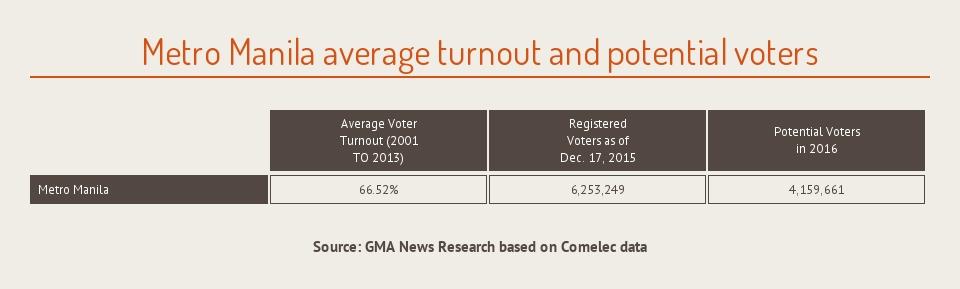
Based on its historical turnout, it can yield more than 4.16 million votes during the May 2016 polls.
Quezon City is the only city in the country with more than one million registered voters. But with an average turnout of 66.43 percent, only 764,172 of its registered voters may show up at the polling places in May 2016.
Manila, the city with the second highest number of registered voters, has an average turnout of 69.04 percent, equivalent to 672,789.
Navotas City has the highest voter turnout in the last five elections: 74.65 percent of registered voters. Las Piñas City had the lowest turnout at 59.89 percent.
Social media effect
Meanwhile, Arugay encouraged candidates for national positions to visit not only vote-rich provinces but also vote-poor ones because every vote counts.
“Kahit alam mo na mahina ka sa isang lugar, you still pour your resources there kasi ang bilangan naman ay down to votes, unlike in the United States where vote-rich states have more electoral votes or college votes. Dito sa atin, no matter how small, posible pa ring makadagdag sa boto mo,” Arugay said.
He also pointed out that social media sites like Facebook and Twitter can give candidates a wider reach, even if they are campaigning in small, remote provinces.
“At this stage, with technology, kahit may sortie ka in some far-flung province, parang national na rin ang reach niyan. With social media, madami ka pa ring maabot. Given technology today, even small provinces may swing votes. -- VVP, GMA News

