

 GMA Brandtalk
 Tracking
 Archives

Even with more congressmen in 2016, many PHL areas still unrepresented
Four new legislative districts were created by the 16th Congress, indicating that four more congressmen will be elected in the May 2016 polls.
Three of the four new legislative districts are located in the Calabarzon area: Biñan City Lone District; Batangas Fifth District (Batangas City), and Batangas Sixth District (Lipa City). The other new district is located in the country's most vote-rich province: Cebu Seventh District.
However, even with the creation of new legislative districts, many areas with large populations still remain “underrepresented” in Congress.
If the Constitution's population per district requirement (at least 250,000 per district) is to be strictly followed, the House should have a total of 327 district representatives based on the existing demarcations of provinces, cities and districts.
Out of 107 provinces and cities with legislative districts, 41 need at least one more district each, data gathered by GMA News Research shows.
In contrast, some areas are “overrepresented,” meaning there are too many districts compared to the number of people residing in that area.
Underrepresented provinces, districts
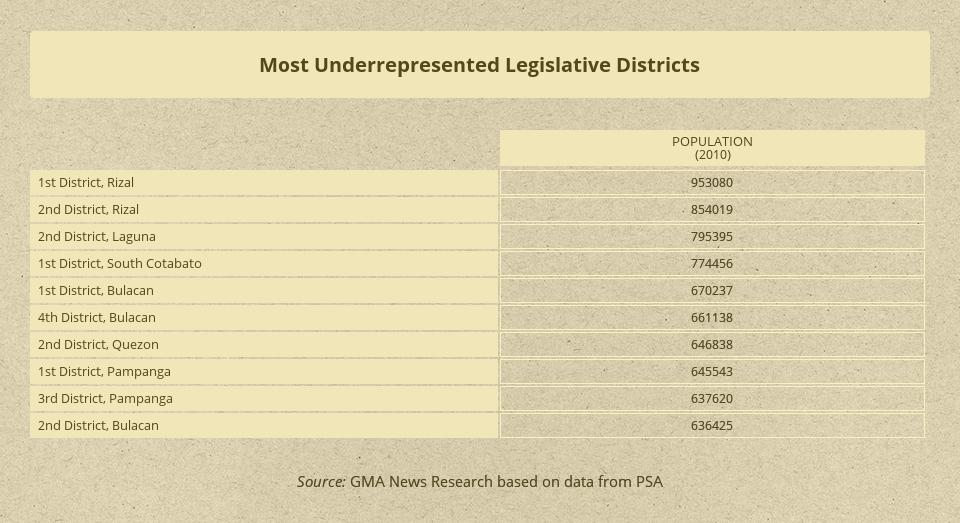
To identify underrepresented districts, GMA News Research counted the total population in all legislative districts and ranked districts with highest population residing within its limits. The table below shows districts with more than 600,000 to nearly constituents based on the latest census.
Based on 2010 PSA data, some of the most underrepresented legislative districts include: Rizal First District (953,080); Rizal Second District (854,019); Laguna Second District (795,395); South Cotabato First District (774,456); Bulacan First District (670,237); Bulacan Fourth District (661,138); Quezon Second District (646,838);
While a piece of legislation does not speak for the number of people in a district, a congressman with a manageable number of constituents “can properly hear the grievances and see the needs of the people,” said Guilbert Samson, chief of staff of Bulacan First District Rep. Ma. Victoria Sy-Alvarado. Sy-Alvarado’s district has a population of 670,237 as of 2010. In 2009, she filed a bill that created the district of Malolos City out of the First District.
The bill, which became Republic Act 9591, was nullified by the Supreme Court in a tight 7-6 vote because the district failed to meet the minimum population requirement of 250,000.
PDAF problem
In August 2013, President Benigno Aquino III announced the abolition of PDAF and suspended allocations for that year amid revelations that billions of pesos in pork barrel funds were misused.
In November 2013, the Supreme Court declared PDAF as unconstitutional. Malacañang has been claiming that the national budget from 2014 onward has been “pork-free.”
Without PDAF, congressmen in big constituencies were left with limited resources for big populations, he said.
“Ang mga congressman, first task talaga ay legislative work. Pero hindi maiiiwasang may mga lalapit, manghihingi talaga ng tulong ang mga constituents,” said Samson.
Laguna Second District Rep. Joaquin Chipeco Jr., who represents some 800,000 people, noted that in terms of legislation, consensus-building becomes more problematic in heavily populated districts.
“With so many perspectives going around, there would always be discordant voices who would oppose, criticize and even pillory official policies,” Chipeco says.
Professor Ronald Mendoza, executive director of the Asian Institute of Management Policy Center, said congressmen in districts that have too many residents may find it difficult to represent the general interests of their constituents.
“One important goal (of redistricting) is to help ensure that our citizens have a voice in their government, notably in Congress. Representation is less fair if some districts have much larger populations while others have far smaller ones,” Mendoza said. “More powerful and influential districts may now be overrepresented.”
'Unwieldy' House
Cagayan de Oro City Second District Rep. Rufus Rodriguez believes the Lower Chamber does not need more members. He has filed a bill that will reapportion all legislative districts in the country based on the latest results of the census on population.
The bill attempts to prevent the practice of creating new districts by increasing the population requirement.
“We are getting too unwieldy already,” said Rodriguez, referring to the growing number of congressmen and his colleagues’ penchant for creating new districts.
Rodriguez’s House Bill 3930 was referred to the House Committee on Local Government and has not moved since it was filed in 2014.
“Hindi ko nga alam kung bakit ayaw basahin. Ang gusto nila create na lang nang create ng new district dito sa House. Plus party-list (representatives), we are 291 here already. We are filled to the brim already,” Rodriguez said.
Rodriguez’s HB 3930 seeks the reapportionment of legislative districts with a minimum population of at least 400,000 per district based on the 2010 census. He said highly urbanized cities still need at least 250,000 population to have a district.
Rodriguez said his bill will not abolish the current districts and will be applied to the succeeding districts.
HB 3930 points out that in the House of Representatives of the United States, there is one congressman per 673,600 people. “I think 400,000 (population per district) is a manageable number. I think we should be big enough but still manageable,” he said.
“I just want to come up with a manageable number,” Rodriguez said. “I think we should be big enough but still manageable.”
Rodriguez said creating new districts is expensive, referring to the additional costs with the new offices that come with them.
He said it will also lead to the corresponding increase in the number of party-list representatives. The Constitution mandates that 20 percent of the total number of seats in House will be for the party list.
HB 3930 would have been the long-elusive resolution to the Constitutional provision mandating a periodic review of the distribution of legislative districts in the country.
The Constitution requires Congress to pass a law, within three years following the return of every census, reapportioning legislative districts “in accordance with the number of their respective inhabitants, and on the basis of a uniform and progressive ratio.”
The ordinance attached to the 1987 Constitution apportioned 200 legislative districts among provinces and cities with a population of at least 250,000. The population is based on the 1986 projection—55 million—of the 1980 national census.
Philippine population has since jumped by 82 percent since 1986. The PSA said the population breached the 100-million mark in 2014.
Five censuses (1990, 1995, 2000, 2007 and 2010) have since passed and the latest census was just concluded but Congress is still creating districts based on the 250,000 population criterion set almost three decades ago. —VVP/JST, GMA News

