

 GMA Brandtalk
 Tracking
 Archives

DOTr: EDSA traffic from Caloocan to Pasay faster by seven minutes
Many motorists might not have felt it but government agencies were able to record a modest improvement in the flow of traffic on EDSA in the first 100 days of the Duterte administration.
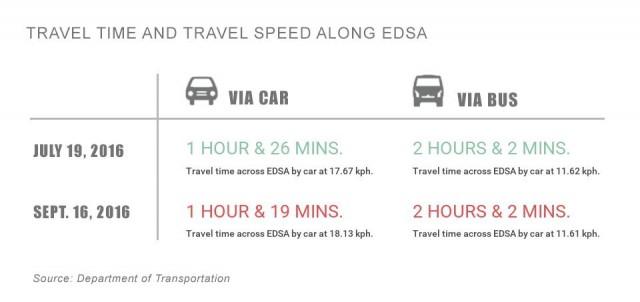
Speed tests conducted by the Metro Manila Development Authority showed that travel time by car on EDSA was shorter by seven minutes during a day in September compared to a day in July.
It took a car one hour and 26 minutes to traverse EDSA from Monumento in Caloocan City to Roxas Boulevard in Pasay City during a speed test on July 19.
In another speed test on September 16, a car negotiated the same stretch for one hour and 19 minutes—faster by seven minutes.
It was not immediately clear what time of day the speed tests were conducted by the MMDA Traffic Engineering Center.
“Nakatala tayo ng kaunting diperensya sa EDSA travel from July until September of this year. We would like to sustain and even make that better,” Department of Transportation spokesperson Assistant Secretary Cherie Mercado told GMA News.
Urban planner Primitivo Cal, executive director of the University of the Philippines Planning and Development Research Foundation Inc., said the difference in travel time in EDSA, although small, was still an improvement—equivalent to as much as 10 percent in travel time savings.
“Mahaba yung EDSA. Assuming ang travel time mo one to two hours, so round about 5 to 10 percent yung saving na yan. Not the final target. But still it’s an improvement,” said Cal.
Travelling by bus, however, remained at a snail-paced two hours and two minutes during the same speed test days on the same stretch.
Meanwhile, in an October 2 press release, the DOTr said the speed of MRT trains increased from 40 kilometers per hour to 45 kilometers per hour.
New traffic management scheme
The improvement in traffic on Edsa can be attributed to a series of changes in traffic management.
In August, the Department of Transportation took over the reins of traffic management in Metro Manila.
Transportation Secretary Arthur Tugade unified traffic agencies—MMDA, Philippine National Police-Highway Patrol Group, Land Transportation Office and Land Transportation Franchising and Regulatory Board—to form the Inter-agency Committee on Traffic (IACT).
IACT was tasked to carry out immediate solutions to the traffic problem pending the emergency powers the Duterte administration is requesting from Congress. It is headed by HPG director Senior Supt. Antonio Gardiola Jr.
With the HPG at the helm, among IACT's first measures was the deployment of additional HPG personnel not only on EDSA but also on the other major thoroughfares of Metro Manila.
IACT also closed U-turn slots along EDSA—southbound near Trinoma and northbound in front of SM North.
The DOTr also launched an intensified campaign against illegal parking and colorum or out-of-line vehicles.
PNP-HPG spokesperson Supt. Oliver Tanseco said that because of this, the number of impounded vehicles increased from 16 to 30 per day.
The LTO also transferred its impounding facility from the University of Life in Pasig to a property in Tarlac City.
Tanseco said the fees to be paid when claiming an impounded vehicle was a;sp increased from P2,000 to P3,000 to about P26,000.
More funds for road infra
Also within the first 100 days, the Duterte administration proposed the allocation of P860.7 billion to infrastructure projects in the proposed P3.35-trillion national budget for 2017.
Of the amount, 41 percent or P355.7 billion was allotted to public transportation.
“Road networks, railways, seaport systems and airport systems will have a combined P355.7 billion next year,” the President’s budget message read.
The DOTr's budget for 2017 was proposed to increase by 22 percent.
The department was allocated P43 billion in 2016 and P53 billion in 2017.
While the changes are promising, Cal said it would need longer than 100 days for real improvement in the traffic situation to take effect.
“The measures to address the traffic problem in Metro Manila are comprehensive and require policy change,” he said.
Emergency powers
In his first SONA last July, Duterte appealed to Congress to grant him emergency powers to deal with the traffic problem. “The worsening traffic situation could be logically addressed if Congress would also accord emergency powers to the agencies concerned,” he said.
Mercado said the DOTr was requesting for emergency powers to hasten the process of building new transport infrastructure.
“Kaya tayo humihingi ng emergency powers ay dahil gusto natin na yung mga proyekto na naisumite natin sa Kongreso mapagalaw at during the emergency powers ay masimulan,” she told GMA News.
Tugade submitted their proposed bill named “Traffic and Congestion Act of 2016” and a list of proposed transport projects worth more than P1.15 trillion.
_2016_10_14_21_04_59.jpg)
Cal agreed that there was a need for emergency powers but doubted its applicability on new projects.
Emergency powers, he said, would be limited to the repair of existing projects.
“That is useful in the case of rehabilitation of existing systems. Halimbawa, when trains bog down, those of MRT3 and other trains, mapapabilis ang pag-procure ng coaches and other spare parts (if there are emergency powers),” Cal said.
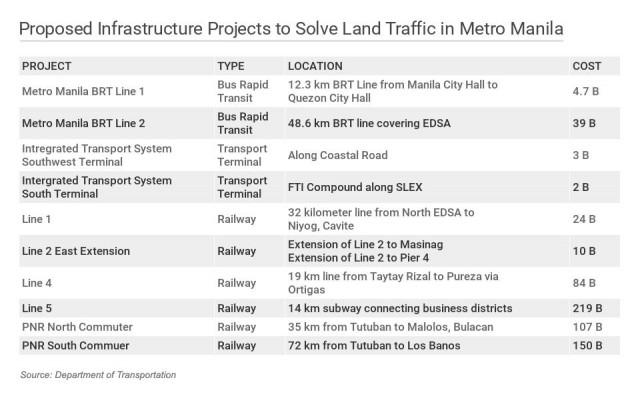
In Metro Manila alone, the DOTr proposal listed six rail projects, two Bus Rapid Transit lines and two integrated transport terminals that will be fast-tracked with emergency powers. These projects total P642.7 billion.
Cal said that preparation for new projects, including feasibility studies and design engineering, took years.
“Walang shortcut sa planning. Hindi kaya ng emergency powers na pabilisin ang planning," Cal said.
Three Senate hearings have been conducted to discuss the emergency powers.
A Technical Working Group is currently studying the DOTr’s proposed bill and list of projects.
Sen. Grace Poe, chair of the Committee on Public Services, said the panel should finalize a Senate version before Christmas.
At the House of Representatives, the Committee on Transportation chair and Catanduanes Rep. Cesar Sarmiento said the House might finalize a bill sooner than the Senate’s target.
If granted, emergency powers will authorize Duterte to exercise all powers necessary and proper to address the transport crisis in two years. Tugade shall be appointed as traffic crisis manager.
The following are among the policy changes in DOTr’s proposal:
- Establish a single authority to manage traffic
- Expedite the procurement process for transportation projects
- Limit issuance of temporary restraining orders and injunctions to the Supreme Court
- Exempt key transportation project from restrictive Commission on Audit rules
- Expedite expropriation process
- DoTr’s reorganization plan
—with a report from Lei Alviz and graphics by Jessica Bartolome/NB,GMA News

