

 GMA Brandtalk
 Tracking
 Archives

As deaths rose, so did shabu prices in Duterte’s extended drug war
Last year, then presidential candidate Rodrigo Duterte trudged through the campaign trail swearing that he would solve the country’s drug menace within three to six months of his term—and in brutal fashion, if need be.
"Tanungin mo lahat ng mayor--ang problema natin, shabu. Kaya lang, walang ginagawa ang gobyerno,” the Davao City mayor railed before his supporters during his presidential campaign kick-off in Tondo, Manila in February 2016. “Ngayon, pag ako ang Presidente... sabihin ko sa militar pati pulis, ito ang order ko ha: hanapin ninyo sila. Patayin nyo. Period," he added, eliciting cheers from the crowd.
Less than three months into office, Duterte claimed the country’s illegal drug problem was more severe than what he initially thought and said he needed “maybe another six months” to fulfill his campaign promise.
The Philippine National Police was just kicking into high gear its intensified anti-drug campaign, Project Double Barrel, at the time the President extended his self-imposed deadline. Now, there are indications that the campaign is slowing down, but the drug problem in the country remains.
Project Double Barrel accomplishments
The PNP began implementing Project Double Barrel in July 2016.
Composed of house visits (Oplan Tokhang) and intensified efforts to net high value targets (Oplan HVT), the project’s implementation was further beefed up by the PNP in October 2016 (Double Barrel Alpha).
However, the involvement of PNP Anti-Illegal Drugs Group (AIDG) operatives in the kidnapping and murder of Korean businessman Jee Ick Joo prompted the PNP to suspend its anti-drug campaign in end-January 2017 and focus on cleansing its ranks. The PNP-AIDG was dissolved and replaced by the PNP Drug Enforcement Group (DEG).
Double Barrel was re-launched in March 2017 as Double Barrel: Reloaded.
Based on updates as of June 13, more than 1.3 million drug users and pushers have surrendered and more than 80,000 drug personalities have been arrested in the Duterte administration's anti-drug campaign since the launch of Project Double Barrel.
More than eight million houses were visited by police as part of Oplan Tokhang.
The number of anti-drug operations under the Duterte administration is unprecedented, given that Duterte has placed the anti-drugs campaign as a centerpiece program of his government.
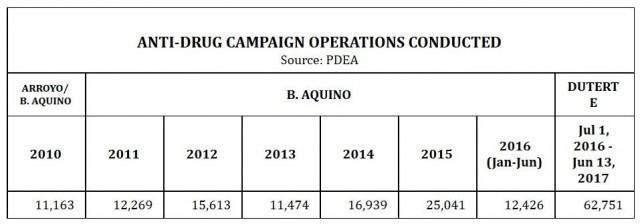
True to the President's words, the anti-drug campaign has turned out to be bloody. Counting both those who died in anti-drug operations and those whose homicides and murders were determined upon investigation to be drug-related, there have been more than 5,000 drug-related deaths since the start of the Duterte administration.
When it comes to high value targets, the number of those who died in police operations—1,036 as of May 31, 2017—is nearly as many as the number of those arrested—1,097.
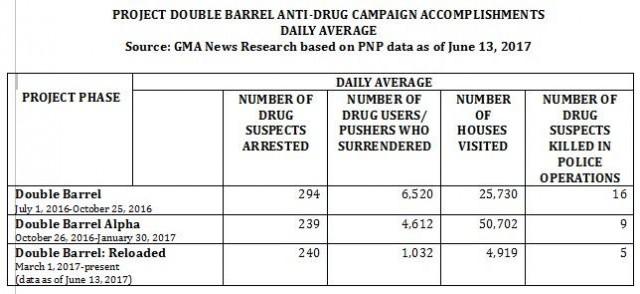
GMA News Research computed the daily average of the PNP’s reported accomplishments in each phase of Project Double Barrel, and the resulting data suggest that the campaign may be easing up a bit.
Computation shows that there have been fewer arrests, from 294 suspects per day when Double Barrel was first implemented down to 240 suspects per day in the current "Reloaded" phase. The number of people turning themselves has also consistently dwindled, from 6,520 per day during Double Barrel’s pilot phase down to 1,032 per day during "Reloaded".
The number of houses visited by police per day doubled when Tokhang was expanded during "Alpha", but this has since dropped in "Reloaded".
The daily average number of suspects killed in police operations seems to have slowed down, as well, from 16 per day during Double Barrel’s pilot phase down to five per day during “Reloaded”.
The slowdown seems to be felt in the drug market, as well. The street price of shabu peaked to as much as P1,300 to P25,000 per gram at the height of Project Double Barrel’s pilot phase last year according to PDEA estimates.
The price of shabu may have been affected by massive arrests and surrenders of pushers peddling drugs, as well as the intensified raids on shabu laboratories and drug buy-busts.
But as of May 2017, the price has fallen to pre-“Tokhang” levels, ranging from P1,000 to P15,000 per gram.
In an interview with the Special Assignments Team of GMA News, PNP DEG spokesperson P/Supt. Enrico Rigor, spokesperson explained that they are still going through a period of adjustment due to the reorganization of PNP’s anti-drug units in the aftermath of the Jee Ick Joo case.
“Bagong pagkuha na naman ng asset, panibagong pagkuha ng impormasyon… natural, nagkakapaan pa,” Rigor said. “Overall, naging effective yung ating campaign against illegal drugs.”
Number of illegal drug users on the rise?
While the latest data suggest a slowdown in anti-drug operations, the same cannot be said about the number of illegal drug users.
The estimates cited recently by the President and other officials of this administration have gone up by millions.
Barely three months into his term, President Duterte said that he'd be "happy to slaughter" three million drug addicts, prefacing his remark with a reference to the Holocaust.
He had bandied about the same figure when he was still a presidential candidate and continued to use it in the early months of his presidency, citing former Philippine Drug Enforcement Agency (PDEA) Chief Dionisio Santiago as his source.
However, the three million figure is far from the most recent official estimates of the Dangerous Drugs Board, the country’s policy-making body on drug abuse prevention and control.
The DDB survey randomly selected 5,000 respondents nationwide to arrive at its estimate of drug users in the country: 1.8 million, or 2.3% of the population, with ages ranging from, of 10-69 years.
The DDB’s 2015 Nationwide Survey on the Nature and Extent of Drug Abuse in the Philippines was conducted from December 5, 2015 to February 5, 2016 to arrive at the estimate.
This figure cost DDB's chair Benjamin Reyes his job. In May 2017, Duterte fired Reyes, saying, "You do not contradict your own government."
According to the latest number attributed to the the Philippine Drug Enforcement Agency, drug users in the country now stands at 4.7 million as of May 2017.
PDEA’ said its estimate is based on its own analysis of surrenderees and houses visited during the implementation of Oplan Tokhang.
This in no way indicates that the drug problem is worsening, says PDEA Dir. Derrick Arnold Carreon.
“Habang sumisipag po ang ating mga operatiba, dumarami ang mga accomplishments, tumataas ang ating mga datos,” Carreon said.
PDEA’s own data shows that the drug problem is very much around one year into President Duterte’s term.
As of June 13, the intensified anti-drug campaign under the Duterte administration has led to the seizure of P18.4 billion worth of illegal drugs and drug-related evidence.
Though it is the biggest haul in recent years, it is just 15% of the estimated value of the illegal drug market in the Philippines which PDEA pegged at P120 billion as of May 2017.
“We should not judge the anti-drugs campaign on just one year of work,” said Ronald Mendoza, Dean of the Ateneo School of Government Dean. “But we can critique the policy. We can share evidence to say that some of what they’re doing is not going to work based on international evidence, and it’s not working based on our own experience and our own evidence.”
Dean Mendoza is one of the authors of a policy dialogue report entitled “Anti-Illegal Drugs Campaigns: What Works and What Doesn’t Work” published by the Ateneo de Manila University in November 2016.
The report said it took countries like the US, Colombia, Thailand, and Indonesia several decades to fight illegal drugs, and they are still fighting it now.
One of the the highlights of Mendoza’s report stated that punitive approaches alone are not necessarily effective: “Without harm reduction strategies that could effectively protect the youth from addiction as well as effectively integrate addicts back into society, countries could face a rising burden of addiction.”
“Ang issue dyan is the extent to which we are clear this is a health issue,” Mendoza said. “You go back to the root causes of why we have drugs in our streets, in some of our schools, in some of our communities—Bakit naakit yung kabataan dito sa drugs? If we start to resolve that, then we will cut the supply of this problem where it actually comes from.” —with reports from Brenda Barrientos-Vallarta and the Special Assignments Team/NB, GMA News

