

 GMA Brandtalk
 Tracking
 Archives

Duterte’s first SONA, one year later: Mining and logging, landfills, Laguna Lake
Every State of the Nation Address is both a look back and a look ahead—to the President's accomplishments the previous year, and to what he or she plans to do next.
When President Rodrigo Duterte delivered his first SONA on July 25, 2016, he had only been in office for less than a month. However, many of the issues he talked about were already familiar to Filipinos as being close to his heart, thanks to the presidential campaign and his long tenure as Davao City mayor.
GMA News Online looks at some of the issues he discussed in his first SONA, and what the administration is doing to address them.
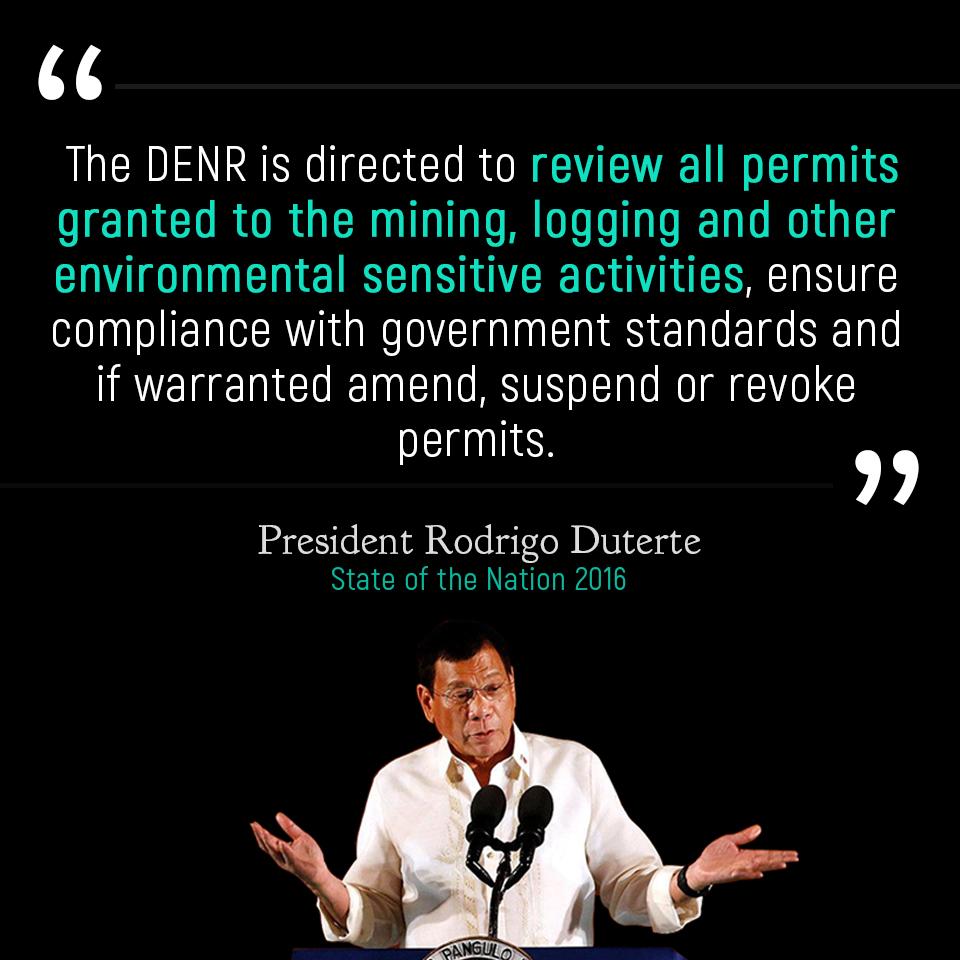
In his first year, President Duterte has had not one but two appointees to oversee the operations of the Department of Environment and Natural Resources (DENR): environmental advocate Gina Lopez, followed by former Armed Forces of the Philippines chief Roy Cimatu.
In May, Lopez accused members of the Commission on Appointments of being influenced by "business interests" when they rejected her for the post of Environment Secretary, after she rescinded 75 mining contracts in watershed areas.
Cimatu was named to the post less than a week after Lopez's ouster.
The appointment has been a controversial one, with groups accusing the former military chief of human rights violations and protecting big business.
In an interview with dzBB that same month, Cimatu said that he would allow "responsible" mining that "does not destroy our environment."
In an email to GMA News Online on July 18, Cimatu stressed that he is taking his predecessor's prerogative by heart by placing strict sanctions on mining.
"Miners have already been warned," Cimatu said.
"You cannot just gain much from your mining operations while various stakeholders and the environment are suffering."
He also said that it was time to "highlight the good side of the industry by promoting responsible mining" and asked the Mines and Geosciences Bureau (MGB) to work harder.
Permits and orders
As of June 16, Cimatu said, the DENR has ordered the cancellation of 22 mineral production sharing agreements, while four were suspended. An Environmental Compliance Certificate was also cancelled.
Meanwhile, the 75 watershed-based projects and 22 Final Mine Rehabilitation and Decommissioning Fund operations were issued show of cause orders.
Twenty-six of the operations took remedial action upon receiving the final orders.
The cited mining companies appealed 17 of these orders to the Office of the President, while the DENR was asked to reconsider 13 cases.
Illegal logging and Marawi rehab
Data from the DENR shows that the department under Duterte filed 367 illegal logging cases in court.
It has also confiscated 2.4 million board feet of illegally cut and transported forest products since Duterte assumed office.
Up to 1,180,371 board feet of the confiscated wood will be made available for the Marawi City Rehabilitation project, Cimatu said.
He also revealed on Tuesday that the DENR and the Armed Forces of the Philippines have signed an agreement to monitor illegal logging operations together on a budget of P120 million.
According to the former AFP chief, the Philippine Air Force will monitor illegal logging activities.
Since last May, the department's authority to grant logging permits has also been transferred from the national to the provincial level.
Business as usual?
However, national environmentalist network Kalikasan People's Network for the Environment gave Cimatu's first two months in office a low score, saying he was steering the department back to its "business as usual path."
Athough they commended the DENR's efforts to execute Duterte's order to finally resolve deforestation, Kalikasan said the department has yet to bring down its major drivers, such as illegal logging tenements, mining operations, agro-corporate plantations and conversion of forests to other land use.
"We fear that Cimatu’s track record of being a protector of logging interests in Talaingod and other parts of Davao will prevail over Duterte’s marching order to finally resolve the problem of big logging in the country," the group's National Secretariat said in an email.
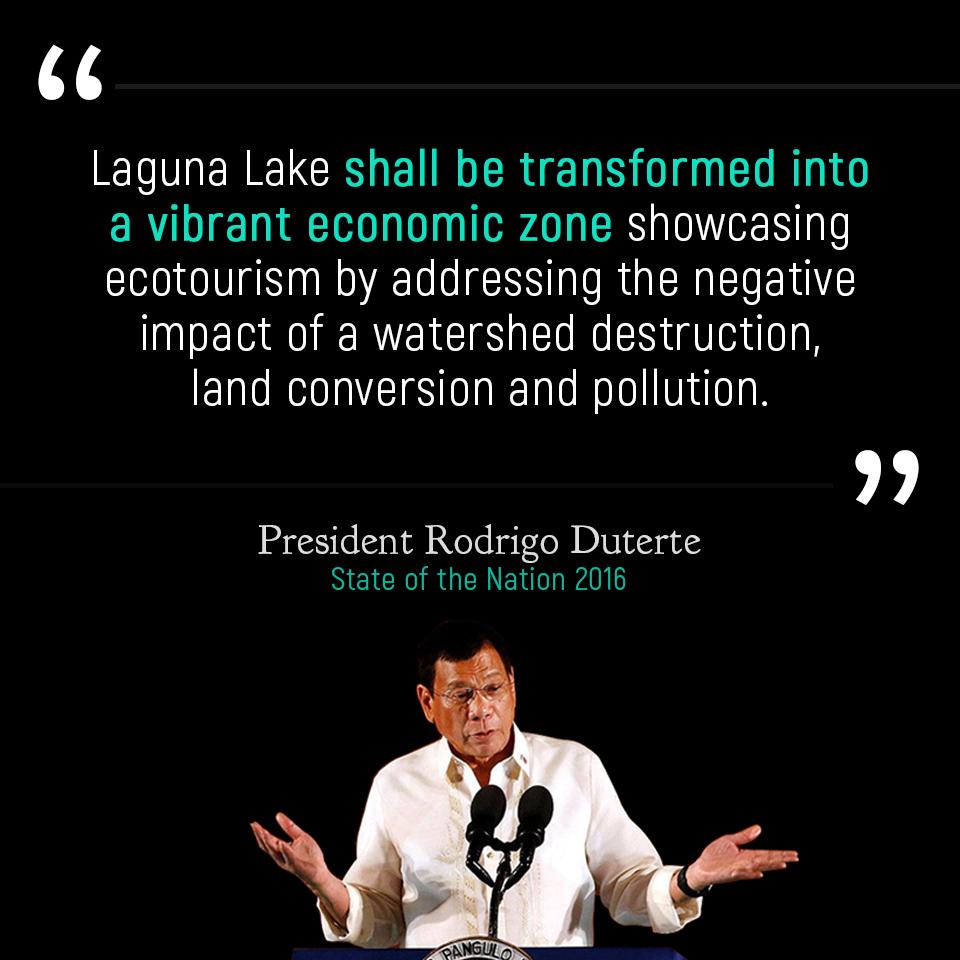
The promised development of the Laguna Lake into a "vibrant economic zone" and premier ecotourism spot was the green highlight of Duterte's first SONA in 2016.
The President also vowed that the area's development would primarily benefit the small fishermen displaced by large operators, lower catch, and aggravated flooding.
In July last year, then-Secretary Lopez outlined the plans for the lake, including reforestation to prevent community-sourced waste from polluting the water.
The Laguna Lake Development Authority said that in the first half of 2017, it planted 19,000 seedlings, bringing to total number of seedlings to sprout in denuded areas within the watershed to 156,000.
Master plan
Earlier this month, just 17 days before his second SONA, the LLDA presented the President a 10-year Laguna de Bay Region Master Plan.
The plan reveals that small fishermen will be operating in only 60 percent of the area.
The remaining 40 percent is reserved "for businesses," among which are leisure parks in an attempt to attract more tourists.
To make room for these developments, over 44 operators or 45 percent of fish pens classified as "illegal" were demolished—clearing 1,660 hectares.
In addition, 15 out of the 323 legal operators were said to voluntarily reduce their fish pen areas to only 25 hectares.
The status report of LLDA's operations headed by General Manager Jaime "Joey" C. Medina was submitted to Duterte in the form of a letter dated July 7. It was made available to GMA News Online almost a week later.
Ten Regional Development Councils of CALABARZON under the National Economic and Development Authority (NEDA) reportedly approved of the plan.
Let the lake breathe
In its email, Kalikasan said that Cimatu must "fully accomplish" the crackdown on large-scale fishpens in Laguna Lake "by clearing out the remaining 1,765 hectares to give the lake time to breathe."
Kalikasan also cited the weakening protection of the coastal environment and the unabated expansion in the country's reclamation coverage of 40,000 hectares of foreshore areas.
Cimatu admitted around 43 million people living in coastal communities are still at risk of displacement and natural disasters such as storm surges, typhoons and tsunamis.
"Faced with challenges of slow implementation of environmental laws, denuded areas and illegal logging, climate change, and mining issues, here I am just waded into a field far removed from soldiery," he said.
"I am now doing my best as President Duterte’s point man in the daunting task of protecting our environment in all its forms," Cimatu added.
Cimatu blueprinted other major plans for the second half of 2017:
- National Greening Program
- Forest Protection Program
- Computerization and easier accessibility for 163 million public land and survey records
- Completion of inventory of Philippine Islands through NAMRIA mapping
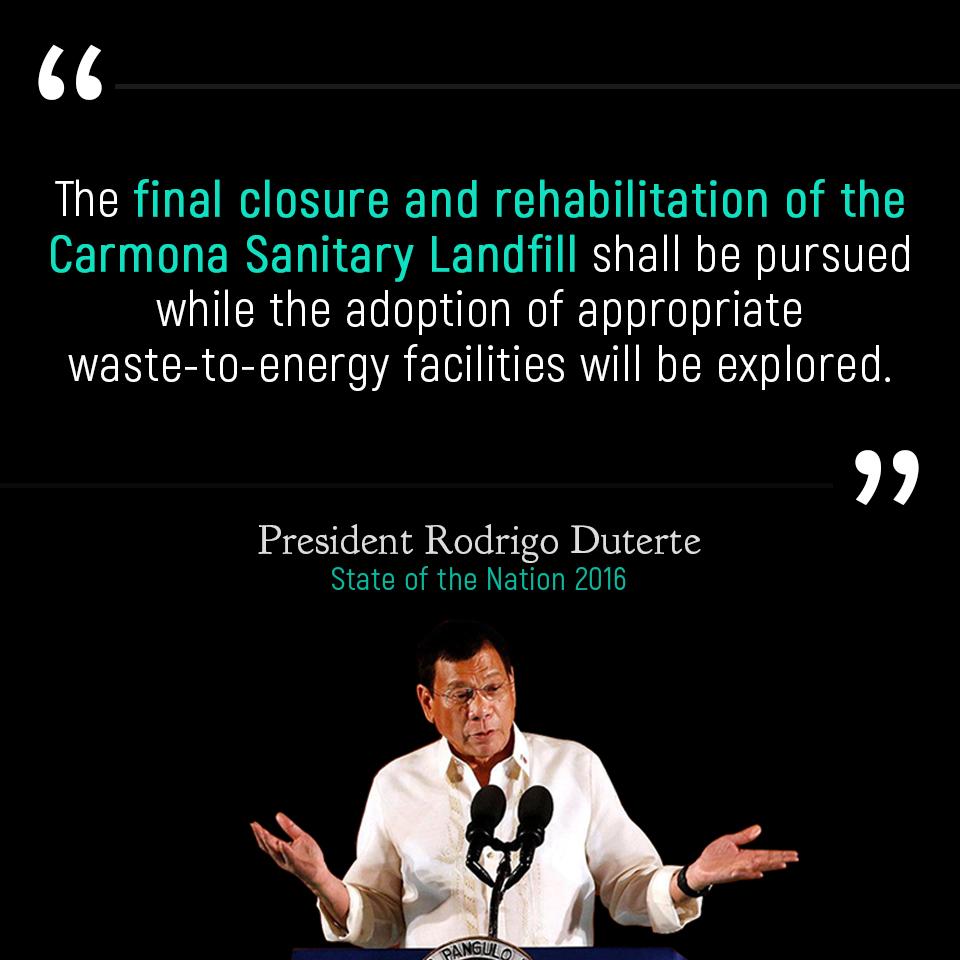
The Carmona landfill in Cavite was closed in 2001 upon the request of nearby residents, who complained of health problems. The landfill had received 80 to 100 truckloads of garbage from Metro Manila every day. The landfill is owned and operated by the Metropolitan Manila Development Authority, which has not responded to GMA News Online's request for an update on the landfill's status.
Waste-to-energy
The DENR has drafted an administrative order for existing landfills to adopt waste-to-energy technologies, especially in urban areas, amid the estimate of 40,000 tons of garbage produced by the Philippines every day.
There are currently three waste-to-energy projects in the country supported by European countries:
- The Quezon City Controlled Disposal Facility Biogas Emission Reduction Project (Switzerland and Italy)
- The Montalban Landfill Methane Recovery and Power Generation Project (United Kingdom)
- The Cebu City Landfill Gas and Waste to Energy (Spain)
Furthermore, the Japan International Cooperation Agency is also working with the Davao City government to kick-start construction of a waste-to-energy facility in Duterte's hometown.
Other pilot cities selected for the Japanese agency's projects on solid waste are Cebu and Quezon City.
The Payatas dump in Quezon City alone is planned to convert 1,200 tons of a day's waste into energy equivalent to 25 megawatts of electricity.
The Environmental Management Bureau also reports that a measly 38 percent of the country's 1,700 LGUs has complied with the solid waste management act since its enactment in 2000. — BM, GMA News

