

 GMA Brandtalk
 Tracking
 Archives

Duterte’s first SONA, one year later: Education and rehabilitation in the war on drugs
Every State of the Nation Address is both a look back and a look ahead—to the President's accomplishments the previous year, and to what he or she plans to do next.
When President Rodrigo Duterte delivered his first SONA on July 25, 2016, he had only been in office for less than a month. However, many of the issues he talked about were already familiar to Filipinos as being close to his heart, thanks to the presidential campaign and his long tenure as Davao City mayor.
GMA News Online looks at some of the issues he discussed in his first SONA, and what the administration is doing to address them.
President Duterte wants all drug pushers dead, and all the drug users too. If he could, he'd kill them himself. This has been stated by the Chief Executive time and again, and his diatribes have become familiar to anyone following him.
In his first SONA, Duterte did not tone down the rhetoric: "Double your efforts. Triple them, if need be. We will not stop until the last drug lord, the last financier, and the last pusher have surrendered or put behind bars or below the ground, if they so wish," he told police and government officials, before wrapping up with a flourish: "I have to slaughter these idiots for destroying my country."
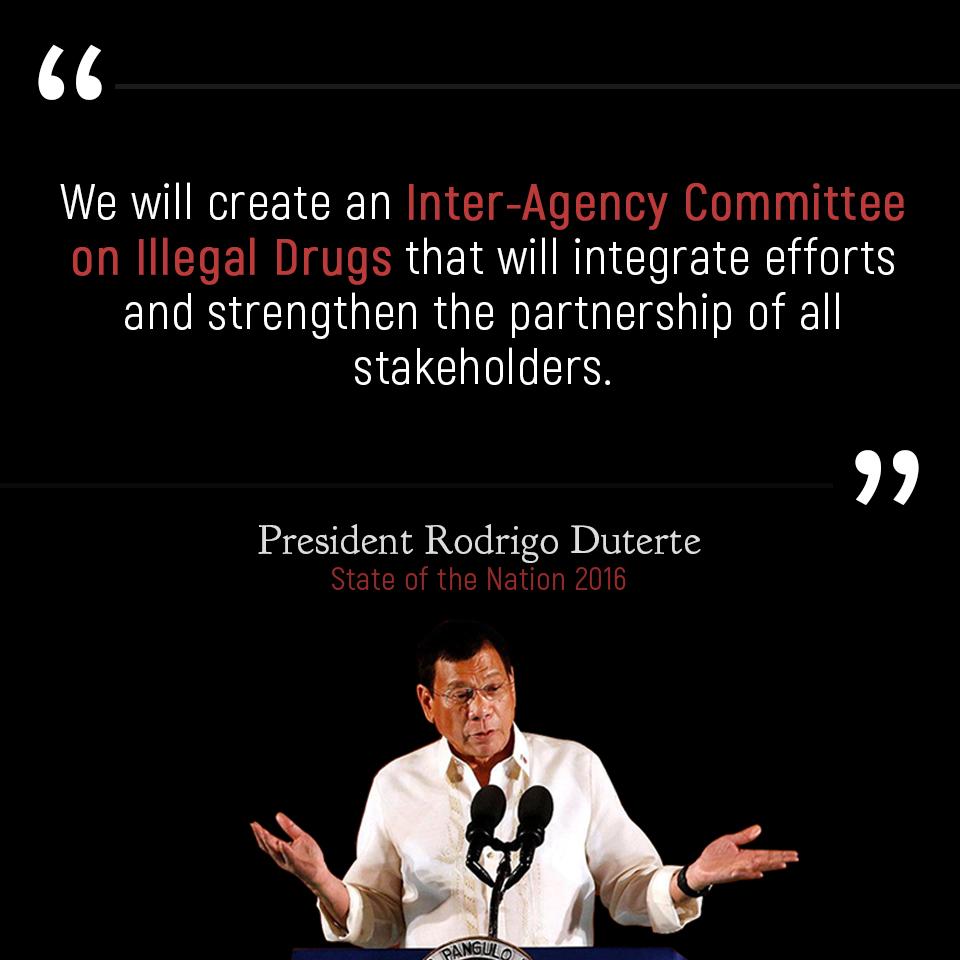
Amidst this rodomontade, Duterte included other goals in his war on drugs that refreshingly have nothing to do with killing people: he declared that his administration would prioritize the rehabilitation of drug users, and that there would be a mandatory education on the evils of drug use.
On March 6, Duterte signed Executive Order No. 15, which created the Inter-agency Committee on Anti-Illegal Drugs (ICAD) led by the Philippine Drug Enforcement Agency (PDEA).
Under the ICAD are four clusters—enforcement, justice, advocacy, rehabilitation and reintegration—and the following government agencies:
- Dangerous Drugs Board
- Department of the Interior and Local Government
- Department of Justice
- Department of Health
- Department of Education
- Department of Social Welfare and Development
- Department of Trade and Industry
- Department of Agriculture
- Department of National Defense
- Technical Education and Skills Development Authority
- Philippine Information Agency
- Public Attorney's Office
- Office of the Solicitor General
- Philippine Coast Guard
- Philippine National Police
- National Bureau of Investigation
- Bureau of Customs
- Bureau of Immigration
- Armed Forces of the Philippines
- Anti-Money Laundering Council
These are the clusters' responsibilities:
Enforcement cluster - conduct anti-illegal drug operations with the support of other law enforcement agencies through the PDEA and the national anti-drug task force.
They may also seek assistance of the AFP, the Coast Guard, and the Philippine Center on Transnational Crime.
Justice cluster - prosecute drug cases.
It should also provide legal assistance to law enforcers and ensure that public attorneys are ready to protect the rights of those who will surrender voluntarily and those subject to warrantless arrests.
Advocacy cluster - conduct a nationwide advocacy campaign for the anti-illegal drug policy and implementing programs.
Rehab and reintegration cluster - implement drug rehabilitation programs and ensure the reintegration of former drug dependents.
In an interview with GMA News Online, PDEA director general Isidro Lapeña said that ICAD is a “holistic approach to address the drug problem,” since it unifies government agencies involved in the anti-illegal drug campaign.
“Hindi lang yung law enforcement ang component ng anti-illegal drug campaign ng ating Presidente but the equally important yung…mga well-being ng mga users and this is on the demand reduction part of the anti-illegal drug campaign,” he said.
“Ito kasi yung advocacy. It includes preventive education, awareness tungkol sa drugs para maiwasan ang pagka-hook ng mga kabataan natin dito sa drugs, at ang kampanyang ito is brought down to the barangays as well as to the families at 'yan po ang nangyayari ngayon,” Lapeña said.
“Kung na-hook na ang ating mga mamamayan, yung mga kabataan natin, they are brought to rehabilitation centers and then treated para sa kanilang addiction and they are trained for certain livelihood para magkaroon sila ng employment and become proper citizens of the society,” he added.
Lapeña believes that the government’s campaign against illegal drugs is “doing very well,” with 1,308,078 individuals surrendering the police. Some 3,171 have been killed in anti-drug operations.
“Most of the 1.3 million has undergone community-based rehabilitation, ito yung at the barangay level pa lang pag-screen sa kanila, eh kung hindi naman matindi yung addiction and then they undergo community-based rehabilitation,” Lapeña said.
He said that PDEA has conducted 64,397 anti-drug operations from July 2016 to June 2017, a 77-percent increased compared to the 36,466 operations of the previous administration on year.
Arrested in connection with drugs number 86,984, a 364-percent increase year-on-year from 18,766 during the previous administration.
Moreover, Lapeña said, nine clandestine laboratories have been destroyed compared to three in the same period during the previous administration.
A total of 152 drug dens were dismantled while 2,446 kilograms of shabu were seized amounting to P12.62 billion.
The value of confiscated drugs and non-drug evidence reached P18.52 billion, a 283-percent increase from the previous administration of P4.83 billion.
As of June 2017, PDEA has also cleared 4,801 out of 20,872 drug-affected barangays since Duterte took office, Lapeña said.
Conducting anti-illegal drug operations on the barangay level is ICAD's “main strategy,” said Lapeña.
"We have adopted yung barangay drug clearing program as the main strategy ng ICAD because itong problema ng drugs is felt in the barangay," he said.
"It should not be just figures; it should be something that should be felt by our people especially in the barangay. That's why we are bringing down the battle against drugs at the doorsteps ng barangay at doon sa barangay. Diyan yung ating straktura where we can bring yung advocacy from the national level down to the barangay and even to the family.”
Lapeña said ICAD believes that education at the barangay and family levels will be the most effective way to stop illegal drug use.
“'Yung mga parents, if they are made aware, they are educated on drugs then the prevention, then yung drug preventive education will be most effective,” he said.
The PDEA chief said that they are planning to clear a total of 5,272 drug-affected barangays within the year.
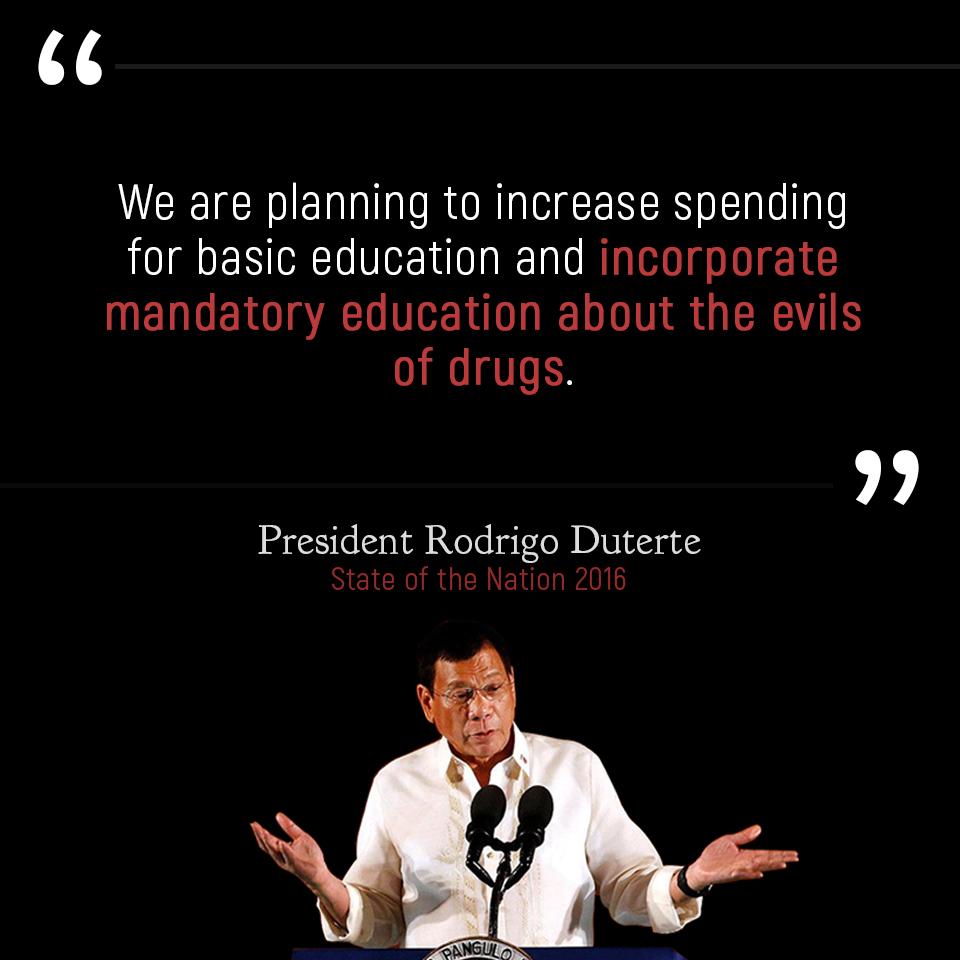
The Department of Education said it is committed to enhancing its existing drug education program, which it says is already mandated for public and private schools.
“We are strongly involved in the advocacy cluster of ICAD and this has been meeting regularly to consolidate the various programs and see whether there are areas where the convergences can be further enhanced or intensified,” DepEd Assistant Secretary Nepomuceno Malaluan told GMA News Online.
Malaluan said that the ICAD has tasked the DepEd and other agencies involved in the anti-illegal drug campaign “not to operate on a business as usual attitude.” He added that there has been a “wake-up call” among all of the agencies involved.
Asked about what has changed since the ICAD was organized, Malaluan said that the body has mobilized DepEd to review the sufficiency of the learning materials, along with the accuracy and currency of the information, as well as the age-appropriateness of the interventions and the capacity of the teachers.
"In relation to that, the Bureau of Curriculum Development has a technical working group that has given us the map on our curriculum for drug preventive education," Malauan added.
The program is introduced in Grade 4 and includes the following lessons:
Grade 4
- proper use of medicines
- protection, prevention and cure
- the potential dangers when a medicine is used and abused
Grades 5 and 6
- introduction on the substances that are precursors to the introduction of drugs, such as tobacco and alcohol
Grades 7 and 8
- a broader discussion on the drug problem
Grade 9
- the "drug scenario"
DepEd's National Drug Education Program (NDEP) has five components that aim to create awareness on the ill-effects of using illegal drugs:
- curriculum and instruction
- co-curricular and ancillary services
- teacher and staff development
- parent education and community outreach
- research, monitoring and evaluation
Mandatory drug testing in schools?
Malaluan said that DepEd is also set to implement mandatory drug testing on teachers and secondary school students (Grade 7 to Senior High School) nationwide—not on all teachers and students, but random samples will be taken.
"There needs to be a training of specimen collectors within the department and they need to be properly accredited specimen collectors," he said.
"We have to understand that the scope of drug testing is big because it's the biggest bureaucracy. So the preparatory matters have to be done first, so we are going to test already within this quarter...the actual drug test."
The drug testing will be nationwide, Malauan added, "so all officers from the Secretary down at the Central Office and then all our officials and personnel at the regional and division offices [will be tested]. But for schools, we can only afford, at this time, a statistical sample. In other words, there's going to be a sample size that would yield a statistical confidence of 95 percent."
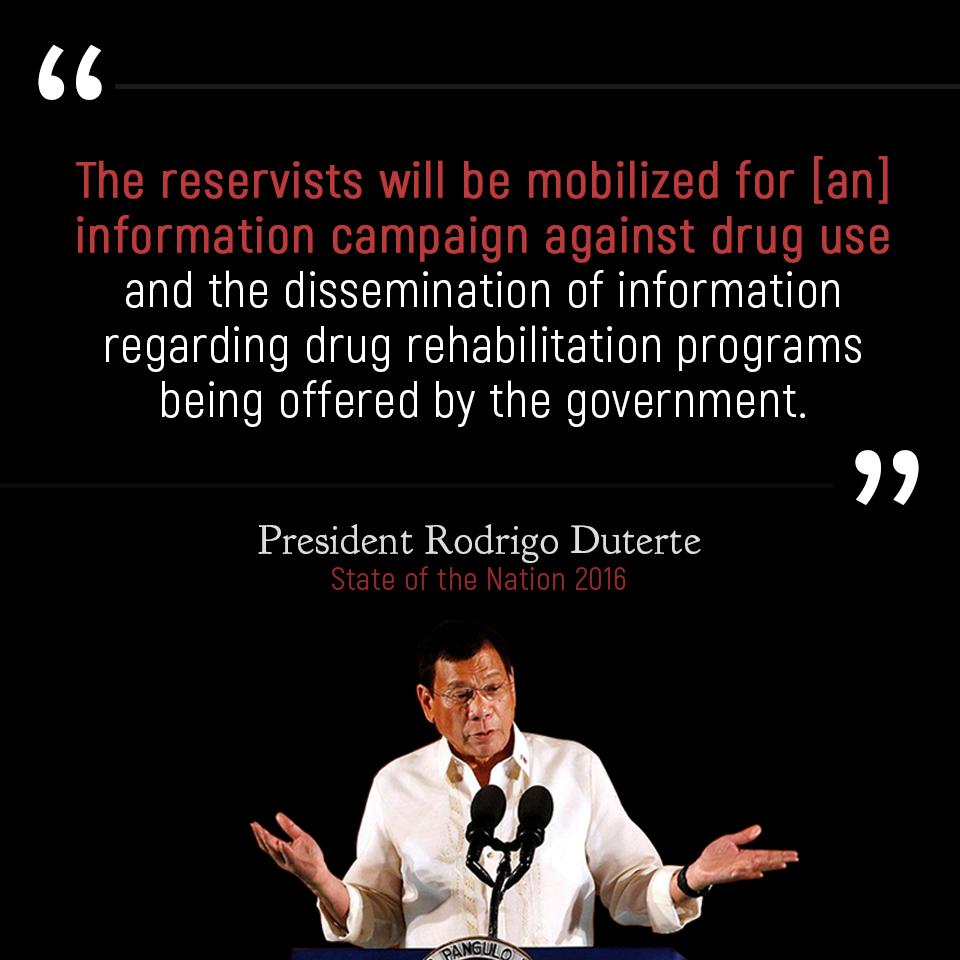
Despite this stated goal, reservists are currently “not involved in the information campaign” against drugs, Armed Forces of the Philippines spokesperson Brig. Gen. Restituto Padilla told GMA News Online.
“Various programs have already been launched by our reservists to educate and prevent illegal drug use. Their participation in the preventive side of the anti-drug campaign is a big boost to the overall effort to deal with the illegal drug menace,” he added, but did not elaborate.

Health Secretary Dr. Paulyn Ubial told GMA News Online that two rehabilitation facilities were opened during Duterte’s first year in office. She added that there are still eight rehabilitation facilities undergoing construction, while 13 DOH regional facilities have been expanded to double their accommodations.
In November 2016, the 10,000-bed Mega Drug Abuse Treatment and Rehabilitation Center was opened in Fort Magsaysay, Nueva Ecija.
Another drug treatment and rehabilitation center was opened in June in Barangay San Antonio, Ilagan City, Isabela.
From July 2016 to June 2017, a total of 2,997 inpatients and 7,114 outpatients were rehabilitated.
From July 2016 to May 2017, a total of 1,643 inpatients were rehabilitated among those who surrendered, while there were 2,759 outpatients.
A total of 1,262 inpatients and outpatients have completed the rehabilitation program among the surrenderers.
PDEA, for its part, said that there are a total of 29 private and 19 government drug abuse treatment and rehabilitation centers in the country.
In addition, 390 community-based rehabilitation centers were established nationwide since the start of President Duterte's administration. — BM, GMA News

