

 GMA Brandtalk
 Tracking
 Archives

Bantay ng Ayungin: Remembering a defining moment for 'Brigada'
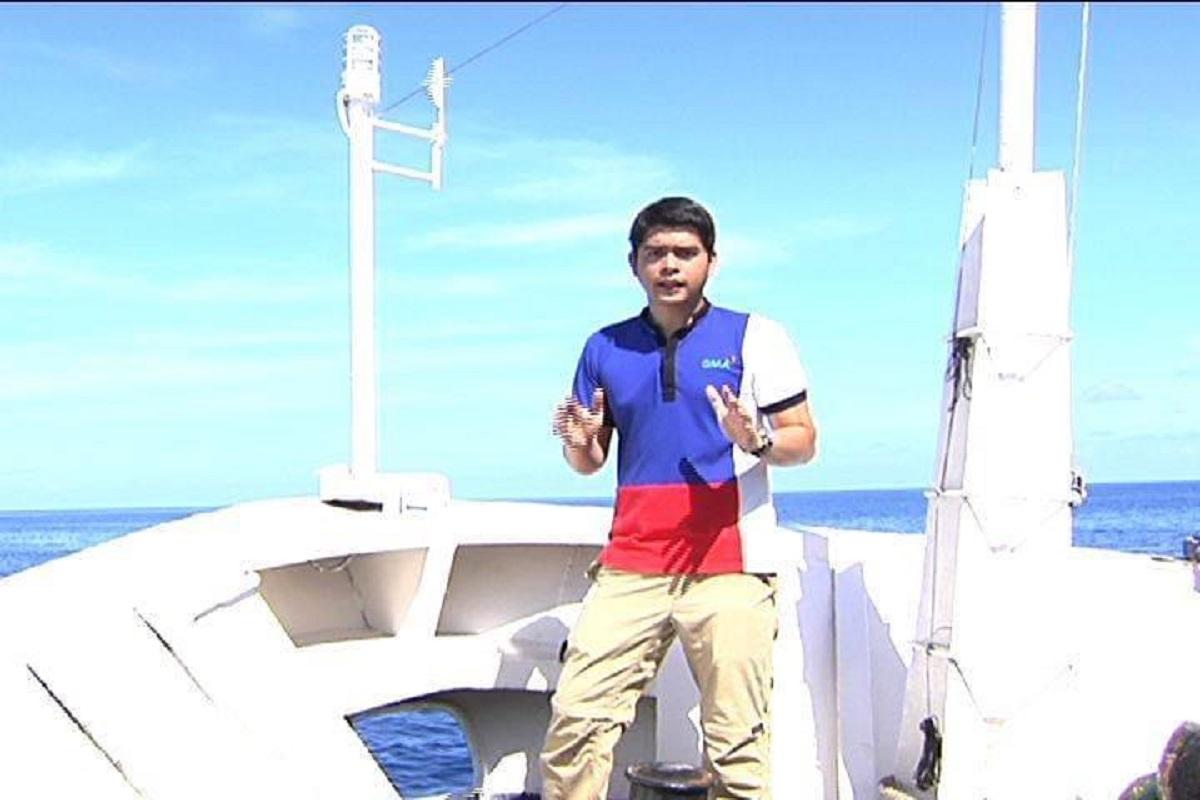
As one of the award-winning Public Affairs programs of GMA aired its final episode on March 16, 2024, many had asked me what my most memorable "Brigada" story was.
A lot of compelling stories came to my mind, but one segment stood out — the mission to Ayungin Shoal (Second Thomas Shoal) in the West Philippine Sea 10 years ago.
In this segment, the Filipino audience saw how difficult a rotation and resupply (RoRe) mission was due to the harassment by the China Coast Guard.
The RoRe mission began in the wee hours of March 28, 2014 and we reached Ayungin Shoal more than 36 hours after successfully evading two huge China Coast Guard vessels tailing, blocking, and nearly colliding with our small vessel, the AM700 of the Bureau of Fisheries and Aquatic Resources (BFAR).
The host of "Brigada," the multi-awarded Jessica Soho, during the Q & A portion of the segment, asked me: "Anong implication na nakalusot kayo sa panghaharang ng coast guard ng China?"
To which I replied: "Jessica, malaking bagay ito. Una, nai-rotate ang tropa ng militar na nagbabantay sa (BRP) Sierra Madre at nadalhan na rin sila ng pagkain at inumin. At nakita rin ang ginagawang harassment ng coast guard ng China sa mga sasakyang pandagat ng Pilipinas."
The segment aired on April 8, 2014, and according to the production team, it garnered one of the highest ratings of "Brigada," proof that even a decade ago, Filipinos were already interested in knowing more about the West Philippine Sea.
The mission was significant as it occurred just before the filing of the voluminous memorial detailing the Philippines' argument and evidence against China's nine-dash line to an international arbitral tribunal at The Hague.
The Philippines won the arbitration on July 12, 2016, after the tribunal nullified China's massive claims in the South China Sea.
Up to this day, China rejects the Philippines' call to comply with the 2016 arbitral award ruling, calling the decision "illegal and invalid."
A call to serve
It was one afternoon on the fourth week of March 2014 when I received a call from then-Armed Forces of the Philippines Public Affairs Office chief Lt. Col. Ramon "Demy" Zagala and requested a meeting in his office. He told me that I was selected to join a few journalists to go to Palawan on March 27.
There was no detailed information before I, cameramen Joseph Salazar, Julius Vilarosa, and systems engineer Roland Manipon, left Manila for Puerto Princesa. It turned out that it was a RoRe mission to BRP Sierra Madre in Ayungin Shoal.
It was a secret mission that I cannot even tell my family about. Only my boss, Grace Dela Peña-Reyes, knew about this mission.
Before the sortie, we had to sign a waiver exonerating the AFP or the Republic of the Philippines from any liability should something bad happen to us during the mission. I signed the waiver without hesitation for I believed that was part of my bigger mission and public service as a journalist.
The trip was actually for GMA News' programs but I asked my crew if we could go the extra mile in covering the mission as only a few were allowed to go on board BRP Sierra Madre in Ayungin Shoal.
I was the second and last Kapuso reporter to date, after the late Cesar Apolinario, to step on BRP Sierra Madre, which was deliberately grounded on the shallow waters of Ayungin in 1999.
I asserted that we can also present the story in its longest form in "Brigada" to maximize our coverage's reach and impact.
For that mission, the Western Command of AFP utilized two vessels, the AM700 of BFAR and the Unaiza May, the wooden batel. Journalists were divided between the two vessels. I and my team were assigned to board the Unaiza May.
Unfortunately, a quarter into the journey, Unaiza May's skipper, the Philippine Navy's Neil Aguila, informed us that we had to abandon ship due to a broken propeller shaft. We were rescued by a rubber boat and transferred to the AM700 where we joined other journalists and sailors.
The harassment
AM700 may be a steel hull boat but its speed was around six knots or just more than 11 kilometers per hour.
During our journey, we noticed some small motorized bancas of fishermen overtaking our vessel. We also saw dolphins swimming side by side on our vessel.
But the serene sight would not last long.
On the way to Ayungin Shoal, there was an intelligence report that the China Coast Guard was preparing for a water cannon attack.
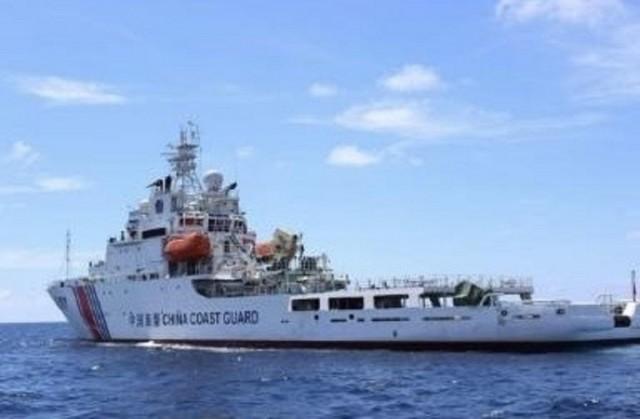
As we passed Sabina Shoal and headed to the vicinity of Ayugin, Chinese vessels started tailing our AM700.
It was around 1:20 p.m. on March 29, about 5.7 nautical miles off Ayungin Shoal, when the China Coast Guard's 1127 vessel, a patrol cutter, sailed near our little boat. Another China Coast Coast Guard ship was seen on the radar heading as fast as 16 knots toward our position.
For the first time, while inside the AM700 bridge, I heard the China Coast Guard’s radio challenge template asking us to identify ourselves, that we had entered the territory of the People’s Republic of China, and that we must leave immediately.
The persistent radio challenge of China Coast Guard 3401 was answered by the head of mission, Navy Lt. Ferdinand Gato, that we were in the Philippines' exclusive economic zone and that we would proceed with our mandated RoRe mission to Ayungin Shoal.
"Your vessel has entered the sea area of the People's Republic of China. We require you and order your boat to leave the sea area," the China Coast Guard insisted in a radio challenge.
"We are proceeding to re-provision our vessel named Republic of the Philippines ship number 5-7 over!" Gato replied.
The firm stand of Filipino troops to go on with the voyage prompted the Chinese to blow their horn endlessly as they harassed our vessel in an attempt to thwart the mission. This time, China Coast Guard 3401 dangerously crossed AM700’s bow at about 70 yards.
In the briefing before the mission, the AFP and journalists agreed that we would only broadcast or publish accounts about the mission upon our return to Puerto Princesa.
But the imminent threat to our vessel prompted Philippine Navy's Chai Cazcarro to grant journalists the green light to break the story.
Through a satellite phone, I was able to break the ongoing harassment of the China Coast Guard vessels on Super Radyo dzBB.
It was through these dangerous maneuvers of the China Coast Guard that AM700's skipper, Lt. Jr. Grade Sherwin Bulahan, successfully evaded it as we were able to go behind their frigate-size vessel.
At last, we were on our path to BRP Sierra Madre!
Sleepless in Ayungin
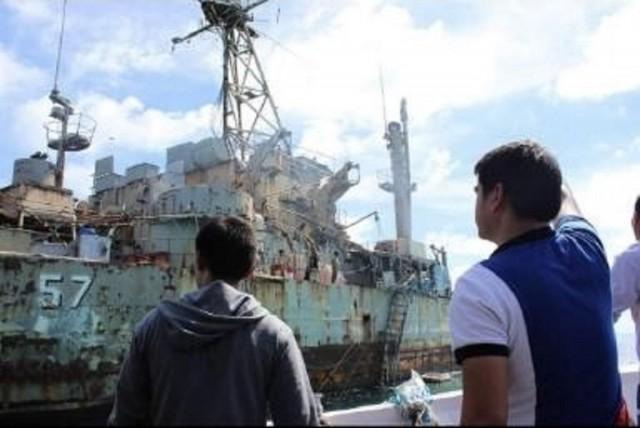
AM700 was anchored side by side with the rusty and dilapidated BRP Sierra Madre during our stay on Ayungin Shoal.
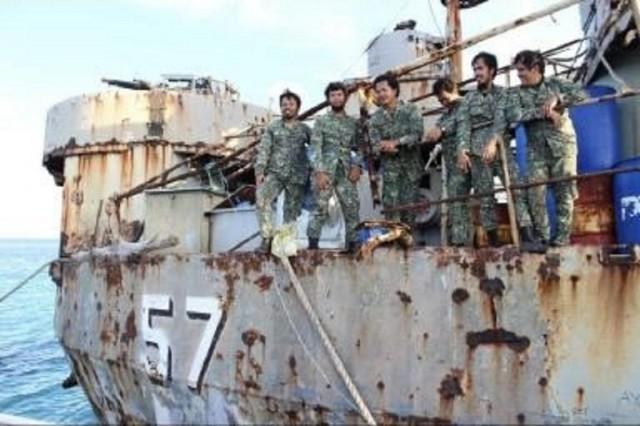
The sacrifice of soldiers onboard headed by Marine Lt. Mike Pelotera was evident in their long hair, beard, and mustache.
Back then, the troop rotation was scheduled every three months. But Pelotera's team lasted for five months because of the unsuccessful RoRe missions due to China Coast Guard's harassment.
It was the lack of freshwater that they faced the hardest. Thanks to Filipino and Vietnamese fishermen, they were able to augment their water supply.
They did not have a problem with food as the West Philippine Sea is abundant with different kinds of fish.
I experienced first-hand how easy it was to catch fish there. While in their kitchen, the soldiers gave me a fishline with a hook then I threw it into the sea. I just waited less than a minute before I felt that I caught a fish that went straight to a hot frying pan to cook it instantly.
Pelotera gave us a tour inside BRP Sierra Madre, which is a World War II-era ship. Some of the ship’s cabins were transformed into a gym and chapel. They even have a "VIP room" similar to a music lounge so they can fight boredom and homesickness during their long stay on the said marine outpost.
Aside from external threats, mental stress was one of the main battles of soldiers deployed in an isolated military base.
While there, we noticed that at least three China Coast Guard ships were in the vicinity of Ayungin, a shoal more than 20 nautical miles away from Panganiban or Mischief Reef inside the Philippines' EEZ but under the control of China since 1995.
At night, they would not go away as they would open their flood lights around midnight toward the Philippine vessels. It was an obvious message from the China Coast Guard that they were there, watching our every move.
During a flag ceremony aboard BRP Sierra Madre, the soldiers and journalists sang the national anthem with a deep sense of nationalism as it sounded louder in the end part of the hymn: "Lupa ng araw, ng luwalhati’t pagsinta, buhay ay langit sa piling mo. Aming ligaya na 'pag may mang aapi, ang mamatay nang dahil sa'yo."
Brigada’s legacy
What we had shown in "Brigada" a decade ago was just the beginning of the ongoing harassment of the China Coast Guard on Filipino vessels and fisherfolk.
Back then, they were just practicing the use of water cannons. Nowadays, it is evolving into a common scenario during any RoRe mission.
What lies ahead and what can the Chinese further do in the West Philippine Sea must be countered as we should not permit them to reign on what is ours. —KBK, GMA Integrated News

