

 GMA Brandtalk
 Tracking
 Archives

Shaken passengers arrive in Singapore after deadly turbulence-stricken flight
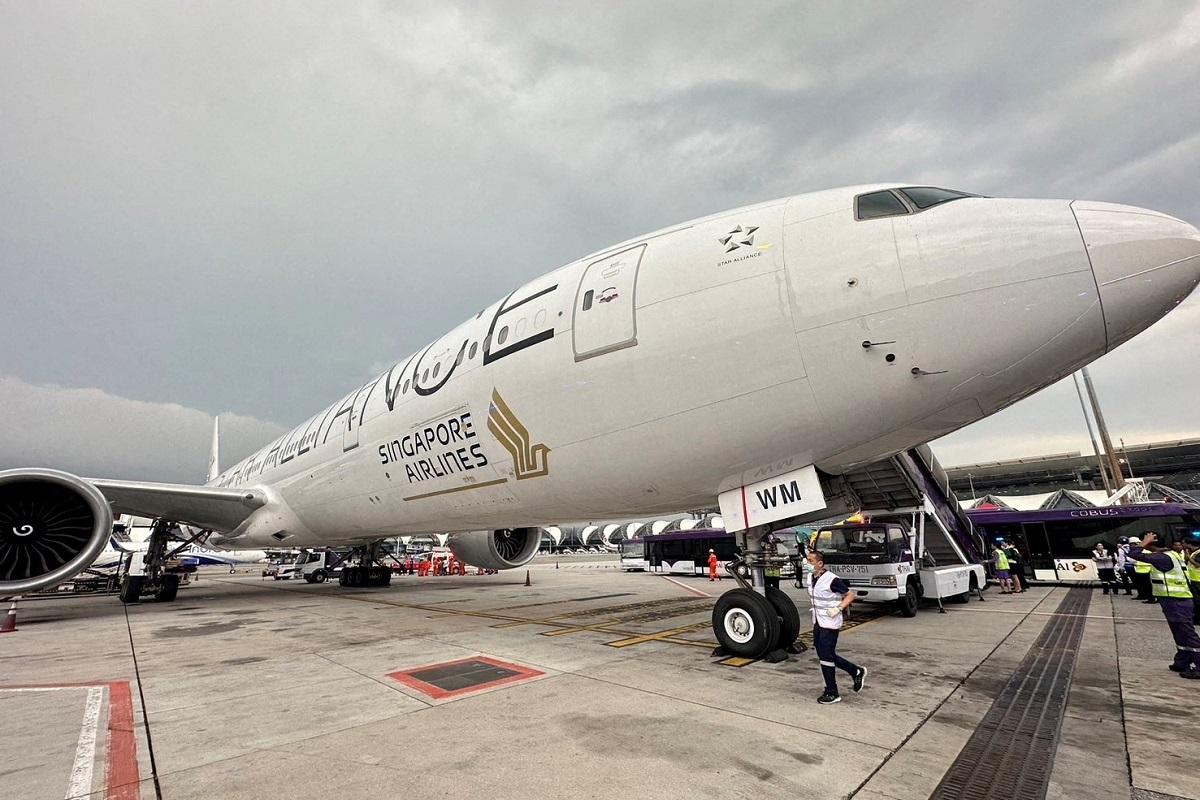
SINGAPORE — More than 140 passengers and crew from a Singapore Airlines flight hit by heavy turbulence that left dozens injured and one dead finally reached Singapore on a relief flight Wednesday morning after an emergency landing in Bangkok.
The scheduled London-Singapore flight on a Boeing plane diverted to Bangkok after the plane was buffeted by turbulence that flung passengers and crew around the cabin, slamming some into the ceiling.
A 73-year-old British passenger died of a suspected heart attack, and at least 30 people were injured. Five Filipinos were among the passengers, their condition yet to be determined.
'People going horizontal, hitting the ceiling'
Around 10 hours into the journey as the plane flew over the southern tip of Myanmar, the flight experienced "a rapid change in vertical rate, consistent with a sudden turbulence event" at 0749 GMT, flight data provider FlightRadar 24 said.
Dzafran Azmir, a Malaysian student onboard the flight, described the incident to Reuters after arriving in Singapore.
"Suddenly the aircraft starts tilting up and there was shaking," the 28-year-old said.
He braced himself and checked he had his seatbelt on. He did. Many of the other passengers did not, he said.
"I saw people from across the aisle going completely horizontal, hitting the ceiling and landing back down in like really awkward positions. People, like, getting massive gashes in the head, concussions," Azmir told Reuters.
"There was a very dramatic drop so everyone seated and not wearing seatbelt was launched immediately into the ceiling, some people hit their heads on the baggage cabins overhead and dented it, they hit the places where lights and masks are and broke straight through it," he added.
Photographs from the interior of the plane showed gashes in the overhead cabin panels, oxygen masks and panels hanging from the ceiling and luggage strewn around.
Debris, including fruit salad, kettles and trays of in-flight meals, was strewn about the cabin, eyewitness footage shows.
"The entire thing happened within the span of less than 10 seconds," Azmir said. "People dropped to the ground, my phone flew out of my hand and went a couple aisles to the side, people's shoes flung about."
Turbulence—or pockets of disturbed air—can have many causes. Singapore Airlines did not say what type was involved.
Weather reports show severe thunderstorms in the area.
"It was cloudy outside, completely white," Azmir said.
Injured still in Bangkok
Singapore Airlines took 131 passengers and 12 crew on the relief flight from Bangkok, which reached Singapore just before 5 a.m. (2100 GMT). There were 211 passengers including many Australians, British and Singaporeans, and 18 crew onboard the original flight; injured fliers and their families remained in Bangkok.
Bangkok Suvarnabhumi airport general manager Kittipong Kittikachorn said on Tuesday seven people were critically injured.
"On behalf of Singapore Airlines, I would like to express my deepest condolences to the family and loved ones of the deceased," Singapore Airlines CEO Goh Choon Phong said in a video message.
Officers from Singapore's Transport Safety Investigation Bureau arrived in Bangkok on Tuesday night, Singapore's Transport Minister Chee Hong Tat said in a statement on Facebook.
As the incident involves a US company, Boeing, which makes the 777-300ER aircraft, the US National Transportation Safety Board (NTSB) was sending an accredited representative and four technical advisers to support the investigation, he said.
The plane encountered sudden extreme turbulence, Goh said, and the pilot then declared a medical emergency and diverted to Bangkok.
Weather forecasting service AccuWeather on Tuesday said rapidly developing, explosive thunderstorms near the flight path of Flight 321 most likely contributed to violent turbulence.
"Developing thunderstorms often have strong updrafts, a zone of upward moving air, that rises very rapidly, sometimes at more than 100 mph, and can leave pilots will little time to react if it occurs directly in front of the plane," said Dan DePodwin, AccuWeather’s Senior Director of Forecasting Operations.
The sudden turbulence occurred over the Irrawaddy Basin in Myanmar, about 10 hours into the flight, Singapore Airlines said.
"It is not a rare occurrence for big thunderstorms in the Bay of Bengal. There are always the chances of bumps," said an airline pilot who regularly flies to Singapore and Southeast Asia. The pilot declined to be identified because he is not authorized to speak to the media.
"We were about 30 miles off track flying around the thunderstorms two days ago on the way to Singapore," the pilot added.
Turbulence has many causes, most obviously the unstable weather patterns that trigger storms, but this flight could have been affected by clear air turbulence, which is difficult to detect.
Sara Nelson, international president of the Association of Flight Attendants-CWA, representing over 50,000 workers at 20 airlines, said it is important for passengers to wear seatbelts whenever seated.
"It is a matter of life and death," Nelson said.
Turbulence-related airline accidents are the most common type of accident, according to a 2021 NTSB study.
Although the airline said 30 people were injured, Samitivej Hospital in Thailand said it was treating 71 passengers.
From 2009 through 2018, the US agency found that turbulence accounted for more than a third of reported airline accidents and most resulted in one or more serious injuries, but no aircraft damage.
Singapore Airlines, which is widely recognized as one of the world's leading airlines and is seen as a benchmark for much of the industry, has not had any major incidents in recent years.
Its last accident resulting in casualties was a flight from Singapore to Los Angeles via Taipei, where it crashed on Oct. 31, 2000 at the Taiwan Taoyuan International Airport, killing 83 of the 179 people on board.
Singapore Airlines shares were not trading on Wednesday because of a public holiday in Singapore. — Reuters

